SrI: SrImathE SatakOpAya nama: SrImathE rAmAnujAya nama: SrImath varavaramunayE nama:
Q and A Video responses
Q. What is the purpose of marriage in sanAthana dharma?
Q. While looking for life partner, should we emphasis on spiritual compatibility or horoscope?
Q. If one is in service to bhagavAn, is it necessary to marry? Or can we remain as brahmachAri?
Q. In present world, how to raise children in a righteous way?
Q. Are women permitted to read all parvas of mahAbhAratham?
Q. Dhraupadhi was kshathrIya woman, yet she didn’t protect herself during vasthrApaharaNam. Why?
Q. How were girls educated in olden days? Where they part of gurukulam?
Q. What is the reason behind long life of people in previous yugas?
Q. As per bhagavath gIthA, does karma yOga refer to just doing our duties without expectations?
Q. According to sanAthana dharmam, who is budhdha?
Q. Apart from celestial bodies and humans, how is the intelligence expressed by other species?
Q. vEdha vyAsa being incarnation of Lord vishNu, why did he compose rAjasa and thAmasa purANas?
Q. thuLasi is considered to be very sacred. Is there any ithihAsam behind this?
https://youtu.be/DsIdq6YrvC4?list=PLcJLpGJlP9mq1ujSPoQLn5ayAi6Jl6Www
Q. How many upanishadhs are there? Are there exactly 108 upanishadhs or more?
https://youtu.be/MF-q5r4jbQ8?list=PLcJLpGJlP9mq1ujSPoQLn5ayAi6Jl6Www
Q. How can bhagavAn be said as destroyer?
https://youtu.be/oJ08BFXS-h0?list=PLcJLpGJlP9mq1ujSPoQLn5ayAi6Jl6Www
Q. Is having devotion towards single form of bhagavAn considered higher nishtA (faith)?
https://youtu.be/ctFPdKCwOiE?list=PLcJLpGJlP9mq1ujSPoQLn5ayAi6Jl6Www
Q. bhagavadhgItha says a brAhmaNa and dog eater should be treated the same. How to implement this?
https://youtu.be/VrCa-bEkcX8?list=PLcJLpGJlP9mq1ujSPoQLn5ayAi6Jl6Www
Q. Women have restrictions in learning SAsthram. How can she raise her children in dhArmic way?
https://youtu.be/YdFAxzhGNr4?feature=shared
Q. rig vEdham mentions about Lord Shiva being a smoker. Is this true?
https://youtu.be/-kl17iLl3Wo?feature=shared
Q. Is gOlOkam, sAkEtham etc part of SrIvaikuNtam or are they different?
https://youtu.be/15ZQxwiwilE?feature=shared
Q. Why is bhAratha bhUmi called karma bhUmi and rest of the world as bhOga bhUmi?
https://youtu.be/vtWh2XySv8A?feature=shared
Q. As per SAsthram, please explain the difference between AthmA in humans and other species.
https://youtu.be/xYRy9qhmhNg?feature=shared
Q. Even after studying vEdham,why karma/gyana/bhakthi yogis,kaivalyarthis do not do SaraNAgathi?
https://youtu.be/dG4jWkgu_S0?feature=shared
Q. How do we understand that our samsAra bIjam is eliminated or not?
https://youtu.be/VBqlSXsxf2w?feature=shared
Q. What is the concept of liberation according to different schools of thought in vEdhAntha?
https://youtu.be/E-DHMQcMQ5I?feature=shared
Q. Why do dhEvathAs want us to worship them? What do they get from that?
https://youtu.be/4nuTuq3_rJc?feature=shared
Q. Do we need to circumambulate (pradhakshiNa) temples? What is the significance behind it?
https://youtu.be/BWVCKSwzWDg?feature=shared
Q. If vaishNavas go to SrIvaikuNtam, where do the Saivites go?
https://youtu.be/Y5SDjmh8AzA?feature=shared
Q. vaikuNtam is always full of sathva guNam, why bhagavAn created world with rajO/thamO guNam?
https://youtu.be/Ytbth_aOpko?feature=shared
Q. Can AthmA reach bhagavAn through his own efforts or by will of bhagavAn? bhakthi vs prapaththi
https://youtu.be/0XRc7vk2ZR8?list=PLcJLpGJlP9mq1ujSPoQLn5ayAi6Jl6Www
Q. When AthmA has a sankalpam, bhagavAn shows us the way. Please explain.
https://youtu.be/PkBtPj–Nqc?list=PLcJLpGJlP9mq1ujSPoQLn5ayAi6Jl6Www
Q. Can we prostrate in opposite direction in front of dhvaja sthambam?
https://youtu.be/ycjWb7a33aI?list=PLcJLpGJlP9mq1ujSPoQLn5ayAi6Jl6Www
Q. To control our thoughts, is AthmA’s will sufficient or bhagavAn’s compassion is also required?
https://youtu.be/oAyQrwLLE6I?list=PLcJLpGJlP9mq1ujSPoQLn5ayAi6Jl6Www
Q. Are we suppose to do anything for removal of evil eye or not required at all?
https://youtu.be/xsNf0rwJ8fw?si=09uKHYye7L3Skmep
Q. How is SAsthram allowing animal sacrifice while considering killing of anything to be sinful?
https://youtu.be/qj-llqVmTSo?si=sauwUZ86WaOmOqck
Q. How to attract general people towards spiritualism as per their interests?
https://youtu.be/Vi4GiSnKI9A?si=yv68cKBGIrQYyuXA
Q. It is said that AthmA always existed and karma is anAdhi. Please explain.
https://youtu.be/yLyzM0pg4-0?si=cpYqSVuIEuBYRAud
Q. Can adhvaithIs be called as kaivalyArthIs?
https://youtu.be/H9NS_UcOwlg?si=L_wR8ntXUR9b4f_g
Q. Is bhagavAn only means to attain him and not his nAmam?
https://youtu.be/eSmRRzXARio?si=B9hsuetPoT3LNrOy
Q. – What is the significance of panguni mAsam?
https://youtu.be/oKzemAVRQdo?si=q8aWMPCWTOIKDuzB
Q. Who is SrImahAlakshmi? Is she a jIvAthmA or a celestial entity?
https://youtu.be/e9Lct-oQ7io?si=3JgFA41nDYx3DCrW
Q. Our AchAryas were sanyAsis, but we see their vigrahams with lot of jewels. Kindly explain.
https://youtu.be/y-Bk7za3HzY?si=_xOx5WX6e5QFEVex
Q. We see few elders have prayed to bhagavAn for some material benefits. Please explain.
https://youtu.be/WxLr8o5jUU8?si=TEARf1sxtIZ2lDiw
Q. Touching dogs is considered impure. Please explain.
https://youtu.be/9gR8EaU7rkU?si=66DJNIDfi2go-96h
Q. I feel excited to hear kAlakshEpams but feel anxious when grasping the content. Is this right?
Q. Knowing bhagavAn is like eating little, bhAgavatha is like eating stomach full. Please explain
https://youtu.be/oGsU_k8SanU?feature=shared
Q. How to retain sAthvic state of our mind all through the day?
https://youtu.be/izpliFqM5VE?si=g7_4sJ7cbkL3P8wb
Q. In temples, why is perumAL wearing Urdhva puNdram (thirumaN and SrIchUrNam)?
Q. Some claim that chaithanya mahAprabhu is incarnation of Lord Krishna. Please explain.
https://youtu.be/yPf-nBlv6y8?si=a0Vwmibds_Z4rkZb
Q. Why is periya perumAL without Sankha chakras?
Q. Is AvaNi rOhiNi celebrated as periya perumAL’s, namperumAL’s thirunakshathram?
Q. Some believe that uththara kAnda is later addition in SrIrAmAyaNa? Is this true?
Q. In SrIrAmAyaNam why most of female monkeys are in normal human forms and not monkey forms?
Q. After vAli died, is it true that his wife thArA was owned by sugrIva?
https://youtu.be/MZ96RmwmCzk?list=PLcJLpGJlP9mq1ujSPoQLn5ayAi6Jl6Www
Q. Who was jatAyu? What was his relationship with lord rAma?
https://youtu.be/qFFDfQL_uK8?list=PLcJLpGJlP9mq1ujSPoQLn5ayAi6Jl6Www
Q. SrIrAmAyaNam teaches us many lessons to be applied in our lives. how to study the grantham?
https://youtu.be/widvIlJbh-8?list=PLcJLpGJlP9mq1ujSPoQLn5ayAi6Jl6Www
Q. In few purANas it is mentioned that bhagavAn vishNu worshipped Siva. Kindly explain.
https://youtu.be/dl-IHt4_wZs?si=vwvPg79Hp0TzPcgA
Q. It is said that bhagavAn’s lotus eyes reveal his supremacy and simplicity. Kindly explain.
https://youtu.be/kyncExxz-mQ?si=K4Ee8OpnqoR-sQWe
Q. In SrIrAmAyaNam we don’t see major role of Sathrugna. Kindly elaborate.
https://youtu.be/jxykG_m2_Og?si=3_20vOHs3MVKf-xS
Q. What is the difference between bhAgavatha and SrIvaishNava? Are they same or different?
https://youtu.be/ysrgrKxO38o?feature=shared
Q. Does bhagavAn give up uplifting jIvAthmAs? Why is mercy of AzhwArs/AchAryas glorified more?
https://youtu.be/PL683O_5bKM?feature=shared
Q. Its not easy to follow standard of living of our pUrvAchAryas in present times. Is it true?
https://youtu.be/RDKaf7Wijsk?si=ReWDid7p-o4nGtNy
Q. Is there any difference between ‘manasu’ and ‘nenju’ (mind and heart)? or are they same?
https://youtu.be/K6PoYA5n_Ns?si=_Y_ud8U5bcT6sPmD
Q. In temples. are we allowed to accept hArathi?
https://www.youtube.com/watch?v=j_84P4K2tQ0
Q. adiyen ramanuja dasan, dasi or dasyai – What is apt for women to address themselves?
https://youtu.be/RLMGR215T2Y?si=draBAPnvqAFkiDtI
Q. bhagavath gIthA explains about dhEva/asura qualities. How to overcome those within us?
https://youtu.be/ht09mgroVTQ?si=djWMqXpdwRiXa9Pp
Q. Are vrindhAvan and ayOdhya appropriate places for a SrIvaishNava to live?
https://youtu.be/Phka4TgHqyg?feature=shared
Q. What is the significance of navarAthri in our sampradhAyam? How is it celebrated?
https://youtu.be/WhKJpym6Pfk?si=jlox1-XrANOXYA24
Q. In temples we see various animals in service of bhagavAn. Are they higher than we humans?
https://youtu.be/UdYeVQ_x1Ik?si=OJOFxn5DxamLfwOn
Q. periya perumAL is compared to krishNa and namperumAL is compared to rAma. Please explain.
https://youtu.be/9g-q_fIvYrU?si=a1v-I_ik_eJFF-JH
Q. Did SrI rAma worship Siva in rAmESvaram in the form of a linga?
https://youtu.be/UP9HASHP1vg?si=yfSzQZKG_ngYH3_M
Q. Among uthsava and mUla mUrthy forms of bhagavAn, who is considered more important?
https://youtu.be/1P94itJXcMw?feature=shared
Q. How can we use koyil.org to commence our spiritual progress?
https://youtu.be/1mV7J_sx-9M?si=C_b0N2x1maNsDnZ7
Q. How can we use koyil.org to commence our spiritual progress?
https://youtu.be/1mV7J_sx-9M?si=C_b0N2x1maNsDnZ7
Q. bhagavAn wanted to take nammAzhwAr to paramapadham along with his body. Kindly explain.
Q. How to handle addiction which is rampant in this generation, in the society?
https://youtu.be/4kAUjj_DD-A?si=gbOVVxTi25aYT8_G
Q. Why SrIranganAtha had been the centre of attraction among AzhwArs and their prabandhams?
https://youtu.be/Dx8BV8wIfnA?si=2r1Zp6KC7X1eYFqm
Q. How knowledge was transferred from nAthamunigaL to various AchAryas (periyavAchchAn piLLai)?
https://youtu.be/gJAsRTxFEGo?si=omCh-FmsHdD3Py3J
Q. During processions why do we see the sequence dhivyaprabandha gOshti, bhagavAn and then vEdham?
https://youtu.be/8cH9BO5Gowo?si=jALkEmANkfGP0iMT
Q. If vEdhas are source about bhagavAn, then why don’t they directly speak about bhagavAn?
https://youtu.be/vCo_-rDkPhM?si=p4dO8y8KGtN_aYaZ
Q. Do we reach SrIvaikuntam if we do dhivyadhESa dharSanam and pAsuram recitals with sincerity?
https://youtu.be/YDDiMCXJX2k?si=EostHYRFsO0uS19x
Q. Is it vaikuNta dhvAram or svarga dhvAram? Why is it opened? What is the essence?
https://youtu.be/DwBMXl6-3Z0?si=4OlK97jSFs6C7YLD
Q. While offering dhUpam to lord in vaikuNtam, does he disappear and appear as krishNa on earth?
https://youtu.be/88Zibd8IT8I?si=15QM_Ud8GDVzSD-u
Q. What is the difference between AzhwAr and AzhwAn?
https://youtu.be/hChWRqhHNes?si=4uxVlBB2RI97yW2Y
Q. As a jIvAthmA, how to live our life as per bhagavAn’s joy?
https://youtu.be/yTqgbcllsm0?si=jJgxVv8wtZM5CYjt
Q. In present day situation, what is the ideal way of doing our sampradhAya prachAram?
https://youtu.be/SwnItMR6fe4?si=fGftN_pyXS2Aau1J
Q. If we ignore people who mock our sampradhAyam/us, then are we arrogant?
https://youtu.be/D4iE_1uFNLQ?si=LCq_x4N8d2xpsXOk
Q. All upAyams are involved in individual effort. Does SaraNAgathi also involves the same?
https://youtu.be/w8oASN9xDa0?si=wFFigHQzFGafXAPo
Q. Are nappinnai pirAtti and rAdha rAni the same and incarnation of neeLAdhEvi?
https://youtu.be/pg8zgSDgSiQ?si=0CSjIfVCdjwVUjlK
Q. Is nappinnai pirAtti one of the eight principle consorts of lord krishNa?
https://youtu.be/RTkr8XqiaB0?si=V6yt9v3ilCFqu_fT
Q. Is rAdha rAni personification of krishNa bhakthi?
https://youtu.be/eA6H5elZ6_I?si=Qh3VhRT2xMq9GinJ
Q. periyAzhwAr/ANdAL described valour of bhagavAn, also worried about dhrishTi to him. Explain
https://youtu.be/ql-vKe0eMgc?si=9A0aLostyXpW32sA
Q. Kindly explain the significance of facial feature of namperumAL.
https://youtu.be/tFAR2JyAq1I?si=fxU0hUru-cnnC4zW
Q. There are thAyArs in the various dhivya dhESams. How to remember their names?
https://youtu.be/gYVbkA6jH7A?si=LdP8t0eMgj7vjkkK
Q. pirAtti being divine consort of paramAthmA, comes under which category (jIvAthmA/paramAthmA)
https://youtu.be/zD9-v81JmzI?si=cqiKJBOvk3wBq_4m
Q. When is the appropriate time to read SrIrAmAyaNam?
https://youtu.be/nJwY2-0TEaY?si=gHzbf4J1KMEEWiMt
Q. Does bhagavAn in vigraha form wake up, bathe, eat, sleep etc?
https://youtu.be/mI5CDgIQyJI?si=ynR3OI2VYd_tmDBT
Q. For a SrIvaishNava, is it compulsory to follow the rules or just enough to have devotion?
https://youtu.be/RTy0KB5gcm4?si=r7NJyrhrMcnfPTrV
Q. In present day, we spend less time on bhagavadh vishayam, how our SaraNAgathi be fulfilled?
https://youtu.be/TmSRzoR1C_E?si=n0_uW-6RCVnwcFXA
Q. What is the purpose of creation? Is it just for bhagavAn’s leelA (sport)?
https://youtu.be/H4rL41nSnW4?si=ALwqzlRtx2TuIuWp
Q. If God is all merciful, why are there evil, sufferings in this world?
https://youtu.be/R9pmU0aERT8?si=vvt28jqi-Yyigagd
Q. How to introduce ourselves to other SrIvaishNavas?
https://youtu.be/OI0x0fpXY-I?si=Gu_oQm42X4ZqkCSJ
Q. Why dhEvathAs are not attaining bhagavAn easily?
https://youtu.be/rALG464A1-Y?si=yHPGJ56zJEs6sTzw
Q. What is the difference between bhAgavatha, prapanna and mumukshu? Their do’s and don’ts.
https://youtu.be/kJnxYeDdhcA?si=LKz5k79fKWo_nzy2
Q. Will there be a time when all AthmAs get liberated from samsAram and samsAram becomes empty?
https://youtu.be/1vvRoAggPqM?si=hg029_g-znQiIxxh
Q. Is there any SlOka or pAsuram to recite for everybody’s well-being?
https://youtu.be/bxWgjITPQBI?si=xnFLWSNpgy9hUUaC
Q. Explain the presence of jIvAthmAs and paramAthmA in all objects we see in this world.
https://youtu.be/VTHmqS4lf-o?si=NldYlGdOzh-nZnO7
Q. Explain individual’s karma and bhagavAn’s causeless mercy.
https://youtu.be/-CgSpt8q480?si=4GtiD4v9vWVh2GS-
Q. Why do dhEvathAs like like brahmA, indhra create trouble for bhagavAn?
https://youtu.be/gey1brxmZQk?si=JEw70UOzbr9zF-ur
Q. How to avoid repeating same mistakes even after having knowledge?
https://youtu.be/889ayAg1ZaQ?si=80hrk7GNXu8rdx5O
Q. What is the essence of thirumaN, SrIchUrNam, Sankham and chakram being together?
https://youtu.be/UoFhVVqSMLY?si=ayykEgAuKLDP2CpB
Q. gangA is SrIpAdha thIrtham of bhagavAn. It was brought by bhagIratha. Explain the connection.
https://youtu.be/-gOylaAGFRM?si=U4lO9rdlaBQcXeE_
Q. Why did bhagavAn not help gajEndhra all along and helped him only after his surrender?
https://youtu.be/Xpt6QA36cf8?si=x6mfz60RD9TtIbUo
Q. How will we get mOksham without doing kainkaryams to AchAryas?
https://youtu.be/7ho0u_icK04?si=I0MDZwxTxD1Ciijj
Q. What is the purpose of an AthmA being born as a SrIvaishNava?
https://youtu.be/OObb1jfDJz8?si=LlB9Gx3ait8GXys9
Q. Why should we go to temple when bhagavAn is present as antharyAmi? Also when he is in home?
https://youtu.be/zDjQDsrAe8k?si=Vtwj4CUAYzsIjxt4
Q. Can we do our kainkaryams with the expectation of mOksham as the result?
https://youtu.be/Pv20bm60qEo?si=rQ6rThrq-kjPiV0m
Q. Sometimes individual AzhwArs are glorified more than other AzhwArs. How to understand this?
https://youtu.be/C8vRzI5b2QQ?si=UJOz1mDQWrUU1w1B
Q. bhakthi is said to be superior to mukthi, why mukthi is said to be goal in our sampradhAya?
https://youtu.be/MGWDSWAjTPQ?si=mweKCNcAiPfNCmD2
Q. Why couldn’t sIthA pirAtti have taken hanuman’s help if he is said to have role of AchArya?
https://youtu.be/NuiIoZBVgPM?si=PZRTnvwKu0VEpqNV
Q. Explain bhagavAn’s feminine decoration. Is it saraswathi or mOhini?
https://youtu.be/BsMDUeZ3y7U?si=NvDGaawgucc2e5wf
Q. What pleases bhagavAn very much?
https://youtu.be/MsW8T6Mw2s8?si=aK1KoSqJXaQLfJ9m
Q. How to handle the sufferings due to dementia, Alzheimer etc spiritually?
https://youtu.be/keBCfW5GaaA?si=XWe07d-gaEaJ7mZ4
Q. While bhagavAn lets everyone go through their karma he also answers our prayers. Explain how.
https://youtu.be/–pSM8YYMKE?si=TxWtGVZtd5VqZO3a
Q. “What is the best life one can get?” The life maNavALa mAmunigaL got is the best.
https://youtu.be/OErD4lqu0WQ?si=NClZgWlZ9citHpwq
Q. Is it easy to satisfy one’s AchArya and rAmAnujAchArya and get mOksha before the end of kali?
https://youtu.be/96IhuvHfaIE?si=c9YjC5F0IUsEm23o
Q. What is sokkappAnai?
https://youtu.be/JxC84qS9hsc?si=3wLKL3DTPKjaB9wv
Q. Why marry within one’s community? Why can’t we marry someone from a different community?
https://youtu.be/QHjDsyXKK2Y?si=viWjNXFrQAIz1B30
Q. What does the terms thAyAr and nAchchiyAr mean? Are they same or different?
https://youtu.be/3BwRMtDfi44?si=uVfw6oHUlc-4YXTQ
Q. If bhakthi done in human form leads to liberation, why are people again born as humans?
https://youtu.be/nlReEXKvYNw?si=ezwoBZ7xasifOq0E
Q. What is the need for mahAlakshmi’s purushakAram if bhagavAn is merciful/eager to help us?
https://youtu.be/L2SF4sIfpkM?si=EwMtrP2uNQzrpms_
Q. If those who violate SAsthram can’t be called as a vaishNava how can we be called vaishNavas
https://youtu.be/pjbSJuQpfDg?si=bSnmSZR_RWMuNY5Q
Q. How can AthmAs be identified in paramapadham?
https://youtu.be/E5Bf01PZfsU?si=xzVgJtS8E2iHdBL6
Q. Do bhagavAn’s leelAs repeat exactly the same way in every chathur-yugam?
https://youtu.be/iiXLr94bxN0?si=aYRvzW7yxwIS-ZT4
Q. Does each word in vEdhas refer to bhagavAn?
https://youtu.be/g0GD87x8qEw?si=VCG6jWCNGREUEfIE
Q. Compared to past, we notice increase in population. Does it mean more AthmAs are created now?
https://youtu.be/j1vXR-aJZ94?si=lW8WsAuiQ32arRVm
Q. In perumAL’s article, why only SrI gIthA, SrISailESa thaniyan are mentioned as his works?
https://youtu.be/4goEdxT0vZ4?si=2zlGHvLXZFC29Am3
Q. Why does thAyAr have separate sannidhi, in spite of being present inside the main sannidhi?
https://youtu.be/_MeCbwJdGVw?si=cyvvmGAxGgfPJEwg
Q. What is artha panchakam? Which grantham explains this in detail?
https://youtu.be/v5wvwncjAPc?si=R2-55adVSdBhY9yM
Q. As per our sampradAyam are women allowed to give upanyasam/kAlakshEpam being on vyAsa pItam?
https://youtu.be/3rEsmW-MDRU?si=b-m5pq6kbp0NsOzm
Q. More sampradayam information revealed in digital media which is misused. How to stop this?
https://youtu.be/QnM6L3uAaUw?si=pXeH3SVvg1X4cfEt
Q. For beginners to progress in sampradhAyam knowledge, which kAlakshEpam should we start with?
https://youtu.be/xpZ85_O0rH4?si=SGBDACIEjBTNEO4T
Q. When an AthmA leaves his body, it is said “AchAryan thiruvadi adaindhAr”. What does it mean?
https://youtu.be/Qcqv_PGGffw?si=MYrJFG5j2AhkoEsp
Q. Why is bhagavAn putting huge efforts to liberate AthmAs while only a few AthmAs get liberated every time?
https://youtube.com/shorts/ByadpAyGJa4?si=TQzkXZBEAVr4aMRL
Q. What is the meaning of the term “jeeyar”?
https://youtube.com/shorts/w1gT34E-5LU?si=dEVYVoq8y0OUF4pr
Q. When nithyasUris incarnate in this world, they sometimes do not act in a sAthvik manner Explain this.
https://youtube.com/shorts/3XYxLU3ZV3c?si=n6qwXTEAg0uIsrk8
Q. Just like relation with worldly relatives, relation with bhAgavathas is also temporary. Why should we have it?
https://youtube.com/shorts/6sj0LodzOIs?si=sGrRivFsqpiMkQer
Q. Plants also have life. Isn’t eating plants the same as meat?
https://youtu.be/R3G0zmEScIQ?si=6qrbQGu6aZK7L9IY
Q. Explain the 3 types of SrIvaishNavas viz sathkAra yOgya, sahavAsa yOgya and sadhAnubhava yOgya. How to interact with them?
https://youtu.be/CDfzS7I1yd8?si=Xs_HnsanjZRZ_PnO
Q. How to control our senses and the urge for sense enjoyment?
https://youtu.be/IamPCwIznkc?si=IJDa5Hz-sLsXIItv
Q. Is mAdhurya rasam not possible in vaikuNtam? Can one enjoy bhagavAn as a master/lord only?
https://youtube.com/shorts/3Pemf361-MU?si=JBvR5vCJie_Rr5xp
Q. Is it possible these days to remain under the shadow of a uththama SrIvaishNava?
https://youtu.be/mdlbiGCcGCE?si=Dn98UF-LvienlGV_
Q and A Text responses
Q. What does “jaya SrIman nArAyaNa” indicate?
It implies mangaLASAsanam to bhagavAn, since jaya, vAzhi, pORRi etc indicate mangaLASAsanam. But in our SrIvaishNava sampradhAyam, there was no such practice of saying “jaya SrIman nArAyaNa”. “adiyEn rAmAnuja dhAsan” is a reasonably standard way of introducing ourselves and greeting others.
Q. Is SrIman nArAyaNa still pleased when we listen to dhivya prabandhams, nArAyaNIyam, etc. even if we don’t understand the meanings?
Yes – language is not relevant – the words of AzhwArs and our AchAryas have great potency. Still, we need to try and learn the language so that we can appreciate the deep meanings.
Q. There are different avathArams of Lord SrIman nArAyaNa. How do we concentrate our mind only on one avathAram of Lord nArAyaNa?
No need to concentrate on one avathAram only – even while reciting pAsurams, sthOthrams during thiruvArAdhanam, they may be for different forms of perumAL – it is ok to let the mind go through different forms of perumAL and experience different emotions.
Q. Sometimes we are scared to go to sleep at night due to frequent unnecessary dreams in the past. Is there any prayer we can do for perumAL and thAyAr for this?
Sleep is considered to be yOga – meditating upon bhagavAn. So, when we go to sleep, we have to think about bhagavAn/AchArya only. If our thoughts towards the end of the day are focused on bhagavath vishayam, naturally such dreams can be avoided.
Q. What is the difference between white chandhan and thirumaN?
thirumaN is prepared from soil in holy dhAms (dhivya dhEsams) such as SrI ayOdhya, thirunArAyaNapuram etc – there is a long process in preparing the solid blocks. I think chandhan is prepared by grinding sandalwood.
Q. Is garuda the primary vAhanam for mahAlakshmi thAyAr too?
There is no separate vAhanam for her – she travels usually with perumAL in garuda. In temples, she has many different vAhanams.
Q. adiyEn was listening to this video about perumAL thIrtham. Should we receive it with vasthram so it won’t fall on the floor? [https://www.youtube.com/watch?v=6bZxD7z3wng]
Yes – we should receive with vasthram so that it doesn’t spill on the floor.
Q. adiyEn heard that one of the reasons not to touch eyes, hair etc., after thIrtha prasAdham is, these parts of the body are considered excretory organs and hence should not be touched. Also, is it okay to say Sri SatAri instead of plain SatAri?
prasAdhams such as mAlai, vasthram, thIrtham and food items etc are commonly placed on eyes and head. So, no need to worry about any other aspect. Ideally, we have to say SrI SatAri or SrI SatakOpam.
Q. While mAlai, thIrtham, vasthram and other prasAdhams are all received with vasthram on head or hands, some AchAryars/jIyars are not seen to touch them over eyes or head. Please explain.
They are all received on hands. If they are offered to someone else (like one’s elder, AchArya, etc.) – then they will not place them in eyes, head, etc. If it is directly for them, it is quite common to place them on eyes and head.
Q. Is there any SlOkam for perumAL that I can chant to get rid of fear and negative thoughts?
Usually, in our sampradhAyam, we recite pAsurams and chant manthrams (specifically guruparamparA manthrams and dhvaya mahA manthram) as kainkaryam only. If we did this sincerely, as a side effect, all negative thoughts and fear will slowly disappear.
Q. Who is thiruvEngadamudaiyAn?
SrInivAsa perumAL in thiruppathi is known as thiruvEngadamudaiyAn.
Q. emperumAn has weapons like Sankham, chakram, gadhai, etc. We do pUja, hOmam and archanai for sudarSana chakram of bhagavAn. It seems there is not much significance for Sankham and gadhai. Please explain swAmy.
sudharSana chakram is the primary weapon. All his weapons are explained as an amSam of chakram. There is also importance given in Agamas for him. Hence, he is worshipped separately also.
Q. What is abhivAdhanam?
It is the process, where we identify our gOthra, sUthra, etc., and our name. This is usually done as a part of vadhIka rituals and also during offering obeisances to elders.
Q. What is the difference between charama SlOkam and thaniyan slOkam?
thaniyan slOkam is a slOkam in glorification of the AchArya. charama SlOkam for a particular person, narrates his ascending to paramapadham, highlighting his identity.
Q. Why does vEdham allow multiple marriages for men and only one for women apart for exceptional cases like that of dhraupathi?
This is how it is defined in SAsthram. If we say it is because men have more strength and more ability to be active for many years (say from 20 years old to 70 years old), some will say even women have more strength etc. Certain things, we just have to accept what is in SAsthram and move on.
Q. How many authentic upanishaths are there? And what are they? What is the pramANam for their authenticity?
Number may not be important – while all sidhdhAnthis accept 10 or so primary upanishaths, different sidhdhAnthis consider different upanishaths as important.
Q. We hear that some changes were brought out in mUlavar in SrIrangam in recent past. Is this true? If yes what exactly happened who changed/try to do it and why would they do it?
During 2015 samprOkshaNam, visible change was the way his thiruvadigaL were laid out. Before they were spread out, now they are close to each other. rangarAjan narasimhan swAmy has documented this issue in detail.
Q. What is the difference between red nAmam and yellow nAmam?
Traditionally, most SrIvaishNavas irrespective of different kalai, use SrIchUrNam (red). Some in vadakalai and few others use turmeric (yellow).
Q. Why during brahmOthsavams in SrIrangam, is namperumAL covered with cloth fully in the front and not adorned with dhOthi unlike adhyayana utsavams or AsthAnams?
namperumAL is considered as very tender and hence not exposed to external atmosphere usually. Inside the temple, it is somewhat controlled environment – so not much covering. Due to his tender nature, if it rains even a little bit, his procession will be cancelled.
Q. Most of us in this day and age of kali yugam are ordinary human beings who are constantly suffering, as our karmas continue to torment us, we even fear that our faith in bhagavAn can shake anytime. Even after surrendering to bhagavAn, we are still struggling for the basic needs of life. What is the way forward for people with such experiences and merely living off making ends meet in this modern world of inflation and soaring prices by the day?
You are not alone in this aspect of suffering. Everyone goes through some kind of suffering – the level and intensity may be different. How can we keep blaming bhagavAn, if we have accumulated so much karma? If we are steadfast in our devotion we will overcome such sufferings. Even if we have to suffer throughout our life – we need to have the heart to face it. Just think about the sufferings of great sages, saints and AchAryas. Even bhagavAn had to go through so much hardship when he was in SrI rAmAvathAram. Imagine bhagavath rAmAnujar who was living in SrIrangam happily with so many disciples – one day had to leave everything and go to mElkOte, with just a few followers. Can we imagine being exiled in forest for 14 years as rAma had to do? Can we imagine losing everything and going to a new place like bhagavath rAmAnujar had to do? Can we imagine losing our eyes like AzhwAn had to go through?
Q. Is it true that pArvathi dhEvi is sister of Lord SrIman nArAyaNa?
In krishNAvathAram, dhurgA came as krishNa’s elder sister. In leelA vibhUthi such relationship between different forms of dhurgA and bhagavAn are shown in SAsthram and pUrvAchAryas’ commentaries.
Q. What is meant by sARRumuRai?
sARRumuRai is the conclusion of any routine – dhivyaprabandha pArAyaNam, vEdha pArAyaNam, kAlakshEapam, etc., will have a concluding portion – that is in known as sARRumuRai.
Q. We generally don’t take photos and videos of “mUla mUrthi”. Is this allowed in ayOdhya because it’s a North Indian temple? Or is it because its followed only in southern dhivya dhEsams?
Yes – in the north, they are not too restrictive about it.
Taking photos of mUla mUrthi is a contentious issue because the purpose is to remain inside and not move around. So, only those who go inside the temple can have his dharSan. Hence, the argument that we should not take photos.
But uthsava mUrthi ventures out to give his dharSan to everyone, for the sake of those who cannot come to have his dharSan. Hence, there is no specific restriction, in general.
But the reality is most of the mUla mUrthis in dhivyadhESams and other temples have already been captured through cameras. It could either be officials or some influential bhaktha or the archaka or kainkaryapara who would have done it. Also, during bAlAlayam there will be more scope for taking pictures.
In those days, before cameras were prevalent, artists would sit and draw based on their grasp of mUla mUrthis – the drawing would mostly be accurate. In one way, these pictures or drawings when well preserved, will help us identify the changes in thirumEni if done.
Q. Is ex-vaishNava aparAdham also a sin?
Hurting anyone unnecessarily through mind, speech and body, is a sin.
Q. There are some instances where we find garudAzhwAr being a mukthAthmA, he himself got hungry to eat a snake and also did some apachAram to perumAL. How do we understand this?
These are leelAs which emperumAn enacts through his dear devotees to derive a particular point. We can also learn how powerful our senses are in binding us from such instances.
Q. Is narasimha avathAra thithi thraoyOdaSi or chathurdhaSi?
It is generally said to be chathurdhaSi.
Q. Why thiruvallikkEni vEnkatakrishNar doesn’t have moustache and wear kavacham after thaila kAppu? Kindly clarify the reason.
It is said that in the past, there was no moustache for mUlavar in thiruvallikkEni and subsequently it was added. Hence, during a few days in a year during thaila kAppu, perumAL actually gives dharSan in his original form. Not sure about the authenticity of this information though.
Q. In which text or sthOthram, the text “sarva dhESa dhasA kAlEshvavyAhatha parAkramA…” is found?
It is part of our sARRumuRai – a SlOkam recited by our pUrvAchAryas like kUrESa.
Q. In thirunarayUr dhivyadhEsam, pagal paththu and irA paththu is not done during vaikuNta EkAdhasi time. Why is this so?
In few dhivyadhEsams such as SrIrangam, thiruchchERai, SrIperumbhUthUr, thirumazhisai etc., local brahmOthsavams and other important uthsavams take more importance over adhyayana uthsavams. For example, in SrIrangam, thai uthsavam date is more fixed – if adhyayana uthsavam clashes, adhyayana uthsavam will be preponed. thirunaraiyUr may also have the same case.
Q. Please explain about gaNdabEruNda avathAram.
No specific information is available in our pUrvAchArya literature on this avathAram. Also, it seems that none of the sAthvIka purANams talk about this avathAram. Hence, it may not be significant from our sampradhAyam perspective.
Q. Can chandhan (sandal paste) be used as thirumaN?
No. This practice is not in our sampradhAyam.
Q. From where can we purchase thirumaN?
Ideally, we can get from dhivya dhEsams, that too known people.
Q. How is japam generally done?
https://youtu.be/ZWPROr2NRrM – please see this video. japam should be done continuously without keeping count and without any other additional tools. guru paramparai and dhvayam are to be done as japam always, by meditating on their meanings. Some AchAryas in the north follow the practice of chanting on beads – but our pUrvAchAryas did not have such practice.
Q. What is the meaning of dhivya dhampathi?
dhivya dhampathi means divine couple – perumAL and thAyAr.
Q. Is there a grantham that describes the 365 uthsavams of namperumAL? We are told that there is an uthsavam daily.
No daily uthsavam – there are times in SrIrangam when there are no uthsavams. But probably close to 250 days, we have uthsavams – we can find out generally even from the annual calendar/diary released by the dhEvasthAnam.
Q. How to view the different views of different sampradhAyams in sanAthana dharmam?
Different sampradhAyams see things differently, depending on whichever grantham/SAsthram they hold as primary. We can stick to our sampradhAyam which is purely explained based on vEdhAntham.
Q. From which grantham can we get full details about the description of vaikuNta and all of Lord vishNu’s associates in vaikuNta, along with proper knowledge of the vyUha forms?
SrI vaikuNta gadhyam of bhagavadh rAmAnuja.
Q. It is said that pancha dhvAraka isn’t considered a dhivya dhEsam in its entirety. Only three of the dhvAraka temples have mangaLAsAsanams by AzhwArs. Please enlighten us about this.
dhvAraka, ayOdhya, etc., are little different from our south dhivyadhEsams – rather than a particular temple/dhivya mangaLa vigraha, in these north dhivyadhEsams – the whole area is considered as dhivyadhEsam and holy.
Q. Why is there a huge difference in North and South India SrIvaishNava practices?
There are 2 reasons:
1 – distance factor led to disconnect between root (south) and branches (north)
2 – influence of other sampradhAyams in the north. Our sampradhAyam people started following other sampradhAyam practices.
Q. Who can wear the thAmarai (lotus) mAlai?
All vaishNavas can wear.
Q. Can we consume mrithyubhOj (food given after death of someone to society)?
We should not consume.
Q. If thuLasi leaves are there in any prasAdham, can we consume it?
Yes – if thuLasi leaves are there in any prasAdham we can consume as it is.
Q. Where does theppOthsavam take place in SrIrangam?
In the tank in the western side of the town.
Q. How should we celebrate hOli?
Not necessary to celebrate at all. In the south there is no specific celebration – it is a regional celebration.
Q. What is dhavanOthsavam?
dhavanOthsavam is celebrated in thoNdai maNdalam (chennai/kAnchipuram region) generally. There is a type of leafy flower named dhavanam – adiyEn thinks this is what is referred by periyAzhwAr as “thamanagam”. During this uthsavam, the maNdapam, palanquin, etc., will be decorated with this dhavanam fully – it has a cooling effect.
perumAL will go to the maNdapam (inside or outside the temple, varies in different temples) – stay there for some time, have thirumanjanam and sEvAkAlam (goshti). After that, perumAL will return to his sannidhi.
Q. Was the temple in rAmESwaram installed by SrI rAma?
rAmESwaram temple was not installed by SrI rAma. That is a fake story. There is no mention about it in vAlmIki rAmAyaNam which is the primary source for rAma’s history.
Q. Can ‘rAma charitha mAnasa’ be considered a primary source?
‘rAma charitha mAnasa’ cannot be considered as a primary source.
Q. Does the ‘SuklAmbaradharam’ SlOkam, refer to ganESa?
In the SlOkam itself, it is ‘SuklAmbaradharam vishNum’ – so it refers to vishNu alone.
Q. Can anger be a good emotion depending on context?
As per the context, there is sAmAnya dharmam (general rules) and viSEsha dharmam (specific for/with vaishNavas). In general, anger may be okay in some cases, but as vaishNavas, we should try to eliminate anger.
Q. Why are SUdhras not eligible to get upanayanam, and can only brAhmaNas perform yagyam?
That is what SAsthram says – SUdhras can remain without yagyOpavItham and still make progress spiritually and succeed in this world also.
Also, brAhmaNas can perform yagyam for self and others. kshathriyas and vaiSyas can perform yagyam for self alone.
Q. Please explain the significance of mAsi magam and why perumAL goes on thIrthavAri on that specific day?
In general, on parva kAlam (amAvAsyai, paurNami, etc.) one can touch the sea-water. On other days, one should not touch sea water. mAsi month is also known mAga mAsa – it has some relation with maga nakshathram. The mAsi magam (and specifically paurNami thithi) is when perumAL goes to the seashore and enjoys thIrthavAri along with all the bhakthas. In different dhivyadhEsams, this is celebrated differently – especially in dhivyadhEsams which are close to seashore – this is celebrated nicely.
Q. Who is mAyAdhEvi? Is she a form of mahAlakshmi thAyAr or dhurga dhEvi? If she is dhurga dhEvi, then why is it said that bhagavAn is mAyApathi, since dhurga dhEvi is the wife of Siva?
dhurga is referred as mAyA often. mAyA has different meanings – it means “amazing” also – in which case mAyApathi could mean husband of amazing lakshmi. But I have not heard mAyApati name for vishNu.
Q. Do AchAryas hold divine power like seeing us and our actions from a distance to guide us or forgive our pApam? Do we need to go and confess our sins once in a while?
AchArya/Sishya relationship is explained already in few videos. In our sampradhAyam, we don’t believe in magic, sidhdhi, etc. AchAryas, due to deep realisations in SAsthram, will be able to identify problems faced by Sishyas quickly – because of their calmness, devotion and intelligence. But for that to happen there must be some communication channel between AchArya and Sishya. Our sins are forgiven and eliminated by bhagavAn – AchArya pleads for the Sishyas’ protection to bhagavAn.
Q. Is vAyu purANam and Siva purANam considered the same? Are both names referring to the same purANam or are they entirely different purANams?
They should be different from each other.
Q. What is the difference between vEdham and SAsthram?
SAsthram means that which ordains. vEdham is the primary SAsthram. So, SAsthram is overall collection of various works including vEdham.
Q. Did SrI rAma consume meat in the forest?
There is a statement in SrI rAmAyaNam sundhara kANdam 36.41 “namAmsam rAghavO bhungthE nachApi madhu sEvathE” (he is neither indulging in meat nor in alcohol). We know he did not consume meat while in separation of sIthAp pirAtti. It is clear that he had meat at other times.
Q. Why is chandra pushkaraNi small in size? While we compare it to various other pushkariNis, the chandra pushkariNi is smaller in terms of size, while we still call it periya pushkariNi?
It is said that chandra pushkariNi was much bigger in size in the past. Not sure about the small size right now.
Q. How did virajA river manifest?
virajA nadhi is always there between vaikuNta and samsAra.
Q. Why do different vaishNava sampradhAyam have different brahmANdam chart?
Different sources may be used and different interpretations of sources may be the reason for the differences in the brahmANdam chart.
Q. Do we have a vaikuNta chart?

Bottom portion has archirAdhi mArgam, above which virajA river and above which SrIvaikuNtam.
Q. How are material world and vaikuNta connected?
Material world and vaikuNta are connected by virajA nadhi.
Q. Some purANas mention that SrI rAma blesses hanumAn to become brahma in the next kalpa? Is this correct?
There is no specific discussion in our pUrvAchAryas’ granthams on this topic.
Q. For most of the uthsavars, eyes are not clearly depicted and it appears like they are closed. Are they closed or do we consider they are open only?
We can consider uthsavars’ eyes as open.
Q. What is the difference between dhivya dhEsam and abhimAna sthalam?
dhivyadhESam is an abode which is sung by AzhwArs in their dhivyaprabandhams. abhimAna sthalam is an abode which is liked by a particular AchArya from the past.
Q. Should kannikAdhAnam must be performed by a SrIvaishNava to their daughter?
Yes. kannikAdhAnam must be performed by a SrIvaishNava to their daughter.
Q. Is ghUnghat (veil) a sanAthana dharmic practice?
veil is not a SrIvaishNava sampradhAyam practice.
Q. Will vishNu sahasranAmam help improve concentration and attention in kids?
Yes – learning some SlOkams and pAsurams, will be of grea help to increase their memory/focus.
Q. What words can be used in place of ‘achO’ or ‘ayyO’? Can we use rAma rAma?
Yes. While we should not use those words frequently, there is nothing wrong in using them in great grief.
Q. Can we consider non SrIvaishNavas as bhAgavathas?
Non-SrIvaishNavas cannot be considered as bhAgavathas.
Q. Did pArvathi get pancha samskAram?
There is no specific discussion about that in our pUrvAchArya works.
Q. Can we consider other school of vaishNavas as bhAgavathas?
We can consider other school of vaishNavas as bhAgavathas if they are exclusively vishNu bhakthas.
Q. Are all vaishNava schools vishNu sarvOththama prathipAdhya?
Yes.
Q. Should SrIvaishNavas worry about travel on bharaNi, kArthigai?
No.
Q. Is SvEtha dhvIpam the highest lOkam in this brahmANdam? What type of mOksham is there in SvEthadhvIpam i.e., is it sAyujya or its equivalent? And like in sampradhAyam, anantha kOti brahmANdam are accepted. So, is there any lOkam of perumAL beyond this brahmANdam and below virajA river?
SvEtha dhvIpam is part of brahmANda only – it is region in the kshIrAbdhi. those who are ready to be liberated are said to be living there. There is no specific lOkams outside brahmANdam and below virajA.
Q. Does each brahmANdam has its own lOkams and kshIrAbdhi?
Yes.
Q. Is sankarshaNa perumAL himself or AdhisEsha?
perumAL himself. He is one of the four vyUha forms.
Q. What is the meaning of santhai?
santhai means systematic, step by step learning process.
Q. Is re-marriage an authentic practice as per SAsthram?
No.
Q. Is it ok to participate in sudharshana hOmam in temples done in the evening time. Heard it should be done in morning time only. What is the right way?
For SrIvaishNavas, these hOmams are not priority. If possible, it can be attended. We should focus more on learning dhivyaprabandhams and rahasya granthams, along with their meanings in a systematic manner, and putting these principles into practice in real life.
Q. Can we prostrate before cow?
No. SrIvaishNavas don’t need to prostrate before cow.
Q. Which granthams glorify mahAlakshmi?
Generally, in dhivya prabandhams – there are many places where her glories are revealed. chathu: SlOkI, SrI sthavam, SrI guNa rathna kOsham, etc., are good sources.
Q. Did karuppuswAmy save thirumAlirunchOlai from malayAla manthrika incident?
These may be folklore and there may have been incidents where such persons may have been instrumental in saving the temple at some point of time. There is no specific evidence from SAsthram for these narrations, as far as I know.
Q. Why do people say har har gangE? Is this a SrIvasihNava practice?
Since gangA was held by rudhra in his matted hair, it is said as such. It is not a SrIvaishNava practice to say as such.
Q. Is the correct way to read SrI bhagavath gItha the same as attending kAlakshEpam? Should we be wearing dhvAdhasa Urdhva puNdram, sitting down on the ground and clothes according to our varNASrama?
At all times, we should be in proper vaishNava attire only. When we have to go to office or school – we are unable to wear our vaishNava attire – hence we are wearing them. Often, we see gruhastha who go to temple or upanyAsam in kachcham, change it immediately after reaching home. Similarly, brahmachAris, women et al, change clothes immediately possible. But such practice is not good.
Q. How to utilise the gandham from thirumala, which was received after kalyAnOthsavam?
gandham can be applied a little bit ourselves daily and distributed to others as well.
Q. Is it correct that for chakkarathAzhwAr vigrahams’ front side it is sudharshana and back side is yOga narasimha? For chakkarathAzhwar should we do pUja from front or back because back we have narasimha?
Yes – chakkarathAzhwAr is front side. chakkarathAzhwar is the presiding deity hence he can be worshipped from front.
Q. AchAryas perform pushpa samASrayaNam to provide eligibility for young/ unmarried girls to recite thiruvAimozhi. Is it best to get that done at early age? Once they get married, will they need another samASrayaNam with husband?
Yes – it can be done at early age. Even proper samASrayaNam can be done for young girls as it is done by some AchAryas. It is not necessary to have 2nd samASrayaNam, if already done.
Q. What is the meaning of the thirunAmam hArdAnudrIhIthan?
hArdAnudrIhIthan means one who remains in the heart and blesses.
Q. When performing prANAyAmam, what is the procedure for breathing in and out?
As per prANAyAmam, we have to exhale through right nostril, inhale through left nostril, hold it, exhale through right nostril.
Q. Why in some dhivya dhEsams perumAL are covered half with a curtain. And why perumAL wasn’t wearing nAmam on forehead?
In many dhivya dhEsams, after jyEshtAbhishEkam, mUlavar thirumEni (form) will be anointed with oil and not be available for dharSan fully. This is an annual procedure. And around pavithrOthsavam, usual dharSan will resume.
Q. What is prayOga chakra?
When perumAL holds the chakram in a launching posture, it is called as prayOga chakra. Example is namperumAL in SrIrangam kOyil.
Q. Do all jIvAthmAs in vaikuNtam have four hands and hold chakram?
Not all jIvAthmAs will have four hands and chakram. Some will acquire such forms with four hands. Some will have feminine forms. Some will have animal, bird forms also. vaikuNtam is for the pleasure of bhagavAn and he will engage mukthAthmAs in whichever way he likes. Fundamental understanding is – vaikuNtam is not a place for our enjoyment. It is a place for bhagavAn’s enjoyment fully and we become totally existing for his purpose only. There is no concept of “I”, “me” etc there. There it is all about “SrImahAlakshmi and SrIman nArAyaNa”.
Q. In vaikuNtam, some jIvAthmAs have four hands, some take different forms. What is the reason for the differences?
The different forms are based on perumAL’s desire and no one can explain his desire fully.
Q. What is the importance of mahAlaya amAvAsya in our sampradhAyam?
mahAlaya paksha has intent towards worldly well-being. Hence it is not pursued by SrIvaishNavas belonging to thenkalai branch, generally.
Q. Should we sleep in a particular direction?
Ideally east/west. But if there is lack of space, other options can be used.
Q. Are we allowed to take medicines that have ingredients that are prohibited as per AhAra niyamam?
As per our sampradhAyam, our anushtAnam is more important. But, if one takes medicine to take care of one’s body for engagement in kainkaryam, it is individual’s choice. Any medicine for that matter, will contain many forbidden ingredients. So, it can be left to the individual to choose.
Q. Is there any significance of Adi perukku for SrIvaishNava temples and uthsavams? Anything that prapannas should do at home during thiruvArAdhanam?
In certain dhivyadhESams, there is specific celebration at the temple. As in SrIrangam, namperumAL goes to ammA maNdapam, stays there for some time and offers vasthram, garland etc to kAvErith thAyAr, and returns to temple. On the way, he exchanges garland with ANdAL nAchchiyAr in veLi ANdAL sannidhi. Nothing specific for us at home. It is a festival to honour water-bodies. It is a socio-cultural event which is nicely celebrated in villages.
Q. Who is qualified to have yagyOpavItham?
Male members who are born in brAhmaNa, kshathriya, vaiSya families only.
Q. Is there any significance of araiyars starting first pAsuram, followed by recital by others during brahmOthsavam (thiruvAdipUram) festival. Other than SrIvilliputhUr, do any other temples follow the same?
This procedure is followed in AzhwArthirunagari, SrIvilliputhUr and SrIrangam (in some sannidhis). It’s a way to honour the araiyars and at the same time giving kainkaryam opportunity for adhyApakas.
Q. Why is krishNa ashtami called SrI jayanthi?
Based on the time krishNa was born, that combination of rOhiNi nakshathram, ashtami thithi etc, is said to be very unique and itself is called as “jayanthi”. Hence his birth is popularly known as “SrI jayanthi”
Q. What is kumara dhaNdam?
kumara dhaNdam means huge crowd.
Q. Did our pUrvAchAryas write about sthrI and purusha dharmams/karthavyams?
They are generally covered in dharma shastrams. Our pUrvachAryas specifically addressed SrIvaishNavas conduct.
Q. What are the most important padhigams from nAchchiyAr thirumozhi, that can be recited during thiruvAdi pUram?
All padhigams are important. However, if not possible to recite entirely, 1st padhigam, vAraNamAyiram and last 2 padhigams can be recited.
Q. Can we wear our parent’s personal items (like clothes and jewellery) once they have deceased or does this hinder their journey?
There is no restriction to use or wear the clothes/jewels used by the deceased.
Q. Does SrIvilliputhUr have another name as thillinagar?
No – this name has not been heard of in the past.
Q. When is garudAzhwar thirunakshathram celebrated?
Adi swAthi.
Q. Which dhivyadhESam kOyil has brahmOthsavam during SrIjayanthi?
thirukkOvalUr dhivyadhESam has brahmOthsavam during SrIjayanthi.
Q. Can brahmOthsavam be done for 21- or 27-days celebration or should it be done only for 9 days like in most temples?
This depends upon each temple’s practice according to Agama SAsthram.
Q. In which ocean did hiraNyAksha hide bhUmA dEvi?
There are 2 versions –> 1) ocean of deluge, and bhagavAn rescues the earth, 2) hiraNyAksha takes earth to pAthALa water, and bhagavAn rescues from there.
Q. Why thirumala and SrIrangam has variance in number of days for adhyayana uthsavam?
Each temple has minor variations, specialities etc. For example, in SrIrangam alone, the day before adhyayana uthsavam starts usually in other places, thirunedundhANdakam is recited to mark the commencement in SrIrangam.
Q. What is the history of sugrIvan and angadhan replacing jaya vijaya as dhvArapAlakas for periya perumAL?
This is incorrect version. Even in SrIrangam they are jaya vijaya as dhvArapAlaka.
Q. Does nappinnai pirAtti have a sannidhi in any dhivyadhESam koyil?
neeLA dhEvi is present in some dhivyadhESams such as AzhwArthirunagari, in archA form.
Q. Why do we experience state of having no emotions? Why do we experience state of emptiness, detachment and other negative thoughts?
Unlike in different adhvaitha mathams, where they emphasise on meditation, focussing on nothing, becoming free from bodily thoughts, etc., in our sampradhAyam, there is emphasis on systematic learning of artha panchakam and rahasya thrayam through grantha kAlakshEpams, getting proper guidance from an AchArya and engaging in kAlakshEpams and kainkaryams. These kinds of feelings such as emptiness, detachment etc, are possibly due to lack of sathsangam. And many such feelings could just be hallucination. Being in a good group of matured devotees, we can relish bhagavath anubhavam, without lust, anger, greed etc. This is the ideal way to shape ourselves in our sampradhAyam.
Q. Did krishNa show four hands to his friend in gOkul?
Our AchAryas have explained that it is only for unfavourable (those who are hostile towards perumAL) persons, krishNa will show two hands. But for his devotees, he will show four hands, when he desires to do so. In general, he lives with two hands only but for his devotees he will manifest special visions.
Q. Did emperumAn SrI krishNan appeared in current – 28th chathur yuga cycle or previous cycle?
krishNAvathAram is said to have happened in this chathur yuga.
Q. Can a non SrIvaishNava by birth perform nithyAnusandhAnam? Can they recite guru paramparA thaniyans?
Yes. As long as they have the intent of getting pancha samskAram. Without that intent, just chanting our paramparA SlOkams, have no purpose.
Q. Can we partake curd/yogurt after sunset?
There are general rules that we should not take milk in morning and curd in night. But they are not strictly followed both in temple and at home, these days.
Q. Can we put Indian flag behind udayavar?
Not a good idea to mix the two. We shouldn’t bind jagadhAchArya to worldly boundary.
Q. Is kauSika gOthram and viSvAmithra gOthram same?
No, they are different gOthrams.
Q. Why yAgam got disrupted when asura gives Ahuthi of meat as in yAgam, bali is allowed?
Not all kinds of meat are allowed. Only certain types of bali are accepted in yAgam- specific for that yAgam.
Q. Why isn’t hanumAn addressed as hanumAn AzhwAr?
In general, AzhwAr means one who is immersed in bhagavAn. Even hanumAn is immersed in SrIrAma – but he is not given that title.
Q. If perumAL sannidhi (facing the correct direction) is in a room which has attached bathroom, is it advisable to move the sannidhi to another area even though the other area may not have the correct recommended directions?
Yes – it can be done. In such situations, we don’t have much control. We need to see the best option and place for perumAL sannidhi there. Better to avoid having perumAL sannidhi opposite to bathroom.
Q. Is kumbAbhishEkam and samprOkshaNam the same?
samprOkshaNam is the term generally used in vaishNava sampradhAyam. Others use the term kumbAbhishEkam. But the meaning is almost the same.
Q. As a devotee of perumAL how to overcome guilt of past mistakes?
We should try to seek forgiveness from perumAL and try to develop our gyAna, bhakthi, vairAgyam with proper guidance. That will help us engage more with perumAL and stop us from making similar mistakes in future.
Q. When is hayagrIva perumAL’s thirunakshathram?
AvaNi SravaNam.
Q. How valid is skandha purANam for vaishNavas?
Any purANa – the sections which align with sAthvika purANa will be accepted. The sections which are contradictory to sAthvika purANa will be ignored.
Q. In vaishNavism, is there anything like keeping chakram and worshipping perumAL?
chakkarathAzhwAr is worshipped in many temples with proper vigraha prathishtA. chakkarathAzhwAr worshipped in his sannidhi. In place of perumAL, he goes for thIrthavAri.
Q. In kumbhakOnam chakrapAni temple, do we need to consider it as separate temple for chakkarathAzhwAr? Or is it perumAL who appears in the form of chakram?
Here – it is perumAL himself appearing in chakra form.
Q. Does araiyar sEvai happen in kOyil? Can prapannas watch as well?
Yes – during adhyayana uthsavam – all can watch it for 20 days. Before rEvathi thirumanjanam also thirumAlai is recited by araiyar.
Q. During perumAL puRappAdu, does araiyar swamy also come? Is this applicable during all uthsavams including panguni uthram and monthly EkAdhasi thirumanjanam too?
Yes. There are other occasions too.
Q. Can we call ourselves adiyEn/bhAgavatha without pancha samskAram?
Yes – the bhAvam/mood is important. Certainly, adiyEn can be said by everyone, since that is the natural position of all AthmAs. If one truly considers oneself as an exclusive devotee of vishNu, one can be considered as a bhAgavatha.
Q. Any specific prabandham and pAsurams that we can learn and dwell upon during Sri Jayanthi?
periyAzhwAr thirumozhi can be recited as much as possible.
Q. What can we do for the non-initiated person in SrivaishNava sampradhAyam who is deaf and unable to do anything and they are old and on their death bed?
We can pray for the well-being of the AthmA and even request emperumAn to engage that person into nithya kainkaryam either at the end of this life or even after subsequent births.
Q. Why do we call krishNa’s thirunakshathram as SrI jayanthi?
The combination of ashtami thithi, rOhiNi nakshathra and the midnight time he was born is very unique and itself has the name “jayanthi” – since it relates to bhagavAn, SrI is added.
Q. What is thaptha mudhrA?
Having Sankha/chakra impressions through heat on the shoulders.
Q. Does our sampradhAyam allow organ donation?
If we are in emergency, we are willing to accept blood/organs from others. Hence if someone is willing to donate on compassion grounds, it should be OK. Not sure about SAsthram perspective – since these were not common back then. Though there are rare situations like Sibi chakravarthy giving his flesh.
Q. Since the dhivyadhEsam thirukkaLvanUr is inside kAmAkshi temple, how did thirumangai AzhwAr go inside that temple?
Temple sannidhis and positions change over time. In many dhivyadhESams, many changes have happened over time.
Q. Can we offer sAmandhi (marigold) flower to perumAL?
Usually, it is better to avoid fragrance-less flowers.
Q. In which dhivyadhESam, AdhivarAhar perumAL is inside the kAmakshi temple?
thirukkaLvanUr is the dhivyadhESam – AdhivarAhar is the perumAL. He is present nowadays inside the kAmAkshi temple. A replica of the same was recently placed in yathOkthakAri temple. Same with nilAththingaL thuNdaththAn perumAL who is present in EkAmbarESvarar temple and having replica in yathOkthakAri temple.
Q. Is it compulsory for us to learn dhivya prabandham from only samASrayaNa AchArya or we can learn from other AchAryas of our sampradhAyam?
Yes – we can see from bhagavath rAmAnuja’s life itself. Though periya nambi was his direct samASrayaNa AchArya, he learnt from many other AchAryas – thirukkOshtiyUr nambi, thirumAlai ANdAn, thiruvarangap perumAL araiyar and periya thirumalai nambi, mainly. He gave all of them equal respect and service. It has been the tradition in our sampradhAyam subsequently in the case of many AchAryas, to learn in this manner. We do need to ensure that the person from whom we learn comes in an authentic gyAna paramparai.
Q. Is the quote ‘treat the person as they treated you’ as per dharma and was such an advice given by krishNa in SrI gIthA?
There is no such mention in SrI gIthA. We need to be magnanimous and do good to even who was not good to us – that is the real SrIvaishNava quality.
Q. What is the meaning of kAlakshEpam?
kAlakshEpam means systematic study of pUrvAchArya granthams, with an AchArya/Scholar reading out the actual commentary and explaining it word by word, as a lecture. Ideally the disciple who is listening should have the text and follow word by word. Ideally, the AchArya should go through the particular section of the grantham before the session to ensure he is speaking contextually with clarity. And the Sishya should do the same after the session to ensure he understood clearly.
Q. What is difference between Achamanam of adhvijas and dhvijas?
dhvijas can recite as manthram, adhvijas can recite just the nAmam.
Q. Can we step on kulasEkhara padi or cross over it?
kulasEkhara padi is the one which is at the entrance of garbhagruham. Other than archakas and kainkaryaparas, no one will cross it. They have to avoid stepping on it anyway.
Q. Can adhvijas read translations of vEdham, upanishaths, and brahma sUthrams because reading translations of the texts supposedly qualifies as learning the texts indirectly?
Everyone is qualified to understand the meanings of vEdham, vEdhAntham through proper kAlakshEpam. It is recommended that SrIvaishNavas focus on dhivya prabandham, rahasya granthams and their commentaries first. There is not much use just understanding some random portion of vEdhas. But they have to be studied in context of our sampradhAyam, with proper guidance.
Q. Are all 18 purANas written by ganESa just like mahAbhAratham?
No. Even there is no concrete evidence that mahAbhAratham was written by ganESa.
Q. In SrIrAma parivAr, why is position of sIthA pirAtti on right side of rAma?
Wife should be on the right side, in general. That is the vaidhIka practice. That is why, we see SrI mahAlakshmi on the right side of SrIman nArAyaNa. Same with sIthAp pirAtti on the right of SrI rAma, rukmiNip pirAtti on the right of krishNa.
Q. Can we get shastiyabdhapUrthi and sadhAbhishEkam?
60th, 80th etc can be used to honour SrIvaishNavas, AchAryas. But it should not be done in a materialistic way as a repeat of wedding ceremony.
Q. What is AchArya’s dharma pathnI called?
Usually for AchArya’s dharma pathnI, ammangAr term is used. In other cases, we can prefix SrImathi with the name, that is sufficient.
Q. Is SrI dhanvanthari avathAram a pUrNAvathAram?
No.
Q. Can women apply SrIchUrNam using upakaraNangaL (tools)?
If possible, they can apply using index finger only.
Q. Can we use any of the other fingers to apply Urdhva puNdram?
mOksham seekers should use index finger only for applying Urdhva puNdram.
Q. Should a thridhaNdi sanyAsi take dhIksha only from thridhaNdi sanyAsi?
Yes – usually, it must be received from another sanyAsi. In exceptional cases like in the case of bhagavath rAmAnuja, bhagavAn himself bestowed sanyAsa ASramam.
Q. Did ranganAtha perumAL appear as the son of kAvEri or the son-in-law of kAvEri (river)?
Not specifically – but it is said that kAvEri is like mother-in-law for perumAL.
Q. Can kanyAs of dhEsika sampradhAyam wear SrIchUrNam and thirumaN before marriage?
Yes.
Q. Can we wear thirumaN before samASrayaNa or only after samASrayaNa?
Before also it can be worn.
Q. Should we wear thirunAmam on all 12 places daily or only in the forehead?
Before samASrayaNa, only on forehead.
Q. What is the significance to offer pattu vasthram to perumAL?
Silk is considered as a commodity which is special and pure. That is why it is used in vaidhIka rituals. But it was not rampant in the past, since there was no mass-production like nowadays.
Q. Did AzhwArs or pUrvAchAryas mention about meat eating?
In general, SAsthram recommends consumption of sAthvika food to acquire sathva guNam. Consumption of meat will increase rajo/thamo guNam only. Hence it is to be avoided. This is the view of pUrvAchAryas as well.
Q. Why do uthsavar and mUlavar thirumEnis have different thilakam?
In most cases, mUlavar would adorn thirumaN/SrIchUrNam. But for uthsavar, it is kasthUri thilakam or sometimes different types of stones. As per Agamam, both mUlavar and uthsavar can be adorned with thirumaN/SrIchUrNam.
Q. Why does anantha padmanAbha perumAL have one hand over Siva lingam?
It is believed to be recent addition and not an age-old tradition. In any case, it could be seen as bhagavAn blessing rudhra.
Q. Why does perumAL appear in different postures in dhivya dhESams?
bhagavAn comes in different postures to attract different AthmAs who have different inclination/taste.
Q. In vaikuNtam, do mukthAthmAs take a body to perform kainkaryam?
Yes – not just one body, but based on the desire of bhagavAn, each AthmA may take many bodies to serve bhagavAn in different ways.
Q. Where is panRiAzhwAn sannidhi located in SrI rangam?
The area is where maNavALa mAmunigaL’s thiruvarasu (brindhAvanam) is present. But no visible/active sannidhi there.
Q. Why AzhwArs choose thamizh language to sing dhivya prabandhams even though samskrutham is called dhEva bhAshai and spoken more in olden days?
It is purely by the will of bhagavAn and the mercy of AzhwArs, we got dhivya prabandhams in thamizh. While these pAsurams are filled with deep philosophy, they are also touched with great love – that is the speciality.
Q. When reading the translated versions of original books, do we get the same amount of puNyam of reading the original book?
Materialistic people will focus on puNyam, etc., as results. Those who are surrendered to bhagavAn, study to become better realised about self and engage in kainkaryam in a better way.
Q. Is it permitted in our sampradhAyam for an AchArya to directly become sanyAsi from brahmachAri without passing through gruhastha and vAnaprastha ASramas?
Yes – ponnadikkAl jIyar (1st vAnamAmalai jIyar), 1st embAr jIyar were like that.
Q. Is it required for all to wear shikha? If so, why did SrI rAmA, krishNa, and other mahatmAs throughout history not wear shikha?
We are just seeing what is shown in movies/serials. But traditionally, they would have had shikha properly.
Q. What was rAma’s age when sUrpaNakA vadham took place?
Possibly around 38 years. It is said that SrI rAmA went to forest when he was 25 years old.
Q. How do we interpret the depictions of a clean shaved rAmA we usually see in photos and movies?
Clean shaven face is often presented in vigrahams and paintings – but that is not accurate in reality. It is just a point of time representation – they would not be clean shaven always. Same is applicable for AzhwArs/AchAryas vigrahams and images too.
Q. Is it true that when rAma married sIthA, he was 12 and sIthA was 6 years old?
Yes.
Q. Can women give hair as we usually see happens in thirumala?
It must not be done at all.
Q. Is it ok to do prArthanai to give hair to perumAL at thirumala?
Such prArthanai should not be done in the first place. If someone had done such prayer – they can ask for forgiveness and withdraw.
Q. What does SAsthram say about doing business in food industry? And why?
Selling food itself is not a good occupation as per SAsthram and we should not buy cooked food for money. When anything done as business for money, mind will go towards profit making, rather than service. In the past, there will be choultries in every town where free food will be provided. Similarly, in temples also, prasAdham will be provided for free, fully. Hence there was no need to pay for food. Even functions like wedding, etc., food will be prepared by relatives only – people will gather and help each other – this was the norm till about 40 – 50 years ago. But then things changed rapidly and selling food for money became one of the biggest business models.
Q. What is the speciality of Saturday? And how it is connected with perumAL?
Every day is special for perumAL.
Q. What is the speciality of purattAsi month? Why it is so special for SrI vaishNavas?
Since purattAsi thiruvONam is thirunakshathram for many perumALs it is special.
Q. Is it true that some nakshathra people should avoid certain kshEthrams?
Actually, it is better to avoid astrologers. All vishNu kshEthrams and dhivyadhESams are dear to bhagavAn and hence dear to us as well. The role of astrologers is limited to marking panchAngam and timings for sannidhi/temple kramams and auspicious times for functions, etc. Over dependence on astrologers, is not good for SrIvaishNavas.
Q. If someone unknowingly pets a dog and got to know that we should not have them as pets, what is the best thing to do?
Accept SrIpAdha thIrtham from AchArya.
Q. What is the meaning of perumAL’s name ‘achyutha’?
achyutha means one who does not let go of his devotees.
Q. How to maintain brass and silver vigrahams at home?
Usually brass and copper can be rubbed with tamarind, lemon and salt combination.
Q. Can we use the store bought pIthAmbari powder for maintaining silver vigrahams?
It is better to avoid for vigrahams. Probably for silver utensils, it can be used.
Q. What is the method of visiting thirumalai? Should we go to gOvindharAjan sannidhi before or after visiting SrInIvAsa perumAL?
First thiruchAnUr, then at thirumalai foot hill place called AzhwAr thIrtham, at thirumalai – varAha perumAL, thiruvEnkatamudaiyAn and then udayavar. This is the old system. gOvindharAja perumAL can be visited before or after.
Q. As adhvijas, if we read an article from koyil.org that has vEdha vAkyam, what do we do?
We cannot read them out loudly – but can be observed and heard.
Q. Is horoscope matching mandatory for marriages in sanAthana dharma?
No. It’s not mandatory. If both families have good understanding, they can proceed with the marriage for the boy and the girl. With proper guidance of elders, if the boy and girl understand the purpose of marriage, they can overcome the troubles they may face.
Q. Is harE krishNa manthram authentic?
It will not be considered as a manthram in SrIvaishNava sampradhAyam.
Q. Is thirupathi laddu, prasAdham? Do all laddus go for naivEdhyam to perumAL?
The laddus sold or given outside, are not after naivEdhyam for perumAL. So, we cannot consider that as prasAdham. Those who follow AhAra niyamam will not eat them.
Q. Which manthram can we recite if we are scared?
Just the nAmam of narasimha is sufficient.
Q. Can someone take dhIkshA or sanyAsa from photo of AchArya if the AchArya is vaikuNtavAsi?
These are not ideal ways.
Q. Is sincerely asking perumAL for forgiveness considered as a prAyaSchiththam?
Not in all cases. Because everyone will just start doing that. In certain harmless acts which does not need any specific remedy to reverse the situation, and which are done only through mind, simply seeking forgiveness from perumAL, accepting SrIpAdha thIrtham of AchArya are acceptable.
Q. Who is vikanasa maharishi?
vikanasa maharishi is the propagator of vaikAnasa Agama based on the orders of bhagavAn.
Q. Why perumAL likes alankAram, and during thirumanjanam why turmeric is used?
perumAL is generally known as alankArapriya. He is the most beautiful personality, and he decorates himself for the sake of his devotees. Turmeric as part of thirumanjanam has a soothing effect and hence used everywhere.
Q. Why is brahmOthsavams celebrated during navarAthri?
purattAsi SravaNam is perumAL’s thirunakshathram and hence it is celebrated as brahmOthsavam in a few temples.
Q. As per rAmAyaNam, hanumAn crossed 100 yOjanas across the sea, but present day SrIlankA is only about 30km across the sea from rAmESwaram sea. So, is that SrI lankA the present-day SrI lanka?
There must have been upheavals and changes over time.
Q. What is the best time to go to bed and wake up early?
Maximum by 10 p.m., and then try to wake up around 4.30 a.m.
Q. Where to get good quality thirumaN & SrIchUrNam? Also should they be in solid block/stick form or can we get powder form?
In SrIrangam, maNavALa mAmunigaL Sannidhi, good ones are available. Even in the shops, there are multiple grades – check if they have better ones. Better to get the powder only. Better to get it from dhivyadhESams or well-known sources. Generally, if it is good quality – it will not cause any black mark, itch etc.
Q. What to do in situations where people around us seem to hold perumAL responsible for their misfortunes?
When someone speaks bad about emperumAn, we have two choices:
Refute them clearly with evidence.
If that is not possible, leave the place.
We should have the courage to politely and firmly refute the points. For that, we need to learn our sampradhAyam systematically.
Allocate at least 1 hour per day to listen to lectures and to read.
It should not be random lectures – but series of lectures which will open our eyes.
We have to develop patience. There is no point getting angry with anyone – it would not help anyone.
Q. In SrI sUktham the verse – “Anandha kardhama chaiva chikleetha” – are Anandha, kardhama and chikleetha, sons of SrI mahAlakshmi thAyAr?
kardhama is the one who assumes SrI mahAlakshmi as his daughter. chikleetha is thAyAr’s palace-guard.
Q. How to cure the guilt that perumAL will be disappointed with our bad behaviour?
By fulfilling our responsibility of dedicating time to learn about him, and practice what we learn. Both gyAnam and anushtAnam are required on our side.
Q. Is madhuparka – abhishEkam or food offering?
Both.
Q. What is the meaning of thadhIyArAdhanam?
thadhIya means devotees. ArAdhanam means to bring pleasure to them. Similar to thiruvArAdhanam to perumAL which has several steps among which offering food is one aspect, thadhIyArAdhanam also implies welcoming devotees, giving them comfort, offering them food, etc. One must humbly request devotees to come and honour one’s residence with their presence and if the devotees accept, they must be treated very nicely to their full satisfaction.
Q. Who is sarasvathi?
brahmA’s wife is known as sarasvathi – she is the one who is worshipped as the deity for knowledge. But she derives her knowledge from vishNu.
Q. Can we get pancha samskAram for achith?
Sankha chakra mudhrA alone is not pancha samskAram. Applying thirumaN, Sanhka chakram for vessels is to indicate that they are fortunate to have connection to bhagavAn through bhAgavathas. Every achith object (insentient) has an AthmA in it. Even animals, birds, pots, dhOthis, etc. – everything is fortunate when there is bhagavath/bhAgavatha sambandham.
Q. Can we apply thirumaN and Sankha chakram to any objects we use in daily lives?
Yes – mainly the objects we use in cooking, storing granthams, etc.
Q. What is the significance of accepting perumAL thIrtham thrice but SrIpAdha thIrtham twice?
It is sufficient to take perumAL thIrtham once. SrIpAdha thIrtham is taken 2 times or 3 times depending on different paramparA.
Q. How many Agamas are authentic?
For SrIvaishNavAs, only two. pAncharAthra and vaikAnasa.
Q. Can we feed crows on a daily basis?
Not a standard practice in our sampradhAyam.
Q. How to take oil bath?
Traditionally, women will do oil-bath on Fridays and men will do on Saturdays. It will be done once a week. The important rule is – it has to be done as a separate routine. That is, we have to complete our daily routine up to thiruvArAdhanam and then do the oil bath separately. First one will apply oil on the head and the body and let it soak for some time. Then we use shikakAi powder (traditional shampoo) along with water which will take out the oil.
Q. If one acts according to AchArya, will AchAryan get pleased with the individual?
Yes – definitely. When one acts according to AchArya/guruparamparai guidelines – it will be most beneficial for the spiritual progress.
Q. When jIvAthmA reaches vaikuNtam, does he remember his countless previous births, previous births memories and family members?
Yes – jIvAthmA will be able to recollect everything from past countless lives. But after reaching bhagavAn he will not think about anything other than bhagavAn.
Q. Does SAsthram permit an individual to change his or her name at any time and also for any reason?
Usually during pancha samskAram, the name can be changed.
Q. If hiraNyan was killed in his palace, how can the place of death be in ahObilam?
narasimha avathAram happened many lakhs of years ago – geography would have certainly changed.
Q. Can we drink kOyil thirumanjana thIrtham?
We can drink, place it on our head and eyes.
Q. How to concentrate while meditating and chanting manthrams?
The main idea in meditation, pUjA, etc., is to focus on bhagavAn’s divine form and experience his divine form, qualities, leelAs, etc. It is not blank meditation – we have to actively think about bhagavAn in different ways in a physical form which we have seen in temple, picture etc. By focussing on his divine form, we can concentrate deeply so we can imagine God through japa.
Q. How did our pUrvAchAryas maintained physical health; did they do yOgam and physical exercise?
Not everyone did physical yOga and exercise. But the lifestyle itself was very healthy. Let us see some aspects – we can try to do some of these too.
Resources were quite natural – air, water, vegetables, fruits, grains, milk, etc., were pure and natural.
Lots of physical activity was available.
Walking was the main method to commute. Usually legs/feet remain very strong and active.
Fetching water was from river or well – which needed physical activity.
Cooking and cleaning also involved lots of physical activities such as using manual mortar/grinder, bringing water, firewood etc manually, use waste cloth to bend down and clean the floor and so on.
Bathing, washing clothes, etc., were also not so easy – lots of physical efforts involved.
Eating and sleeping was quite regulated, due to lack of electricity.
Very little distraction which will bind our body to just a place (like watching mobile, television, etc.) without physical activities.
As part of sandhyAvandhanam, thraivarNikas would do prANAyAmam with manthram. Others would do prANAyAmam without manthram if they had learnt it.
There are so many reasons which made them live a healthy/happy life.
Q. How can we get perumAL’s grace to cure chronic diseases?
We should only pray for steady kainkaryam – everything else such as necessary health, wealth will be included in that. We can be ignorant and pray for bodily things (like health, wealth) ; or we can be intelligent in praying for kainkaryam which includes everything.
Q. How long to keep the dried manjaL we get from sannidhi?
We can keep it at home even if its dried.
Q. Can SrIchUrNam and kumkum be used interchangeably?
SrIchUrNam can be applied in place of kumkum. But kumkum should not be used in place of SrIchUrNam.
Q. Can brahmachAris give dhIkshA or only sanyasis and gruhasthas can give?
brahmachAris can give – provided they have been given the privilege to do so, by their AchArya.
Q. As a SrIvaishNava, should we consider the vAsthu when buying a house or undergoing modifications of the house?
No need to fully engross in it, basic rules like where the kitchen should be, where the toilet should be, etc., can be checked.
Q. Is varAhi, avathAram of lakshmI?
No.
Q. Why does thiruevvuL veerarAghavap perumAL go to SrIperumbUthUr once a year?
Usually, in many dhivyadhESams, thiruvUral uthsavam will be celebrated where perumAL will travel to a nearby place which has a water-body and enjoy thirumanjanam, etc. It has been a practice where veerarAghavap perumAL comes to SrIperumbUthUr. He stays in the vEdhAntha dhESikar sannidhi on the banks of the pushkariNi and enjoys thirumanjanam and puRappAdu there.
Q. What’s the correct sequence of the four vEdhas?
vEdhas are 1 single body which has 4 parts. rig, yajur, sAma, atharvaNa is said to be the 4 parts. There are other ways of dividing also. rig, etc., are not exactly sequential also. They are just different sections.
Q. When sIthA pirAtti was in aSOka vanam, what gAyathrI manthram did she recite?
No such incident explained by our pUrvAchAryas.
Q. Is it true that in previous yugams, women were allowed to undergo upanayanam, learn/recite vEdham, and do sandhyAvandhanam?
There may have been exceptions – don’t think it was the norm.
Q. Is the name of the temple associated with SrIvaishNava sampradhAyam in mathurA and vrindhAvan called ‘rang ji mandhir’?
Yes.
Q. Can adhvijas undertake kAlakshEpam of SrI bhAshyam and gIthA bhAshyam?
Yes – but traditionally, the way it was done was – kAlakshEpam will be done for dhvijas and adhvijas will study along.
Q. In paramapadham, are the Sankha and chakra that the jIvAthmAs hold just symbols or are they functional and used by them?
It would only be as decoration. There is no particular use. Even here, in some temples, sannidhi garudar will have Sankha/chakra.
Q. Is it fine to give money to needy people who sit near temples?
Helping others can be individual choice. We can try to make sure that the money is not used for illicit purposes and habits.
Q. How to mitigate the suffering in this birth? Are there any specific dhivya prabandhams to be recited for relief and peace of mind?
Every pAsuram in every dhivya prabandham is an aid to become free from samsAra. samsAra is the biggest suffering. To be relieved of it is the top most priority. But we cannot end it when we like – we have to develop the maturity to be detached from the joy/sorrow in samsAra. For that, learning prabandhams along with rahasya granthams, and their vyAkyAnams, through AchAryas will be the best way. See https://divyaprabandham.koyil.org/index.php/2016/07/purva-dhinacharya-27/
Q. Should brahmachAris sleep on the floor?
Yes – brahmachAris should ideally sleep on the floor.
Q. Is there a correlation between SrIchUrNam colour and faith? What is the difference between vadakalai and thenkalai SrIchUrNam?
It was probably another way to externally distinguish the different groups. Both red and yellow SrIchUrNam are based from turmeric which implies auspiciousness of thAyAr. Even in vadakalai, many people wear red SrIchUrNam and especially women wear red only. Not sure about any specific gradation – though some people may have imaginary ideas for these. In general, if people discuss about thenkalai/vadakalai differences – I would say to them “Let us just try to follow emperumAnAr’s orders, and when we are situated in that nishtai at least a tiny little bit, we can think about these – but when we get that nishtai, we will no longer desire to discuss these things, rather focus on pUrvAchAryas’ teachings”. But to be factual, we do see red SrIchUrNam in most dhivyadhESams. AzhwArs and AchAryas avathAra sthalams which make us understand that this is the traditional practice.
Q. What does the red dot sAndhu pottu that young girls wear, signify?
It implies/signifies auspiciousness which is derived from the divine mother of the whole universe, SrI mahAlakshmi. Also, instead of dot, it is preferrable to use thilakam (small vertical line) for unmarried girls.
Q. What and where is kailAyam? What is kailAya prApthi and what happens to those who reach kailAyam?
kailAyam is the abode of Siva. It is within each aNda in sathyalOka. It is also a temporary abode. AthmAs who reach there will stay there until their wish and Siva’s wish. At the end of mahA praLaya, everything will be gone and be recreated during Srushti. At that time, based on karma of each AthmA, they will start from different places.
Q. Is there any specific number of times pradhakshiNams should be done in perumAL sannidhi?
Generally, 2 pradhakshiNams are recommended. As kainkaryam (out of love) we can do any number of pradhakshiNams. As upAyam (means for attaining something), we should not even do one pradhakshiNam.
Q. Is kambar a SrIvaishNavar?
A look at his literary work suggests that he must have been a vaishNava. puthUr swami has given a grantham explaining this.
Q. In case one belongs to svayamAchAryas and was not able to do pancha samskAram due to AchAryan attaining his AchAryan thiruvadi, are there sampradhAyam rules as to who can do pancha samskAram?
If no one is ready or qualified in the family, one can seek SrI vAnamAmalai mutt (which is considered as the foremost mutt of SrIvaishNava sampradhAyam since this mutt has been involved in prachAram for more than 600 years) or other established AchArya thiruvamSams.
Q. In the sthOthram on SrI ranganAthA, “SrI kUrmam purushOtthamam cha badharI….”, what is tharkshyAdhri?
It is ahObilam.
Q. What is purushakAra prapaththi?
Surrendering to SrI mahAlakshmi requesting her help to reach out to bhagavAn. bhagavath rAmAnuja first surrenders to SrI mahAlakshmi in SaraNAgathi gadhyam, and then surrenders to perumAL with her purushakAram. Same can be said in surrendering to AchArya first and seeking bhagavAn’s acceptance with AchArya’s purushakAram.
Q. Does haldhi have significance in our sampradhAyam or perumAL?
As per bhagavAn’s sankalpam certain things are auspicious (mangaLam). haldhi is one of them. Other things like cow dung, cow urine, certain rivers, etc., are declared sacred/auspicious by bhagavAn by his divine will.
Q. Is kaliyan aruLpAdu a rahasya grantham of periyavAchchAn piLLai?
Yes, it is one of the granthams given by him but it need not be considered as rahasya grantham.
Q. Is there a mention of gaNdabEruNda avathAram in any dhivya prabandhams?
No.
Q. What is the difference between pApam and apachAram?
apachAram is one type of pApam. pApam means an act which gives displeasure to bhagavAn. apachAram means offending someone. For example, eating onion/garlic is pApam. Hurting another SrIvaishNava is apachAram (it is a pApam too).
Q. Since nAradha is called thrilOka sanchAri, does he visit perumAL in SrI vaikuNtam or does he also stop at thiruppARkadal?
nAradha is able to freely go about only in this samsara within his aNdam. There are many aNdams in this samsAra. Each aNdam has its own set of creation and the created beings in that aNdam are limited to that aNdam only. Hence nAradha also is restricted to within the aNdam he is present. Each aNdam will have its own nAradha.
Q. What is aNdam?
aNdam is on oval shaped universe and in each aNdam there are 14 lOkas.
Q. If we are unable to finish drinking perumAL thIrtham, can we keep the thIrtham in a bowl for birds to drink?
Yes.
Q. In temples, those who carry thAyAr, AzhwArs AchAryas, what are they called by?
Just as how bhagavAn’s carriers are called SrIpAdha thAngis, similarly those who carry thAyAr, AzhwArs and AchAryas are also called as SrIpAdha thAngis.
Q. What happens to the chiranjIvis such as hanumAn, ashwatthAma, mArkaNdEya during praLayam?
They are chiranjIvi for a limited time. At the time of praLayam, they will also get annihilated.
Q. Do mukthAthmAs come back to samsAra mandalam for service?
No. Generally SAsthram says, nachapunar AvarthathE. That is mukthAthma won’t return to samsAram. But if bhagavAn wishes, they will come.
Q. What is the significance of nose piercing in our sampradhAyam? What are the criteria’s for getting piercing?
Nose piercing is a common practice in our tradition. Women will generally have their nose pierced at a young age. In those days, a good time will be chosen for any activities.
Q. What is pradhOsham and how to calculate it?
pradhOsham generally is celebrated on thrayOdhaSi days. It is more often related to rudhra, but sometimes related to narasimha bhagavAn always. But there is no specific worship of narasimha definitely by our pUrvAchAryas, specifically on pradhOsham days.
Q. What is the meaning of thiruvamSams?
It means paramparA (lineage).
Q. Why is garuda in vAhanams seen with snake around him?
sumukha was a snake who wanted protection from garuda. Hence krishNa asked garuda to always protect sumukha. That is why garuda is carrying snake.
Q. Can we keep belongings of our late parents?
We can keep them. There are no restrictions.
Q. When is gOvardhana pUja?
Usually, it is next day of dhIpAvaLi.
Q. Is pancha samskAram and samASrayaNa same?
Yes, pancha samskAram and samASrayaNa are the same.
Q. Do we need adhikAram to read manu smruthi?
Some say smruthi, ithihAsa, purANams can be directly studied only by thraivarNikas. Better to focus on dhivya prabandhams, rahasya granthams and their commentaries.
Q. Why does the thirunakshathram of AzhwArs/Acharyas sometimes fall on different days in different dhivya dhEsams?
nakshathram sometimes overlaps between 2 days. In that case, if there is a specific number of nAzhigais on the second day, the second day will be considered as that nakshathram. In some places 6 nAzhigais are sufficient on the 2nd day. In other places, 10 or 12 nAzhigais required. That is why in different places, different days are considered for a nakshathram.
Q. What is thirumanjana kattiyam?
thirumanjana kattiyam is recited just before thirumanjanam at temples. Anyone can recite it at their homes.
Q. What is the meaning of thirunAmam ‘dhrushtAntha rahithan’?
dhrushtAntham means example. rahitha means “not having”. He has no example. He is so unique and hence cannot be compared to anyone.
Q. Is it prohibited to keep garuda purANam at home and read it?
There are no such restrictions.
Q. Can we keep mahAbhAratham book at home and read it?
Yes, we can keep mahAbhAratham book at home and read it.
Q. Can women during menstrual cycles, listen to kAlakshEpams?
kAlakshEpams should not be heard. General upanyAsams can be heard during this time. pAsurams, perumAL’s dhivya nAmams can be remembered in the mind and chanted in the mind. But should not be spoken out. More meditation on bhagavAn’s divine qualities, AzhwAr/AchArya vaibhavams can be done during this time.
Q. Shouldn’t women touch thuLasi mAlai?
No such rule that women can’t touch thuLasi mAlai.
Q. What is the significance of bhAgavatha purANam?
SrI bhAgavatham is one of the sAthvika purANams. It is greatly glorified by AchAryas from different sampradhAyams. Our AchAryas have also quoted some SlOkams from SrI bhAgavatham. The essence of 10th kANdam with reference to AzhwArs’ pAsurams is in https://granthams.koyil.org/krishna-leela-english/ .
Q. If we do bhAgavatha sapthAham with full devotion, will we attain mOksham?
If we are SrIvaishNavas/prapannas, we should not do anything else in expectation of mOksham. All our activities should be kainkaryam only. Because we have surrendered to perumAL and accepted him as the means for mOksham – which is eternal kainkaryam to him.
Q. Please explain about the Unjal uthsavams at SrI rangam?
In SrIrangam, for SrIranganAchchiyAr, Unjal (jhUlA) uthsavam or dOlOthsavam is celebrated. Every day, in the evening thAyAr will be visiting Unjal maNdapam, and placed on the Unjal. She will enjoy araiyar sEvai, vAdhyagOsham and thiruvArAdhanam. After that, she will return to her sannidhi.
Q. During ghOsti, why do SrIvaishNavas fold hands when reciting prabandhams?
Usually, folding hands imply subservience. Hence that is done. During special pAsurams, bhAgavathas will perform anjali.
Q. Do we have to perform namaskArams before going to ghOsti?
Yes, we have to perform namaskArams before going to ghOsti.
Q. Is SrI annamAchAryar considered as AzhwAr?
As of now there are only 12 AzhwArs as identified by our pUrvAchArayas. annamAchArya may be a great devotee, but he is not specifically identified by any of our pUrvAchAryas as an AzhwAr. There are/were many great devotees of vishNu – but one cannot be easily called as AzhwAr by us, unless there is strong evidence for the same, as identified by our pUrvAchAryas.
Q. Is annamAchArya considered as an incarnation of nandhakam?
No authentic reference for that as shown by our pUrvAchAryas. We cannot just like that say someone is an incarnation of nithyasUris, etc., it has to be determined by learned scholars of our sampradhAyam.
Q. Is prapannAmritham considered as an authentic work?
It is somewhat popular outside thamizhnAdu since that is one of the few available guruparampara granthams in samskritham. puthUr swamy has done a translation of this grantham – it seems ok generally – but some portions may not be acceptable by all. It is said there are some contradictory views on this grantham from some elders.
Q. If thAyAr climbed on perumAL’s divine chest only in kUrmAvthAram, were they not together before the avathAram?
It is part of a leelA in an avathAra. It is similar to SrI rAma marrying sIthAp pirAtti in rAmAvathAra.
Q. As per dhEva perumAL’s six words to thirukkachi nambi, he says prapaththi is upAyam, but we hear that perumAL is upAyam and upEyam? How to reconcile these two statements?
When anyone says surrender is the upAyam, that implies bhagavAn is the upAyam. Because SaraNAgathi by definition is the prayer to bhagavAn asking him to be the upAyam. So, it is reconciled in this manner.
Q. What to do with the flowers and thuLasi given by archaka swAmy in temples?
We can wear the flowers on our hair/shikai. We can consume a little bit of thuLasi also as his prasAdham. If we receive perumAL’s flowers, etc., it can be used to decorate AzhwAr/AchArya pictures at home. If there is excess, we can place them on the ground where plants grow, as fertiliser.
Q. How to wear upper vasthram during bath?
Wrapping around the waist.
Q. How to interpret the incident of rudhra showing his lingOdhbava rUpam to prove he is supreme over bhagavAn & brahma?
It is not an authentic story. Even if such stories exist, they will be in thAmasa purANams which are not held as pramANam for us. Whatever mentioned in thAmasa purANams, need to be understood in proper context and anything which violates supremacy of vishNu, we have to reject those statements as bewilderment of the author of the purANa.
Q. Is the recital ‘harE rAmA harE rAmA, rAmA rAmA harE harE, harE krishNa harE krishNa krishNa krishNa harE harE’, a manthram or nAma?
It is a SlOkam, but by those who believe that it protects them, it can be considered as manthra since manthra is that which protects the one who meditates on it.
Q. What is the significance of vaikuNta chathurdhasi?
Not specifically celebrated in our sampradhAyam in that name.
Q. What can we do with the dried thuLasi?
They can be placed in the ground as fertilizer for plants.
Q. Was anugIthA told by kaNNan emperumAn to arjunA?
Yes – anugIthA was told by krishNa to arjunA.
Q. Is nAradha a nithyasUri?
No, nAradha is not a nithyasUri.
Q. Is vidhEsha yAtrA allowed for dhvijAs?
For brAhmaNas, it is not allowed.
Q. Are we allowed to eat thAmbUlam?
gruhasthAs can eat. Others cannot eat.
Q. What to do with the thAmbUlam offered to perumAL, if we cannot consume it?
We can give to someone who can consume. Also, it is not compulsory to offer. We can offer whatever we can consume only.
Q. What is aupAsana?
aupAsana is a fire-based ritual which has to be done every day by gruhasthas. Just as brahmachAris would perform samithAdhAnam twice a day, aupAsana is also done twice a day by gruhasthas. But this practice is not prevalent these days.
Q. What is thAmbUlam?
thAmbUlam is betel leaf, betel nut.
Q. Can we perform upAsana on pUri jagannAtha bhagavAn?
upAsana is not a common practice in our sampradhAyam. We try to relish bhagavAn’s auspicious qualities and render kainkaryams to him. that can be done to pUri jagannAtha bhagavAn.
Q. SAsthram says bhagavAn is inside AthmA and bhagavAn is along with AthmA. Which is correct?
bhagavAn exist inside AthmA who is inside the body. But he is also all-pervading and present everywhere.
Q. If souls are the body of bhagavAn then how are we different from bhagavAn?
We are body and he is the soul – that is the difference. He is all-pervading, we are minute.
Q. How does bhagavAn manifest into mUrthi after prANa prathishtA?
After prANa prathishtA, he manifests as the AthmA of the mUrthi, and remains as the direct controller of the mUrthi. He accepts all the worship made to that mUrthi and grants the results through that mUrthi.
Q. What is the significance of kArthikai dhIpam festival?
kArthikai dhIpOthsavam is a tradition of lighting lamps at homes during the whole of kArthikai month. On dhIpam day, more lamps are lit throughout the home in the evening. Please see this video for more details – https://youtu.be/eyFAplLkINo
Q. Are vigraham and bhagavAn different?
Yes – bhagavAn has 2 aspects – svarUpa (AthmA) and rUpa (form/vigraha). Both are different and distinct from each other.
Q. Should we chant as SrImathE rAmAnujAya nama or ‘namaha’?
Chant as ‘namaha’- SrImathE rAmAnujAya namaha.
Q. In paramapadham where do mukthAthmAs stay and what are the activities they do?
First of all, mukthAthmAs will assume various forms based on the desire of bhagavAn. There also, each person will have abodes to stay, etc. There is no specific materialistic need like here – but for leelAs (pastimes), bhagavAn gives variety of anubhavams to all mukthAthmAs.
Q. If our family members are non-vegetarians, can we (as vegetarians) give away food with meat in it to those in need? Or this amounts to pApam?
Better not to acquire. When it comes to meat eating, all those who are involved in the process, like the butcher, the transporter, the seller, the consumer, etc., accrue sins for the same.
Q. Is LGBTQ allowed/permitted in SrIvaishNava sampradhAyam?
As per vaidhIka dharmam – marriage is the only way for sense enjoyment and that is between man and woman only. One may have strong/deep friendship with others – but that is not the same as what we see in the world today. Also, the goal is to develop detachment towards sense enjoyment in all forms.
Q. Is LGBTQ and kaivalyam same?
No – kaivalyam involves single AthmA (no bodily engagement).
Q. Are the pAsurams of AzhwArs a result of their intellect and innate deep bhakthi or are they just acting as representatives of emperumAn and composing?
The pAsurams are an outcome of their experience which were blessed by bhagavAn directly.
Q. What nAmams do the 12 Urdhva puNdras represent?
The 12 primary names of vishNu namely: kESava, nArAyaNa, mAdhava, gOvindha, vishNu, madhusUdhana, thrivikrama, vAmana, SrIdhara, rishikESa, padhmanAbha, dhAmOdhara.
Q. How will I know who is my AchArya? How to identify?
By interacting with other bhAgavathas, we will identify our AchArya, with the help of bhagavAn who resides as antharyAmi in our heart.
Q. What is the difference between manthram and nAmam?
manthra usually has rules/regulations on when to chant, how to chant etc. nAma has no such restrictions. Both help us to think about him, but the usage is different.
Q. What should be our attitude towards LGBTQ? Are they eligible for samASrayaNa?
Everyone is eligible for samASrayaNam, as long as they are ready to accept guidance and reformation, to become properly situated in our sampradhAya principles, which is to develop gyAna, bhakthi and vairAgyam. We can interact with others to guide them properly – but not to be influenced by them and go in their ways.
Q. Where are sages like vEdha vyAsa today? If they are still alive, then why are they not in the list of chiranjeevis?
It is said that vEdha vyAsa is still residing in badharIkASramam. Sages may still be in naimiSAraNyam – but they may not be visible for us. They may not live till the arrival of praLayam – that is why they may not be included in the list of chiranjeevis.
Q. From when did the thApa samskAram (pancha samskAram) start?
pancha samskAram is an ancient practice. It was streamlined in emperumAnAr’s period.
Q. Can we accept bilva dhalam for thAyAr archanai?
Yes, we accept bilva dhalam for thAyAr archanai.
Q. Why in our mutts we call pontiffs as jIyars and not as jagadhAchArya rAmAnujAchArya of that particular mutt?
Generally, our jIyars are called as rAmAnuja jIyar only, along with their specific names.
Q. If blood falls on dhOthi, do we clean it and use or throw it away?
Yes, we can wash it well and re-use it if the stain is gone.
Q. What is the meaning of the word ‘empAvAi’ in the thiruppAvai pAsurams?
It indicates the nOnbu (vratham). For more refer: https://divyaprabandham.koyil.org/index.php/2014/12/thiruppavai-01-margazhi-thingal/
Q. Why do we say three times, ‘pallANdu pallANdu pallANdu’, ‘gOvindhA gOvindhA gOvindhA’, ‘poliga poliga poliga’?
Like in vEdham “shAnthi shAnthi shAnthi”, it means emphasis, highlighting the importance.
Q. How to take care of gut health?
When after passing stool, one should take bath. If there are health related issues, one should try to streamline one’s lifestyle and bring the health issues into a control. If it is still a botheration, one can seek forgiveness and try to do the best in the given circumstances.
Q. In which lOka does rudhra live?
In thathva thrayam, it is explained that brahma, vishNu and rudhra have their abodes in sathya lOka.
Q. What is the lifespan of rudhra?
rudhra lives till the end of the aNdam – he is involved in mahA praLayam and bhagavAn finally consumes him also. Hence his life span is almost as long as brahmA’s life span.
Q. Did Siva grant mOksham to mArkaNdEya?
No. rudhra did not grant mOksham since he cannot do it. He directed mArkaNdEya to vishNu.
Q. Why do some people get attracted or attached to certain dhivya dhESams?
Each individual gets certain impressions based on how perumAL influences that individual. For some, SrIrangam is closer to heart. For others, thiruvallikkENi is closer to heart. And so on.
Q. Can brahmachAri dhvijas wear gold necklaces?
As surrendered persons, we should not desire worldly decorations, etc.
Q. If we purely consider our body as temple of bhagavAn, then we can decorate the body with many ornaments. Otherwise, wearing ornaments for self or others enjoyment is not good.
Please see https://acharyas.koyil.org/index.php/2012/09/11/parasara-bhattar-english/ . Once bhattar instructs his disciples to develop detachment on this body and bodily decorations. But the next day, he wears nice silk clothes, ornaments, etc. When the disciples ask about the contradiction in his instructions and the actions, bhattar says, he considers his body as a kOilAzhwAr – vAsasthalam (residing place) of emperumAn. So just like we decorate a mandapam where emperumAn stays for a short while, if we have developed that athavasAyam (strong faith) we can also decorate our body in many beautiful ways.
Q. As jIvAthmA is of feminine nature can he serve bhagavAn with valour, strength, power, etc.?
AthmA is of purusha nature on his own and is of sthrI nature when looked in connection with bhagavAn. In any case, the body, which is received according to one’s karma, should be put in use for bhagavAn. If one has strong and well-built body, and if one is allowed to as per dharma, one can use that for bhagavAn.
Q. Why is ramESwaram part of the four dhAm instead of SrIrangam?
In the north, to accommodate other dhEvathAs, they have included it.
Q. Can we read rahasya grantham without samASrayaNam?
If we plan to get samASrayaNam, we can read rahasya grantham.
Q. During mArgazhi mAsam, what special can we do apart from reciting thiruppAvai?
We can learn the meanings of thiruppAvai using the lecture series https://www.youtube.com/playlist?list=PLcJLpGJlP9mrOiaK8y-wZ_vzIuYeDrkrv .
Q. While framing SuddhAdhvaitha philosophy, did vallabhAchArya refer to rAmAnujAchArya’s granthams?
Yes – it sounds similar – but there will be differences, by the fact that it is named differently, and they don’t identify themselves as rAmAnuja followers. It is somewhat unnecessary to keep comparing different sampradhAyams. Let us focus on our sampradhAyam and learn it thoroughly – this must be our motive.
Q. What is the content of vEdhArtha sangraha grantham?
vEdhArtha sangraha is a grantham which clarifies certain misunderstandings in upanishadh (mahA)vAkyams. It also precisely establishes viSishtAdhvaitha philosophy and highlights the deficiencies in various other philosophies.
Q. Which pAsurams describe bhagavAn consuming all dhEvathAs?
There are quite a few pAsurams which speak about bhagavAn consuming all the dhEvathAs.
periya thirumozhi 11.6 describes it nicely:
nillAdha peruveLLam * neduvisumbin mIdhOdi nimirndha kAlam * mallANda thadakkaiyAl * bagiraNdam agappaduththa kAlaththu ** anRu ellArum aRiyArO? * emperumAn uNdu umizhndha echchil dhEvar * allAdhAr thAmuLarE? * avanaruLE ulagAvadhu aRiyIrgaLE?
neRRimEl kaNNAnum * niRaimozhi vAy nAnmuganum nINda nAl vAy * oRRaikkai veNpagattin * oruvanaiyum uLLitta amararOdum ** veRRip pOrkkadal araiyan * vizhungAmal thAn vizhungi uyyak koNda * koRRappOr AzhiyAn * guNam paravAch chiRuthoNdar kodiyavARE!
Q. Does the nava granthams of bhagavath rAmAnujar have any connections with navagrahas? Is there a reason rAmAnujar chose to write only 9 granthams?
There is no connection with navagrahas. Not sure of any significance for that number in this case.
Q. When nammAzhwAr composed thiruvAimozhi, what did he name the prabandham as?
Possibly thiruvAimozhi only.
Q. Is it true that nammAzhwAr’s first 10 pAsurams were reflected by thiruvaLLuvar in first 10 kUraLs?
Not fully. Maybe there are some resemblances.
Q. What can we do in situations where we feel lethargy post eating?
We can listen to lectures or read at this time. If we still feel lazy, better to recite pAsurams or sthOthrams, which involves more active action.
Q. Did SarabESwara, who is a form of Siva, came to control the anger of hiranyakaSipu?
Sarabha was controlled and defeated by narasimha bhagavAn.
Q. Which pAsuram describes narasimha avathAram as very beautiful?
The pAsuram which declares him to be very beautiful is https://divyaprabandham.koyil.org/index.php/2018/07/nanmugan-thiruvandhadhi-22/ .
Q. What can we do with the broken perumAL photo?
We can place them in rivers, river beds, etc., where there is no scope for people stepping on them, and where they will be naturally decomposed.
Q. Is the offence committed by dhaksha prajApathi towards rudhra an example of bhAgavatha apachAram?
Not necessarily – they were not arguing/fighting as bhAgavathas. But more concerned about personal insults, etc.
Q. Which is the correct way to pronounce the thirunAmam ‘SatakOpa’ when it comes in the pAsurams?
SatakOpa is the sanskrit word शठकोप. In thamizh it is said as sadagOpan often. But it is better to say it as SatakOpa. But in thamizh pAsurams, we should say as ‘cha’ only.
Q. Is it correct to say sEnai mudhaliAr or sEnai mudhanmayAr?
Both are fine. It is fine to pronounce in either way.
Q. What is the meaning of bhagavallAbham mentioned in sUthram 19 of mumukshuppadi?
bhagavallAbham means attaining bhagavAn and ultimately engaging in kainkaryam.
Q. Why is adhvaitha philosophy more widely known than SrIvaishNavam, and why do their miracles and teachings attract more people? What do SrIvaishNava AchAryas say about our sampradhAyam’s unique spiritual depth and miracles, and how can it be spread effectively?
There are some good observations about adhvaitham being well preached all over the world. But it is only partially correct. Many of these personalities mentioned are not real adhvaithis. They take some aspect of adhvaitham and spread that. Moreover, miracles are subjective and some of them may be coincidental and also exaggeration.
In our sampradhAyam also miracles are well observable – the biggest miracle is – we who are living examples. We have been totally body oriented for countless births, but we have been transformed now by the grace of bhagavAn and bhagavath rAmAnuja to accept the truth, clearly. The miracles others show can even be done by magicians, who actually do a better job in that.
Now, the need of the hour and it has been the need for quite a long time is to share the wisdom given by our pUrvAchAryas, all over the world, starting from our family, friends, relatives and so on. By the grace of our pUrvAchAryas we have a variety of abundant content in koyil.org portal and youtube channel – pls share this information in all our circles. If you are in daily updates group, you can share the messages we post there into all your circles. Anyone can be brought into our Q & A group to learn our sampradhAya in depth.
WhatsApp group: https://chat.whatsapp.com/Ev3lelpOEZP105Evbd1n4q , YouTube channel – https://www.youtube.com/@KoyilOrg , and
kOyil.org WhatsApp Channel: https://whatsapp.com/channel/0029VaAWvbCL7UVPyraBvN1d , can be circulated widely.
Q. When a jIvAthmA reaches vaikuNtam, it gets 8 guNams. What is the need to mention abhimrutyu as AthmA doesn’t die in any case? Is it a comparison to: an AthmA with SarIram in samsAram vs an AthmA with SarIram in vaikuNtam? If yes, is the same logic applicable to the other 7 guNams too?
Yes – generally, birth and death would mean acquiring body based on karma. That is what is negated here. Similar principle can be applied for other qualities, where karma-based reactions will not occur.
Q. Is bhAgavatha purANam equal to vishNu purANam in its glories?
Each purANam has its own significance and glories. Generally, SrI vishNu purANam is glorified as the best in revealing the truth.
Q. If bhAgavatha purANam and vishNu purANam are both sAthvika purANam, then why is SrI vishNu purANam glorified over SrImadh bhAgavatha purANam?
https://divyaprabandham.koyil.org/index.php/2016/12/sthothra-rathnam-4/ – In this SlOkam, ALavandhAr explains how SrI vishNu purANam is complete in explaining all the important principles. Even other sAthvika purANams do – but this one is special in this aspect. Each purANam has its own glories, but this one is most complete.
Q. Can we consume aval (pohA)?
Yes – if homemade it is fine.
Q. Will thuLasi be able to survive outside in the snow? Some temples in foreign countries have thuLasi outdoors.
There are newer options based on technology to grow plants indoor. Such options have been implemented in some countries with cold weather. Those options could be tried.
Q. Should a child get pancha samskAram before or after upanayana?
In the current day and age, the usual procedure is to do upanayanam first and pancha samskAram next. That can be followed. upanayanam should be done at the right age. For brAhmaNas, at 7, kshathriyas at 11 and vaiSyas at 13 or 14.
Q. Can we start wearing Urdhva puNdram before pancha samskAram?
Urdhva puNdram can be applied even before pancha samskAram. In fact, we can/should apply Urdhva puNdram for even our household utensils, etc.
Q. What is the significance of siddhitrayam grantham authored by ALavandhAr?
This is one of the first granthams explaining about chith, achith and ISvara in viSishtAdhvaitha point of view clearly.
Q. Can adhvijas read the bhagavath gIthA verses or they can read only the translations?
vAkyams can be read in the mind but not expressively.
Q. Is the depiction of pirAtti pressing perumAL’s feet that we usually see in photos, present in kshIrAbdhi? How are they present in vaikuNtam?
This depiction is from kshIrAbdhi usually. Pressing the feet is an expression of great love in servitude towards someone. That is why pirAtti is always seen in this posture in kshIrAbdhi. In SrIvaikuNtam, usually, bhagavAn and pirAttis are in a seated posture and emperor with his consorts.
Q. What is the difference between kshIrAbdhi, vaikuNtam and SvEthadhvIpa?
SrI vaikuNtam is paramapadham. kshIrAbdhi is milk ocean which is present in each universe and SvEthadhvIpa is an island in kshIrAbdhi.
Q. What is in the SvEthadhvIpa island?
Very exalted devotees who are very devotional and peaceful, live there happily serving bhagavAn. The residents of this island are known to be muktha-prAya (those are as good as liberated souls).
Q. What is the origin of varAha charama SlOkam?
Origin of varAha charama SlOkam is varAha purANam.
Q. What is the meaning of the term ‘vAzhiyE’, that we say during thiruvArAdhanam, after sARRumuRai?
vAzhiyE means mangaLASAsanam.
Q. Can we visit temple after 15 days (post subhasvIkAram) of passing of mother-in-law?
Yes, we can visit temples and AchAryan sannidhi after subhasvIkAram; 15 days post passing away.
Q. Who can do sarvAnga kshavaram and when?
sarvAnga kshavaram is meant for gruhasthas only and they must do sarvAnga kshavaram only and that too by a barber only (no separate facial shaving, that too self-shaving should not be done at all). For brahmachAris and sanyAsis – only kshavaram upto the face.
Q. Why are sages like parASara, Saunaka, and nAradha referred as bhagavAn?
bhagavAn is a term which means one who possess 6 qualities in full. It is applicable only for SrIman nArAyAna. For others, it is used as an honorary term – since they have some of these qualities in some small proportion. Please see this video – https://www.youtube.com/watch?v=NJHCWK-qBdQ – this topic is explained here in detail.
Q. What is the meaning of ‘AchAryan thiruvadi balaththAl’?
“AchAryan thiruvadi balaththAl” means ‘by the strength given by the divine feet of AchArya’. It is not a manthra – it is a statement we use when we say we have accomplished something. For example, we can say “AchAryan thiruvadi balaththAl, adiyEn got good kainkaryam today”.
Q. Which colour pavithra mAlA can we wear?
Different colours are there – we can wear whatever we get as long as it comes from a temple.
Q. Can we buy pavithra mAlA from shop?
No. We have to request the temple authorities after completion of pavithrOthsavam. If they have some, they will give. Also, wearing pavithra mAlA is not compulsory. Hence, we don’t need to try so hard for it. If we get by bhagavAn’s grace, we can wear it, otherwise, it is fine to be without it.
Q. Which mAlA we can wear daily?
We can wear thuLasi mAlA and lotus mAlA.
Q. Where can we get thuLasi mAlA and lotus mAlA? And what are the rules for wearing them?
We need to buy ideally from holy places, that too made by vaishNavas. We get good ones from vrindhAvan, ayOdhyA etc.
We should not wear mAlA while sleeping, eating, going to unclean places like toilet/washroom, wearing shirt over it, wearing chappals, shoes, etc.
Q. Who is a Saivite?
Saivite – a follower of Siva. Actually, those who follow Saiva Agama and take dhIkshA from a Saiva AdhInam (guru pItam) are only to be called as Saiva. They are usually Siva bhakthas. On the other hand, there are followers of different philosophy such as adhvaitha, viSishtAdhvaitha, dhvaitha, SudhdhAdhvaitha, bhEdhAbhEdha etc. These philosophers may have accepted vishNu or Siva or anyone else as their primary dhEvathA. In general, vaidhIka (vEdha based) philosophers, will only accept vishNu as supreme lord and their primary dhEvathA.
Over time, many of the adhvaitha gurus, became Siva or Sakthi worshippers and started applying basmam (ash) too. Hence, they are seen as Saiva followers. But in the past, even the followers of Sankara mutt, were worshipping vishNu as supreme, though their philosophy was different from rAmAnuja’s philosophy. In the past, many adhvaithis would only wear gOpi chandhanam as Urdhva puNdram and never touch basmam.
Q. What should be the length of the yagyOpavItham?
It should be in the waist level, neither above nor below.
Q. Is sAnkhya philosophy for atheist?
sAnkhya is said to be bAhya matham – atheistic philosophy, since it does not accept vEdham as the only supreme authority.
Q. If sAnkhya philosophy doesn’t accept vEdham, is it a nAsthika dharSanam?
Yes – that is one of the definitions of nAsthika. Asthika means vEdham should be accepted as ultimate pramANam.
Q. Why is bhUmi dhEvi called as mother of sIthAp pirAtti?
bhUmi dhEvi is called as sIthAp pirrAtti’s mother because sIthAp pirAtti came out of earth (bhUmi). bhumip pirAtti is considered as an honorary mother for sIthAp pirAtti in this incarnation.
Q. Is bhUdhEvi different from SrI bhUdhEvi (consort) of nArAyanA?
They are same.
Q. Is it true that there were two kapila avathArams?
In our sampradhAya, there is no discussion about 2 kapilas. But there is discussion about sESvara sAnkhya (who accept ISvara) and nirISvara sAnkhya (who does not accept ISvara). In either case, ISvara is not significant – hence both are avaidhIka mathams only.
Q. Is there anadhyayana kAlam even for kAlakshEpams?
Not separately – it goes with dhivya prabandham anadhyayana kAlam only.
Q. Are upanishaths eternal?
upanishaths are also part of vEdhas – which means they are also anAdhi and apaurushEyam. Though some upanishaths have some rishi association, they are still eternal only. upanishaths speak about brahmam’s svarUpa, rUpa, guNa, vibhUthi mainly.
Q. Is there a difference between thuLasi mAlA and thuLasi kanthi mAlA?
thuLasi mani mAlA is worn in our sampradhAyam upto navel, along with lotus mani mAlA. thuLasi kanthi mAlA is worn in other sampradhAyams, around the neck.
Q. What is dhIkshA?
dhIkshA is the process of initiation into a particular discipline. For example, pancha samskAram is a type of dhIkshA. Agama dhIkshA is also there.
Q. Does dhIkshA differ in vaikAnasa and pAncharAthra Agamas?
The process is different in both Agamas.
Q. What happens when dhIkshA is given and who is the AchAryan for this?
Usually, each discipline would have different set of AchAryas. Those who are authorised can perform dhIkshA for others.
Q. What does the prefix ‘u.vE.’ before the name mean?
u vE means ubhaya vEdhAnthAchArya. This means those who are well versed in both samskrutha vEdham/vEdhAntham and thamizh vEdham/vEdhAntham. dhivyaprabandhams are thamizh vEdham, rahasya granthams and commentaries can be said as thamizh vEdhAntham.
Q. What are the ways to attain bhagavAn?
Usually, it is said in SAsthram that bhakthi yOgam and prapaththi are the best means to attain bhagavAn. Even in this, bhakthi yOgam is self-driven and there is no divine favour from bhagavAn. In viSishtAdhvaitham, surrender is emphasised and is stated as the best means to attain him.
Q. Why do other philosophies seem to be more popular than viSishtAdhvaitha sidhdhAntham?
Couple of reasons – 1) adhvaitham grew in the recent past, due to continuous prachAram by many adhvaitha scholars. 2) It is easy to accept for people who are in distress – if someone says that all your suffering is false continuously, it is easy to accept in the hope of relief by thinking that it does not exist.
Q. What is the purpose of bali peetam?
Many dhEvathAs stay around temples usually, to protect them. Every day, after offering food to perumAL, a portion of that will be placed in bali peetam (sacrificial place) to help those dhEvathAs. bali generally means sacrifice/offering. In vishNu temples, usually a handful of cooked rice will be placed as the offering.
Q. What is the significance of dhvaja sthambam?
We prostrate in front of bali peetam which will be usually together with dhvaja sthambam. Also, dhvaja sthambam may or may not exist in temples. In some temples, dhvaja sthambam is erected before brahmOthsavam and taken down once it is done. dhvaja sthambam means “victory pillar”. It signifies bhagavAn’s victory over everyone.
Q. Do we celebrate gIthA jayanthi?
We don’t specifically celebrate gIthA jayanthi in our sampradhAyam, traditionally. But it has been followed based on practice from uththara bhAratham.
Q. In ancient times, was SrlvaishNavam called as mAliyam by thamizh people?
mAI means nArAyaNa, vishNu. mAliyam means vaishNavam. It was a term used in thamizh literary circles.
Q. Can we give money to the temple as a monthly subscription if mother-in-law passes away?
Yes. We can give money to the temple.
Q. As the birth of parikshit happened at the end of mahAbhAratham war and lord krishNa ascended to vaikuNtam after 36 years of the war, then probably the kali yuga started only in 1359BCE. (345+1050=1395, 1395-36=1359). Then how to understand the commonly accepted tradition based on astrology that the kali yuga started in 3102 BCE?
Better not to go into these timeline research. It is impossible to correlate some of these things with the help of modern/scientific tools. Those who are faithful will accept and follow our calendar – let others follow theirs.
Q. Should we fast during dhanur mAsam?
No. we don’t fast during dhanur mAsam.
Q. How to cope with the challenges at work/life so it doesn’t impact on spiritual life too?
Positive thinking and relishing the works of AzhwArs and AchAryas in sathsangam, will give us the boost to cope up with the challenges in our life. We need to make it a habit to listen to lectures or read some good books especially early in the morning when we are fresh and before going to bed (to avoid negative thoughts).
Q. How to handle situations where we encounter mishap/ unfortunate accidents on the way to a dhivya dhEsam and thus are unable to visit the temple?
We shouldn’t become demotivated. Everything happens for a particular purpose. We need to remain steadfast in our faith and devotion. Need to look at the positive aspects that we did not get any major injury.
Q. Is gAyathrI manthram part of vEdham and how does it have connection to vishwAmithra?
manthram is said to protect those who think/chant the manthram. gAyathrI manthram is a vEdha manthram. vishwAmithra is the one who came to know it. Many manthrams likewise given to us by some other.
present as prApyam.
Q. What is the opinion of pUrvAchAryas on aNNAmalai vrudhAntham?
aNNAmalai vrudhAntham is said to be a lie.
Q. How can we describe brahmANda?
brahmANda is one universe which is oval shaped (aNda) and is headed by brahmA (that is why the name brahmANda). There are multiple brahmANdas in samsAra. samsAra is made of millions of brahmANdas. SrI vaikuNtam is separate from samsAra and is much bigger than samsAra.
Q. What is the real purpose of giving humans brahma sUthram and vEdham?
vEdham is eternal. It is revealed by bhagavAn during every srushti. brahma sUthram was composed by vEdha vyAsa as a concise treatise of the essence of upanishaths. The purpose of vEdham is to cater to people who are in different modes – sathvam, rajas and thamas. They may be seeking different goals and vEdham will facilitate such goals. But the real purpose of vEdham is to understand bhagavAn and reach him. brahma sUthram is fully focussed on understanding bhagavAn clearly.
Q. Does vEdham exist in SrIvaikuNtam too?
Yes – vEdham is present everywhere.
Q. Is it correct that we have vAsanA and ruchi from previous births and does it get eliminated post pancha samskAram?
Yes – vAsanA (past impressions) and ruchi (taste) are carried forward from birth after birth. bhagavAn will not remove vAsanA and ruchi, but will facilitate and help in the process. After death, If the prapanna goes to vaikuNtam, none of these vAsanA, ruchi will remain. All of those will be wiped out while taking a dip in virajA river. If the prapanna somehow ends up getting another birth, then they will remain.
Q. Why are there restrictions in touching archAvathAram perumAL but we see that in vibhavAvathArams, people touch perumAL?
Different forms of bhagavAn have different rules. For example, even though antharyAmi bhagavAn is within each one of us, we are unable to realise/see him. archAvathAram is treated based on Agama rules in general. Hence those restrictions. Even in that there are two points of view – some say, SAlagrAma mUrthis can be touched by all and others say they can be touched only by dhvijas. But in practice, SAlagrAma emperumAns are touched by non-dhvija males also these days, in many places. vibhavAvathArams are for the purpose of easy access of bhagavAn to AthmAs, hence, depending on the incarnation, different people would have interacted with him closely.
Q. Does SAsthram say that we must not have any food past sunset?
This is false, shastram does not say so.
Q. Why is bhagavAn in vaikuNtam and archAvathAram, in sleeping posture?
In SrIvaikuNtam, the Lord is in the form in which He is seated. Generally, every form of emperumAn is for the enjoyment of the devotees. Similarly, the generally reclining form refers to the yOga nidhra of the lord. That is, closing eyes as if sleeping, thinking about how to do good for the chetanas.
Q. Where is chErakulavalli nAchchiyAr thirumEni in SrI rangam?
In arjuna mandapam, chErakulavalli nAchchiyAr’s thirumEni is there. During rAma navami, there is sErthi uthsavam with namperumAL.
Q. There are innumerable chEthanas. Do they all have a purpose?
Yes – There are so many species – each have particular design, purpose etc. Every AthmA gets a body according to one’s karma. They all contribute in a particular way in the environment and its balance.
There are certain species which have higher scope for knowledge and liberation. When one gets birth in a species where there is scope for such knowledge and liberation, one should make use of it fully.
Q. How can we manage the situations where people around us are holding other philosophies?
Tolerance is an important quality of a SrIvaishNava. Similarly, patience, perseverance etc are also very important. In our hand, each of the 5 fingers are different. Similarly, in our family, each one may have different interests. We have to remain calm and focussed and perform our duties properly and be a role model for others. Naturally, others will be attracted towards our process, when they see the output. If we show arrogance, anger – that will result in negativity only.
Q. How to respond to those who ask us to follow other sampradhAyam upanyAsams?
Many sampradhAyas are there and many devotees of emperumAn are present everywhere. Some of them may be more influential than others. It is very important for us, SrIvaishNavas to follow AchAryas and vidhvAns who follow the principles of our pUrvAchAryas as it is, at the least, those who accept the fundamental principles and follow them. If fundamental principles of our sampradhAyam are accepted fully and practiced, then it is fine to follow them. If they are ignored by them, then we should remain indifferent towards them – neither we glorify them nor we insult them.
This principle is common for all – whether they are within our sampradhAyam or outside our sampradhAyam. We need not discuss individual personalities. But we must remain firm on the principle for our own well-being.
Q. What is the difference between prAyaSchiththam and parihAram?
PrAyaSchiththam is the method shown by Shastras for getting rid of sins. In some cases, sins cannot be absolved by prAyaSchiththam, but by experiencing the effect of sins. Some people- mostly astrologers- take what the SAsthrams say as prAyaSchiththam and present it as ‘parihAram’, instructing individuals to perform these rituals.
Q. When is hanumAn jayanthi?
In the south bhAratham itself, it is celebrated on 2 or 3 occasions – thai amAvAsyai, mArgazhi thirumUlam, mAsi sathayam etc – we have almost lost track of it by now.
Q. As per this video: https://m.youtube.com/watch?si=r64rQr2iWvsM0obp&v=P4gHJD_a-TI&feature=youtu.be : hanuman is both the son of vAyu and an incarnation of vAyu. In the comments of this video, dhEvarIr said that even arjuna & karNa are both sons & incarnations of Indra & Surya respectively. How is it possible for someone to be their own son? Isn’t this logically contradictory? Also, per this video, hanuman should be worshipped alongside SrI rAmA. Would worshipping hanuman alone result in one incurring pApam, or would it be considered as bhagavath apachAram? Is it permissible to worship Hanuman without SrI rAmA so long as this worship isn’t done with a materialistic mindset & is solely done for the purpose of worshipping a great bhagavata?
1 – amSa has few meanings – here vAyu gives his power to his son hanuman. There is a saying –> AthmAvai puthranAmAsi (it is the AthmA who is born as a son) – i.e. Father and son are same,
2 – Separate worship of hanuman is not recommended in our sampradhAyam – that is – separate consecration of hanuman in temple for materialistic benefits, that too established and managed by non-srivaishnavas, is not worshipped. If there is a separate hanuman sannidhi in SrIvaishNava temple, he can certainly be worshipped there.
Q. Should we follow the souramana and chandramana mAsams?
According to our family traditions, the region we belong etc. we follow the particular calendar. Family tradition includes sampradhAyam mainly.
Q. Can we perform samASrayaNam to two sons at a time?
Certainly, that can be done.
Q. Why does krishNa say that he is Siva among rudhras?
In this adhyAyam, he is talking about his vibhUthi (wealth) and he is identifying himself with the best among each lot. That is the principle to understand. If you go through the slokas, he identifies himself with many objects – we don’t ask about those. The reason why we ask about this is, we have been trained to consider certain dhEvathAs to be supreme, and seeking references for that.
Q. Can I perform samASrayaNam even though no one in my family till now has performed samASrayaNam?
You can definitely do samASrayaNam.
Q. Is general social service(helping the needy in any means) considered a kainkaryam or just as a punya kAryam. What should be the mindset of a SrIvaishNava engaging in social service?
Social service is good – but we cannot lose our focus. Mere social service without self-realisation is not sufficient. If we give knowledge about the self, if we teach devotion and if we engage others in kainkaryam, that will be the real help/benefit for anyone.
Q. Why did SrI rAmA recite Adhithya hrudhayam?
SrI rAma assumes the role of a human being and mostly abides by the rules/regulations here. As a kshathriya, he was given some upadhESam by agasthya and he followed it. It is for that time and place.
We, as SrIvaishNavas (and aspiring SrIvaishNavas) should have a larger perspective and focus on a higher goal, that is, eternal kainkaryam.
Q. If AthmA is neither created nor destroyed, what is brahmA’s role, is it just to create bodies?
Yes. brahmA supervises the overall creation through 10 prajApathis. AthmAs are given appropriate bodies based on their karma.
Q. Do we need to visit all the dhivya dhEsams?
Nowhere it is said in granthams that SrIvaishNavA should visit all dhivya dhEsams. There is already a question answered on dhivya dhEsam visits – if it is possible, one can go and do mangaLASAsanam. It is not compulsory. In fact, it is better to render kainkaryam in one sannidhi properly and continuously, rather than just visiting various dhivyadhESams.
Q. Is brahmA and brahmam different?
brahma is different from brahmA. brahmA is chathurmukha. brahma or brahmam is sriman narayana.
Q. Did thiruvEnkatamudaiyAn perumAL appear before this kaliyuga or in this kaliyuga?
It is in kaliyuga, but not certain about which kaliyuga, whether in the current one or from previous ones.
Q. Is thiruvEnkatamudaiyAn an avathAram or rUpam of vishNu?
vibhavAvathAram turned into archAvathAram.
Q. How do we deal with toxic people we encounter in our day-to-day lives? And how to identify real and fake friends?
Irrespective of how others treat us, we should try to remain calm and always maintain our dignity. Sooner or later others will realise their mistake. It is actually easy to always be truthful, so that we don’t need to cover up our false stories when we are caught.
True friend will help us when we are in difficult situations. Fake friends will pretend to help us in such situations, without really helping. We have to be alert and keen observers, so that we spot such qualities quickly. In any case, we should seek friendship with bhAgavathas only, in general.
Q. Is brahmA and brahmam different?
brahma is different from brahmA. brahmA is chathurmukha. brahma or brahmam is SrIman nArAyaNa.
Q. What is the difference between ISvara and brahma?
ISvara means one who controls everything, naturally. brahma (not brahmA) means one who is great. brahmA means 4 headed person who appears from vishNu’s navel. vishNu is ISvara, brahma etc – each name shows different qualities of bhagavAn.
Q. Is bhagavan nAma same as bhagavAn?
bhagavAn is a noun, bhagavan is sambOdhanam (calling someone).
Q. If a friend’s mother passed away, if we visit the family to pay respects, can we visit temples once we take bath?
Yes – you can proceed as per the plan.
Q. Is the name of God different from God?
Always, the name is different from the entity which carries the name. But due to the close proximity they are often seen as the same by some people. But our AchAryas have not shown such equality specifically. Our AchAryas have not said that bhagavAn = his name. How can a word and the object indicated by that word be the same? They just have a close relationship with one another.
Q. Did nammAzhwAr attain paramapadham on vaikuNta EkAdhaSi day?
Not sure about the exact reference where the day of his ascent to paramapadham. But in general, vaikuNta EkAdhaSi is considered as the day he ascended to mOksham. But the event is celebrated for 10 days, where perumAL/AzhwAr pursue each other – possibly some connection with AzhwAr singing 10 centums in thiruvAimozhi.
Q. Can women wear perumALukku sAthina pavithram?
We don’t generally see that practice.
Q. How to interpret the simple meaning of the first line of krishNa charama SlOkam?
Seek (vraja), by leaving all dharmas (sarva dharmAn parithyajya) and accepting me alone (mAm Ekam) as upAyam (SaraNam).
Q. Can a SUdhra also keep SikhA?
Certainly, yes.
Q. What is the sarvagyathva guNam of bhagavAn?
sarvagyathva – being sarvagya (omniscient), sarvaSakthathva – being sarvaSaktha (omnipotent).
Q. Why do men and women have different thilak shapes?
The shapes are based on SAsthram (mostly mentioned in Agamam) – not sure about the authentic reason for the difference.
Q. What is the significance of doing thri ranga dharSana in a single day?
These are newly found ideas. Can we imagine this before the arrival of quick transportation?
Q. Can we say, ‘let the soul rest in peace’ as per hindu religion?
We pray for eternal kainkaryam for the departed bhAgavatha. We are followers of vaidhIka dharma. Also, our religion may be “Hindu” – but in reality, the vaidhIka dharma has various mathams (philosophies) and we are followers of viSishtAdhvaitha matham. Our sampradhAyam is SrIvaishNava sampradhAyam.
Famous SlOkam from mahAbhAratham AraNya parvam 86.26 “ yEcha vEdhavidhOviprA: yEchAdhyAthmavidhO janA: | thE vadhanthi mahAthmAnam krishNam dharmam sanAthanam ||” (Those who know the vEdhams and the scholars who are thorough in vEdhAntha, say that krishNa is the most ancient form of dharma).
Q. Could we use the term “sanAthana dharma” interchangeably with “vaidhIka dharma”?
Yes – both can be used.
Q. At home is it advisable to have two SAlagrAma for nithya ArAdhanam?
No need to worry about the count – perumAL comes in as many forms as he likes.
Q. Is it true that if we have 24 SALagrAmams, then it’s considered as a dhivya dhESam?
Yes, it is true.
Q. What is the meaning of ‘thOthAdhri?
adhri means hill. thudha is the root word for thOdhAdhri. It means the hill which removes our sorrows. Though it is commonly said as thOthAdhri, thOdhAdhri seems to be the correct form. Our present jIyar swAmy explained this recently.
Q. If we touch the woman who has a period, do we just wash that part or have to take a complete shower?
Need to take a bath.
Q. What is the occasion for which exclusively thAyArs have been receiving the ArAdhana.?
Even during usual Fridays, thAyArs will have purappAdu, Unjal etc.
Q. If hanumAn is the son of vAyu and incarnation of vAyu, how is it logically possible?
amSa has few meanings – here vAyu gives his power to his son hanuman. There is a saying –> AthmAvai puthranAmAsi (it is the AthmA who is born as a son) – i.e. father and son are same.
Q. Can we worship hanumAn in a separate shrine or only as part of rAmA parivAr?
Separate worship of hanuman is not recommended in our sampradhAyam – that is – separate consecration of hanuman in temple for materialistic benefits, that too established and managed by non-SrIvaishNavAs, is not worshipped. If there is a separate hanuman sannidhi in SrIvaishNava temple, he can certainly be worshipped there.
Q. Who is eligible for becoming priests?
Everyone can be a priest at their homes to their personal bhagavAn (SAlagrAma mUrthi or vigrahams). In temples, it depends on the Agama or the lack thereof. If it is an Agama temple, generally brAhmaNas will be eligible. That too those belonging to a hereditary family of the same Agama. Non-Agama temples may have abrAhmaNas also being priests – there too there may be hereditary priest-ship which is seen in many village temples.
Q. Is there difference between gruha perumAL and temple perumAL?
Yes – they are different archA forms. The gruha perumAL form is a more merciful manifestation of bhagavAn since he does not seek proper rules and regulations as in the case of a temple. His ultimate magnanimity is shown in gruha perumAL form.
Q. Is it true that according to padhma purANam Siva resides inside the heart of vishNu?
Some passages may be there for glorification. krishNa says in SrI gIthA in https://githa.koyil.org/index.php/7-18/ – that “All of these are generous, but the gyAni is the one who sustains (me) – this is my principle. Isn’t he the one who desires to be with me, having me only as the unsurpassed goal?” Hence at a particular time if Siva was like that, he may have been in vishNu’s heart at that time – but it is not a permanent one, as we can see that Siva is manifesting various moods (some contrary to vishNu bhakthi) at times.
Q. For rAmA and krishNa nAmA sankIrthanam we have ‘harE rAmA harE krishNa’. Similarly, is there anything for rAmAnujar?
There are many songs glorifying rAmAnuja.
Q. If one has undergone surgery and during surgery, they have removed the pUNUl, when can we put a new pUNUl? Can we stay without pUNUl until discharged or should we put the pUNUl which was removed during surgery and put a new one on when we return home?
We can wear them as soon as possible. But once we return home, we can change it.
Q. Does vEdha talk about only dharma, artha and kAma or mOksham too?
Certainly, it talks about mOksham. All purushArthas are understood from vEdham only.
Q. After SaraNAgathi are we not supposed to watch movies?
Yes – anything which takes our time from perumAL should not be done, ideally.
Q. Is purchasing milk from outside prohibited?
Yes – ideally, fresh milk can be purchased from outside, but boiled and pasteurised milk should be avoided as much as possible. On the other hand, milk products such as curd, butter, ghee, butter milk can be purchased from outside, if they are known to be done in a reasonably ethical manner.
Q. Why does SrIman nArAyaNa recline on AdhiSEsha using him as a bed instead of using a regular one?
Nowadays, people are seeking “smart beds and mattresses” which can adjust temperature, texture, fragrance etc – these are naturally seen in AdhiSEsha. That is how bhagavAn chose his bed to give maximum comfort to him.
bhOga means enjoyment and serpent, both. Because bhagavAn is the ultimate enjoyer due to being the owner of everything, he gets to enjoy it by reclining on AdhiSEsha which gives the maximum enjoyment for reclining.
Q. Who wrote vEnkatESa suprabhAtham?
prathivAdhi bhayankaram aNNA.
Q. What did krishNa say about growing a beard and moustache?
krishNa spoke bhagavath gIthA to explain about jIvAthmA, paramAthmA and the means for jIvAthmA to attain paramAthmA. There are other places where he has spoken about these principles. But I am not sure if he has specifically and directly spoken about hairstyle etc. These are usually explained in dharma SAsthram (i.e., smruthis) and followed based on the conduct of pUrvAchAryas and our sampradhAya elders who are well versed in SAsthram.
Q. What is meant by ‘brahmacharya should not shave below the neck’?
For gruhastha men, sarvAnga kshavaram should be done – that is they should shave head (except for tuft), facial hair, armpits, chest, hands (except forearm), legs and pubic hair. all of these must be done together and they should be completely shaven not trimmed or cut. but for brahmachAri men/boys, only hair on head (except for tuft) and face should be shaved – nowhere else.
Q. Did bhagavAn have AdhiSEsha eternally? Or at some point of time, he willed to have one and then created AdhiSEsha?
Eternal.
Q. Due to family responsibilities, it seems like not consuming medicines even when ill is something only sanyAsi can practice, similar to ‘sallEkhana’ in jainism. How to develop our maturity towards bodily needs and vairAgyam? For ex: not taking medicines even when ill.
When it is done with dry detachment without any devotion and faith towards bhagavAn, then those fall under practices of jainism, budhdhism etc. But when this detachment towards the body is developed as per our pUrvAchAryas with faith and devotion towards bhagavAn, it is very exalted.
The top most level need not apply only for sanyAsis – it can be practiced by everyone. But it won’t come overnight. One must slowly practice such things. One has to train the body to become more robust to handle diseases etc. For example:
i) One has to develop a regular food consumption routine based on bodily limitations. One can try to stretch the limits little by little. Just as one can control one’s food routine during tharpaNam and SrAdhdham days, if one has the will one can do it more regularly.
ii) When one gets a cold, fever, headache etc, one can try to rest more and use natural remedies as much as possible, instead of immediately taking allopathy medicines.
iii) Wherever applicable, we can try to walk more and ride vehicles less.
In this manner, we need to train our body to be oriented more naturally and less dependent on medicines and external support. By doing this, we will slowly progress upwards in vairAgyam.
Q. Due to medical reasons, if we are not able to perform tharpaNam on thai amAvAsya, what is the prAyaSchitham?
When we are unable to do it due to physical condition, that is fine, we can seek forgiveness from perumAL.
Q. If father’s paternal aunt had passed away, and we could not attend cremation; if the 10th day falls on thai amAvAsya day and we won’t be able to travel, what should we do?
10th day you have do get kshavaram done. 11th day need to purify yourself and others and change yagyOpavItham.
Q. What is the difference between “saundharya” and “lAvaNya” kalyANa guNams of bhagavAn?
lAvaNya is overall beauty. saundharya is part by part beauty.
Q. If a distant relative had gone to a death ritual, and they got the rice from there and put it in our flowering pot in our garden, what should we do?
No need to worry. You can remove it if possible, the following morning before taking a bath.
Q. Should we always face north while doing sAshtAnga namaskAram at kOyil?
Depends on the direction of perumAL and other sannidhis.
Q. Isn’t it true that we can’t do SAshtAnga namaskAram past dhwaja sthambam, as inside the temple we may accidentally show our feet towards some sannidhis?
Not like that. We can do in certain designated places. It is common in many dhivyadhESams.
Q. What is the alternative for a person who is admitted in hospital and can’t perform tharpaNam?
Just need to seek forgiveness from perumAL and resume it whenever possible.
Q. If perumAL is not east facing then what side should we prostrate towards?
Usually, we will do it on the right side of perumAL. But if there is any sannidhi behind us, we can do it from the opposite side.
Q. At SrI rangam, in praNavAkAra vimAnam, why does para vAsudhEvan have chakram sideways?
It is prayoga chakram. It is in a launched posture.
Q. Is there different karma bEram of periya perumAL, or namperumAL is the karma bEram?
There is yAga bErar and thIrtha bErar, in addition to namperumAL and periya perumAL.
Q. Who are upAsakas? What is their focus?
upAsakas are those who are engaged in bhakthi yOgam with the performance of yagya, dhAna, thapas etc as per vaidhika methods, after getting initiated with yagyOpavItham and brahmOpadhESam. They have to be born in brAhmaNa, kshathriya or vaiSya families, and be males. They are continuously engaged in devotional activities. This upAsanA may extend for several births before they can attain bhagavAn, who is the ultimate goal.
Their focus is also attaining mOksham and performing eternal kainkaryam. The method they adopt is different from SaraNAgathas.
Q. What are the different colours of the SAlagrAmams?
Traditionally SAlagrAma SrImUrthys are in black colour (in different shades – light, dark etc). There are also white ones.
Q. What is the meaning of puRappAdu?
Procession.
Q. Can we light ‘akhanda dhIpam’ at home?
No.
Q. Is it correct that—vEdham is part of/ with bhagavAn who is eternal, hence it is also eternal?
Yes.
Q. Can we do prachAram of SrIvaishNava sampradhAyam to other bhajanai sampradhAyam devotees?
Certainly – we can always present the truth to everyone. Those who are serious in spiritual pursuit will quickly understand and start practicing.
Q. Is it necessary for SrIvaishNavAs to complete dharSan of all 108 dhivya dhESams before the end of their life?
No – it is not compulsory. In fact, in the past it was not possible to do so, due to the travel difficulties. Please see https://www.youtube.com/watch?v=YDDiMCXJX2k and https://youtu.be/0nC366ND4nI for more explanation.
Q. Is there a requirement to visit all dhivya dhESams within the same year or can we visit them gradually over an entire lifetime?
There is no compulsion at all. Instead, we should develop good qualities, gyAnam, bhakthi, vairAgyam and engage in kainkaryam for bhagavAn and bhAgavathas, even in a single dhivyadhESam.
Q. Is moringa (muringai) thAmasik and if yes, then in which purANam or smrithi it is written about it being thAmasik?
Its nature is well known – even in general public understanding, everyone knows that it stimulates passion.
Q. Is thiryak puNdram wearing smArthas being part of vEdha pArAyaNam gOshti in dhivyadhESams acceptable as per our sampradhAyam?
In some dhivyadhESams, such practice has creeped in due to government control and also due to lack of SrIvaishNava vEdha vidhvAns.
Q. Can vEdha be learnt before upanayanam?
No.
Q. Should bhagavath gIthA be learnt only after manthrOpadhEsam?
No.
Q. Can we offer the flowers, chandhanam and mAlA that we get from perumAL sannidhi to our home vigraha rUpa ArAdhana perumAL and perumAL photos?
Yes.
Q. When is narasimha AvirbhAva thithi?
Usually, it is said to be narasingha chathurdhaSi.
Q. How many years does it take to learn yajur vEdham, rig vEdham and sAma vEdham?
It depends on how much time one spends in it. But to even complete one vEdham, in gurukulam, usually it takes from 5 to 6 years.
Q. On a woman’s 4th day of her period does she become pure?
No. Only on the 5th day.
Q. Was ANdAL innovative with her kondai? Is there any significance associated with her hairstyle?
Not sure of any significance – it is just a special identity for her.
Q. Can SrI vaishNavAs pray and perform pUjai of gaNapathi deity by considering it as deity of vishwaksEnar or SrIman nArAyaNa?
No.
Q. Why are women impure during their periods?
Because SAsthram says that men and women become impure at certain times.
Q. When does a man get impure according to SAsthram?
During birth and death occurrences in the family. Only after the designated number of days, one can purify through bathing and other applicable rituals.
Also, everyone becomes impure after sleeping, passing stool, coming in contact with people who have not taken bath and in many other situations. In these cases, bathing will be sufficient to purify oneself.
Q. How to tie the shikhA?
We have to gather all the hair together, rotate them around and tie the end portion into the bunch. Some people make it like a ponytail – that is not correct. The end portion should not be hanging out – it should be tied and tucked in.
Q. Are bhagavAn’s leelAs eternal? What does that mean?
Yes – bhagavAn’s leelAs are eternal – this means, that in nithya vibhUthi, he continuously enjoys various leelAs and in leelA vibhUthi, during creation, he incarnates in many forms and enjoys various leelAs. In leelA vibhUthi, after mahApraLayam, there is nothing, not even leelAs. Only after mahA srushti, leelAs resume again. Incarnations do repeat – but the leelAs need not be the exact same.
Q. What are the names of the nAchchiyArs of thOthAdhri perumAL?
The thAyAr who is seated on the right side is SrIvaramangai nAchchiyAr. The thAyAr who stands on the right is SrIdhEvi nAchchiyAr. bhUmi dhEvi nAchchiyAr is standing next to perumAL on the left. Standing next to her is ANdal nAchchiyAr.
Q. In yathIndhra pravaNa prabhAvam, it is said that azhagar (uthsavar mUrthi) from thirumAlirunjOlai left to thirukkurungudi- shifting his divine residence. Why uthsavar mUrthi would change His divine residence?
Those were testing times – many invasions took place and dhivyadhESams were in danger. Hence many archA emperumAns moved around over a period of a few centuries. Devotees took emperumAn thirumEnis to whichever places considered safer at that time.
Q. How to control ‘I’ and ‘mine’?
By developing true knowledge through listening to authentic lectures and by putting the learnings into practice. It is a long process. One of the main aspects is developing servitude towards true AchArya(s) and SrIvaishnavas. Traditional system recommends Sishyas to be totally subservient towards AchAryas like taking care of the AchArya’s bodily needs like food, clothing, shelter and comforts such as massaging the feet, washing the clothes etc so that servitude becomes natural. But some of these are totally antagonised by society nowadays. By realizing that one is a servant (of apt bhagavAn and AchAryas/SrIvaishNava), one will be devoid of I and mine, eventually.
Q. What is aNda piNdam?
In general, aNda piNdam means universe which is in the form of a lump.
Q. Is there a manuscript called ‘udayavar choorna viLLakam? Some people quote from it saying, SrIvaishNavAs wore bhasmam before the arrival of rAmAnujar?
No such grantham. It is well known that all our AchAryas starting from SrIman nAthamanuigal always recommended Urdhva puNdram with SvEtha mruth (white soil) only, that too based on ancient practice only.
Q. There’s no reference in vAlmIkI rAmAyana regarding SrI rAmA having worshipped Siva. However, the term ‘mahAdhEva’ is generally used for Siva. ‘har har mahAdhEv’ is a common battle cry. So, it is rather confusing for a common person to know that here it refers to samudhradhEva.
Words should be understood based on context. ISvara refers to rudhra in common practice – but in SAsthram, ISvara refers to nArAyaNa in many cases.
Q. What is the significance of gaja lakshmI above the doors in temples?
Probably relates to auspiciousness since she is the most auspicious personality.
Q. What is lord rAmA’s gOthram?
His gOthram will be vasishta gOthram.
Q. Does rithvik mean those who have learnt vEdhas?
rithvik has different meanings. It is mainly associated with one who has learnt vEdham, conducts yagyas etc.
Q. Why are the vigrahams in temples covered with a metal cover that covers the vigrahams, except the face portion?
In many temples, bhagavAn’s archA form is covered with a kavacham (armour) to protect the divine form for a long time. This kavacham is usually removed once a year during jyEshtAbhishEkam and in some temples, on that occasion, we can have dharSan of his divine form fully.
Q. What is the meaning of the term “swAmy”?
svam means possession; swAmy means owner who has the possession.
Q. What is the meaning of the term kOyil adhyApakar?
adhyApaka – one who recites/teaches dhivya prabandham. kOyil means SrIrangam specifically, temple in general.
Q. What is the significance of prabhAvali behind perumAL and what is the significance of kIrthimukha on top of prabhAvali ?
It is the shine of bhagavAn’s kirIta (crown). It is just to show that he is divine.
Q. Can we wear perumAL dollars?
Those days, such dollars with pictures were not there. Nowadays, many are wearing it. It is not necessary to do so.
Q. If a man is bleeding, is he allowed to perform kainkaryams?
Usually one with injuries are not allowed to perform kainkaryam.
Q. Where in our body does the AthmA reside?
AthmA resides in the heart.
Q. With what material is the thAnAna archA form of rAmAnujAchArya in SrIrangam kOyil made from?
sudhai (limestone).
Q. Does bhagavAn stay in heart as antaryAmi in each living entity?
Yes.
Q. Are the vyUha forms different from the other 3 manifestation of bhagavAn popularised by a well known sampradaya as (kAraNOdhakaSAyi, kshIrOdhakaSAyi and garbhOdhakaSAyi)? Are the 3 forms of anirudha, vAsudhEva and sankarshaNa same as kAraNO, kshIrO and garbhO forms?
No.
Q. What is adhvaithas’ one thathvam?
brahmam is only one. Everything else is false.
Q. Did pANdavas attain mOksham?
No. All the pANdavas said to have reached svargam only.
Q. We regularly conduct pest control measures, which inevitably results in the death of cockroaches and other small insects. Does this action constitute pApam due to the intentional or unintentional killing of these creatures?
This is a tough question to address. Most of us face this situation. We need to pray to emperumAn for forgiveness on such occasions. We can try to minimize such incidents by keeping the place clean and neat – but that is also tough to ask for some people.
Q. Are these incidents a coincidence or there is a reason for these: SrIvaishNava day such as panguni uththiram clashes with those of muruga’s festive days. emperumAnAr’s thirumEni was installed in SrIperumbhUthUr on the same day as thai pUsam, also a day which is known to be dedicated to muruga. emperumAnAr was born in thiruvAdhirai, a star which is again generally related to rudhra, which in turn coincides with the birth star of Adhi Sankara as well.
There are so many coincidences in this world. Every incident needs a day to occur. There are only so many days in a year – hence there will be multiple occasions on the same day. If it is vaishNava related multiple occasions on the same day, that is a reason for us to cherish. But if other incidents overlap with vaishNava festivities, it is not significant for us. Maybe, if they understand the true greatness of the day, they can cherish saying “my occasion occurs on an already significant day”.
Q. hArathi is done in temples for 2 reasons. One is for the dhrushti dhOsham for perumAL. What is the other reason?
To have his dharSan in a nice manner.
Q. Some books from koyil.org have manthra thrayam clearly revealed in it. Since it has to be kept secret, can we give those books to aspiring SrIvaishNavAs who have not undergone pancha samskAram or non SrIvaishNavas to read?
It is unavoidable to publish manthras in books. “Secret” is a difficult concept to explain. It means they are more valuable than normal teachings. Many times, we see in many granthams that certain concepts are very secret/confidential. But the fact that all of those secrets are well known to us, implies that they were revealed through various means to various persons at various times.
So, to keep it short, if people are genuinely interested or will be genuinely interested, we can give these books.
Q. Is it a pApam if Urdhva puNdram isn’t applied properly?
It is not a sin. We just need to try to do it well. With practice we get better. Usually, when we apply thirumaN/SrIchUrNam, we should try to not shake that place too much, since that will cause such smudging. We have to try to remain still for a few seconds. Also, if one has a sweaty body type, nothing can be done. We just have to leave it, with whatever shape it ends up as.
Q. Both SrI rAma and iLayALwAr were humans, did SrI rAma have separate prasAdham? Then would iLayALwAr have remnants of SrI rAma’s prasAdham?
Yes – they were in human forms. First SrI rAma would have and then lakshmaNa will have.
The concept is lakshmaNa (iLaiya perumAL) would only consume any food, if it is first offered to SrI rAma. lakhsmaNa was always with SrI rAma, so no question of having anything separate from him – it will always be after perumAL accepting it.
Q. In vAmana and paraSurAma avathAram, in what form was pirAtti present?
In vAmana avathAram , she is present on his chest which is covered by him using the deer skin. paraSurAma avathAram is AvESa avathAram only – so pirAtti’s presence is not required.
Q. Is it mandatory to stay in badhrinAth temple for a night? (while going for badhri tour & dharSan)? Why?
Usually, we are supposed to stay in any dhivyadhESam for 3 days (3 nights presence), when we go there.
3 days is the bare minimum time required to get a feel for the dhivyadhESam, attend daily routines in the sannidhis, visit nearby sannidhis, visit AchAryas/SrIvaishNavas in the vicinity and interact with them and get their upadhESams/blessings, and so on. Also, we can relish AzhwArs’ pAsurams on the particular dhivyadhESam along with the vyAkyAnams if possible.
Q. As per sanAthana dharma, pApa puNya done by kids upto their 14 years of their age, would accrue to the account of parents. The puNya done by the husband, 50% of that would accrue to his wife. The pApa that he does would accrue to him only, fully. Whatever puNya that the wife does, would accrue to her only fully. But the pApa done by her would accrue to her and to her husband, equally. Is this true?
I have heard about these and it is commonly quoted. But not sure about the exact source of the same.
Basic aspects of dharma will be applicable certainly to SrIvaishNavas too. But when it comes to punishment, bhagavAn will generally be merciful towards prapannas, especially towards mistakes committed unknowingly and mistakes which were atoned.
Q. Can we use araLi flower garland for perumAL? Also can we cultivate the flower plant in front of our house?
Yes.
Q. What is the reason for keeping bhOgam on small peetas, around the perumAL sannidhi?
These are known as bali peetas where dhEvathAs reside and protect/serve bhagavAn. Everyday, as part of pUjA routine, rice and water are offered on every bali peetam.
Q. Should we do namaskAram for parents before or after thiruvArAdhanam?
Does not matter.
Q. We always think and want to reach bhagavAn in vaikuNtam. But bhagavAn exists in kshIrAbdhi too, which is also the abode of bhagavAn. So, shouldn’t we think that that’s also an eligible place to go?
vaikuNtam is permanent. kshIrAbdhi is part of the material world and hence gets destroyed as part of deluge. Hence our goal is vaikuNtam only.
Q. Why is thAyAr on the right lap of narasimha perumAL, in thiruvahIndhrapuram dhivya dhESam? Since the right lap is for daughter, does this mean thAyAr in this kshEthrams is as daughter to perumAL?
Not like that. thAyar can sit on any side of perumAL.
Q. Do the mUlavar perumALs in dhivya dhESams have prANa prathistA?
Except in svayam vyaktha kshEthrams, where bhagavAn has himself descended on his own will, in all other dhivyadhESams where mUlavar was consecrated as per various individuals’ desires, mUlavar vigraham will also have prANa prathishtA.
Q. In azhagar kOyil (thirumAlirunchOlai) they are providing thaila kAppu for mUlavar for 6 months from thai amAvasai to Adi amAvasai once in every 3 years. What is the reason for this practice?
Probably to safeguard the thirumEni (vigraham).
Q. Can we use hibiscus flower in pUjai? What flowers are prohibited?
Ideally, we can use flowers which are fragrant. bhagavAn does not reject anything offered by bhakthas – but we have to offer the best to him. https://divyaprabandham.koyil.org/index.php/2015/08/thiruvaimozhi-1-6-1-parivathil-isanai/ – you can see in this pAsuram, it is explained nicely.
The concept is in two folds –> bhagavAn will accept anything, devotees will offer the best.
Q. Since AthmAs are not created as it is eternal and ever in existence, what was created by brahmA?
brahmA associates AthmAs with different bodies. He first creates the different types of species and then allocates each AthmA a particular body in any one of the species, based on AthmA’s karma.
Q. What is the difference between the word bhagavadh and bhagavath? And when to use which word?
This is grammar specific. When joined with another word it will be bhagavadh, if we recite separately, it will be bhagavath. For example – bhagavadhgIthA, bhagavadhvishayam.
Q. If we visited few ASramams in tribal hamlets which has a samadhi of a swAmi, should we change our yagyOpavItham after visiting the place?
Yes – better to bathe and change yagyOpavItham afterwards.
Q. What is the reason for not celebrating festivals when we have lost someone in the family?
In the olden days, people engaged in SrAdhdha kainkaryam in a dedicated manner for 1 full year for the departed person. Hence, they would not be able to celebrate festivals in a grand manner. SrAdhdham dates and festive days could coincide and may lead to conflict – hence, festivals were stopped at home for the first year. Also, it is a period of mourning for the loss and hence no grand celebrations. But vaidhIka duties and sampradhAya kainkaryams should continue as best as possible.
Q. How can I learn the thamizh that is being used in the dhivya prabandhams? Please guide me.
Yes – thamizh is necessary to get a deeper/expert understanding of AzhwArs works. You can try local thamizh teachers and learn – that is the best way. Second option may be using online tutorials, thamizh can be learnt.
Q. Can we celebrate vasanthOthsavam?
vasanthOthsavam is part of Agama celebrations in temples – that can be done in temples.
Q. By doing SaraNAgathi we are putting all our burden and worries on bhagavAn and he will take care of everything. In that case, should we check rahu kalam and start new ventures on good (auspicious) days etc?
We need not see rahu kalam etc for every step of our acts. But usually, any vaidhIka activities and temple kainkaryams should be done in auspicious times. Since these are present in panchAngam, we should respect them.
Q. Can we consume thinai (foxtail millet) and sapota (chikkoo fruit)?
thiNai can be consumed for sure. sapota is not used in temples/mutts – that may be an indication that we should not eat it. sapota doesn’t seem to be natively grown in bhAratha dhESam – so it should be avoided.
Q. What are the general rules that we must follow when traveling with our ArAdhana perumAL?
We need to ensure few things:
i) When we carry perumAL, we should ideally be not wearing footwear.
ii) We should make sure that there is a comfortable/clean place and facilities in the destination for perumAL.
iii) We should make sure that the travel is not so difficult. if it is difficult, we can think about leaving perumAL locally.
iv) We should ensure that we continue our anushtAnam even in our destination and do thiruvArAdhanam in a timely manner.
v) We should ensure that perumAL is not touched during travel by others, as part of checking etc. If there is a risk for that, we should leave perumAL locally.
Q. Is it fine if we do thiruvArAdhanam to our perumAL in a SrIvaishNava kOyil, in the city we are travelling to with permission of the bhattars?
Sure – if they allow the perumAL there, it will be apt.
Q. In daily routines like eating, talking, etc, we are using pancha bhUtham to please another pancha bhUtham(our body) and nothing for AthmA. Then we perform various kainkaryam for bhagavAn which is for him. So, what do we do for this AthmA? And what is meant to be done by this achit SarIra for the AthmA in a daily routine?
If bhagavAn is pleased, AthmA will also be pleased.
Q. Is bhagavath kainkaryam and SravaNam of his guNams meant for the AthmA?
Yes – it is for the pleasure of bhagavAn but benefits AthmA as well.
Q. Can we recite sthOthrams or vishNu sahasranAmam during the eclipse time?
Yes.
Q. rAgi is very common in karnAtaka, so can we consume rAgi?
It is not used in vaidhIka thaLigai (preparations). Some practices may be common in different regions, but it may not be accepted in AhAra niyamam.
Q. What is the main reason for prohibition of root vegetables for consumption?
No such prohibition for all root vegetables. Some are allowed. Only jains avoid all root vegetables.
Q. How do we ask for pancha kachcham vEshti for snAnam named ‘snAna shAthi’, at the shops?
Not many shops may have these – I have seen a pale white dhoti material used by some swAmys. we can just use a regular pair of cotton vasthrams as well.
Q. What is the ruling in regards to dating with the intent of marriage? Assuming there is no sex, as premarital sex is a pApam.
One thing will lead to another. It is better to follow the traditional process of maintaining a distance until the actual marriage happens.
Q. In a few granthams there is an exclamation mark along with the text. What do they mean?
It is a sign of amazement, just like it is in the English language.
Q. Does thiruppARkadal come in the archirAdhi mArgam?
thiruppARkadal is not in the archirAdhi mArgam.
Q. Are vibhava avathArams taken by thiruppARkadal bhagavAn?
avathArams are taken by thiruppARkadal emperumAn only.
Q. What does the term dhasa rAthra nyathi and thri rAthra nyathi mean?
dhasa rAthra nyAthi are those who are paternally connected with us in 7 generations, and we have 10 days ASoucham when birth or death happens in such families. thri rAthra nyathi means 3 days, in the same way.
Q. What is the meaning of dhAyAdhi?
dhAyAdhi also means close paternal relatives.
Q. Do we have to do anything if a bat enters the house?
No need to worry and do anything. Just continue your routine activities.
Q. Is the archA form of bhagavAn considered as paramAthmA, or achith, or chith?
All forms of bhagavAn are divine but achith only.
Q. Why is there a mirror kept in front of the main sannidhi of perumAL, in all temples?
Not in all temples – may be in some temples. Probably to let bhagavAn see himself and enjoy his beauty.
Q. Are we allowed to apply thirumaN and SrIchUrNam on small vigraham (smaller than a palm size) of rAmAnujAchArya and perumAL?
Yes – we can apply.
Q. Do men and women both say ‘dhanyOsmi’?
Should be dhanyOsmi when men say it and dhanyAsmi when women say it.
Q. Should we try to reconcile the timeline in puraNas and SAsthram with science? Should we reject science and follow only the timeline said by purANas , or other way round?
Better to keep them separate. Why do we need to reconcile everything? We accept SAsthram as complete – that is the foundation of our sampradhAyam. So, let that take precedence. Whether dinosaurs lived 2 million or 3 million years ago, how does it change our life now? We need to focus on learning the essential principles of our sampradhAyam and put them into practice.
Q. Is killing insects like mosquitoes and bugs a sin?
Killing insects is also a sin.
Q. sIthAp pirAtti is said to be avathAram of mahAlakshmi. She is also said to be bhUmi dhEvi’s child. Should we see sIthAp pirAtti as SrIdhEvi or bhUmi dhEvi nAchchiyAr?
sIthAp pirAtti is SrIdhEvi only.
Q. Was sIthAp pirAtti aware that she is mahAlakshmi herself when rAmAyaNa unfolded in thrEthA yugam?
Yes.
Q. Did iLaya perumAL, balarAman, and rAmAnujar (during the period of their avathArams in this world) knew that they are incarnations of AdhisEshan?
Yes.
Q. What does the thiruvAchi (arch) around perumAL signify?
It is for decoration. Just like a king will have certain paraphernalia, bhagavAn the biggest king, also has these decorations such as thiruvAchi, chathra, chAmara etc.
Q. What does ‘SrIpAdha thIrtham’ mean?
thIrtham (holy water) which has cleansed the divine feet of AchAryas/bhAgavathas.
Q. Why in some places like Karnataka, Telangana and Andhra Pradesh, they celebrate the ugAdhi as new year and in Tamil Nadu the new year is puthAndu? Why is there a difference for different locations?
Because of following sauramAna (sun based) and chAndhramAna (moon based) calendars.
Q. What atonement can we perform if we consume food from outside during travelling or working in offices?
Usually remembering our SaraNAgathi and repenting for the mistake and vowing to not repeat the same mistake is considered as the primary atonement. Additionally, SrIpAdha thIrtham can be accepted as quickly as possible. Atonement means not repeating the same mistake again. We cannot repeatedly do the same mistake and do the same atonement.
Q. Is it correct that if we invite bhAgavathas soon after(within a few days) their pilgrimage to holy places, it is beneficial?
Meeting bhAgavathas and getting their blessings are always auspicious. After dhivyadhESa yAthrA, yes, they will be immersed in the experiences from the yAthrA – hence it will be even more beneficial to meet and get their experiences first hand.
Q. Why do sanyAsis wear kAshAya vasthram?
kAshAya is supposed to show renunciation.
Q. It is said that the stepping stone between the doors in a house or temple shouldn’t be stepped upon. Why is this so?
The stepping stone into garbagruha is known as kulasEkaran padi – that is because kulasEkara AzhwAr desired to remain as that in thirumalA. Not sure about any restrictions at all other places – if the steps are really wide, we can step on them.
Q. Why is prasAdham usually consumed on banana leaves? Is it used because it is more convenient than other leaves or is it recommended by SAsthram?
Not sure about the rules relating to it – it may just be based on natural shape and availability; it is used more than other leaves. But on dhvAdhaSi day, some have the practice of not using banana-based products, including leaves. In any case, the general rule is that whatever container is used to consume prasAdham, that must be disposed of. That is why leaves are used instead of (any) metal plates.
Q. Is it correct that AdhiSEshan was born as ananthan in the first yugam (krutha yugam)?
Not a separate incarnation – but in the beginning he remains in the kshIrAbdhi as ananthan.
Q. Nowadays people keep photos of people who’ve ascended to paramapadham. They offer flowers, incense sticks etc. to these photos. Was this part of our sampradhAyam?
No. In fact there were no photos some 100 years before. This only started in the last 50 years when taking photos became popular.
Q. What does the prefix “HH” mean, in jIyar swAmi’s name?
His Holiness.
Q. Other than mElkOtE, are there any other abhimAna sthalams in Karnataka?
pancha nArAyaNa kshEthrams are said to be dear to bhagavath rAmAnuja and hence can be considered as abhimAna sthalams. There is also SrIrangapatna which is an important temple, and dhoddamallUr.
There is also vaduga nambi’s avathAra sthalam – mithilApuri SAlagrAma, ananthAzhwAn’s avathAra sthalam – kiranganUr, thirukkaNAmbi where namperumAL and nammAzhwAr stayed together for sometime, and many others.
There’s also Lord varadharAja swAmy temple at sathyakalam, where swAmy dhEsikan stayed for many years.
Q. Why is there a cloth covered for the EkAngi around their face?
To avoid hair falling into the materials carried to perumAL.
Q. Are there any rules that one should not wear new clothes/vasthram on amavAsya?
Not aware of such rules.
Q. When is bhUvarAha perumAL thirunakshathram?
bhUvarAha perumAL – is celebrated on purattAsi SravaNam in AzhwArthirunagari.
Q. When is dhanvanthri perumAL’s thirunakshathram?
dhanvanthri perumAL – probably panguni uthram since it is heard he also came out of kshirAbdhi like SrI mahAlakshmi.
Q. When is chakrathAzhwAr thirunakshathram?
chakrathAzhwAr – Ani chithrai.
Q. Why among all nithyasUris, garuda is specially recognised as vEdha svarUpi?
Because garuda is carrying bhagavAn always and making bhagavAn reach everywhere, which is similar to vEdham which carries him and makes everyone understand him.
Q. When is periya perumAL and namperumAL thirunakshathram?
panguni rOhiNi – periya perumAL. chithrai rEvathi – namperumAL.
Q. How many pallakkus does namperumAL have?
There are different vAhanams. But overall, it will be in the 10s only.
–*–
Q. Why pAndavAs didn’t get mOksham even after being with association of krishNa?
mOksham is not very easy to get. Desire for mOksham is also difficult to acquire. Though they had great association with krishNa, they did not desire for mOksham due to their past karma and present choices.
Q. It is said that arjuna took next birth as a bhakta kanappa to get mOksham by shiva after donating his two eyes to shiva. Is this correct?
It is not authentic – there is no such mention of it by any of our pUrvAchAryas.
Q. What does thirumbukal mean?
Return procession.
Q. Why do we feel a heavy heart and get tears while having darshan of thiruvEnkatamudaiyAn?
Generally, thiruvEnkatamudaiyAn attracts everyone. He is common for all – nithyasUris, dhEvathAs, humans, animals in the forests on the mountain etc. His saulabhyam (easy approachability) is greatly enjoyed by all AzhwArs. Different bhAgavathas have similar emotional bonding with different dhivyadhESam emperumAns – it is not unique to thiruvEngadam only. Still, because of the aforementioned reasons, some bhAgavathas have a greater emotional attachment with thiruvEnkatamudaiyAn.
Q. Is bhagavath gIthA merely about mOksham or is it like a guide for solution of life problems?
mOksham is the ultimate concept explained in SrI gIthA. but he has also explained so many other concepts. Please see https://granthams.koyil.org/2020/12/23/srivachana-bhushanam-suthram-14-english/ for detailed explanation of the instructions given by bhagavAn in SrI gIthA. Very important sUthram to understand.
Q. Please provide explanation for the verse (this is the 5th verse of the first jithanthE Stotram):
न ते रूपं न चाकारो नायुधानि न चास्पदम्
तथाऽपि पुरुषाकारो भक्तानां त्वं प्रकाशसे
This SlOkam is referred in many places in our pUrvAchAryas’ commentaries. It indicates that bhagavAn’s forms, weapons, abode etc are for the enjoyment of his devotees. A quick search for “bhakthAnAm” will show many references in our sites like divyaprabandham.koyil.org.
Q. Could you clarify if for reciting pancha sUkthams we need to learn it from vEdha guru/ AchArya or can we chant on our own by watching and listening?
Yes – learning from a guru is the proper way.
Q. In the SrIvaishNava sampradhAya, do we observe / celebrate festivals like vasantha panchami & ratha sapthami?
We can attend the function in the temples wherever they are happening, if we are present in that neighbourhood. but no specific celebrations at home. no specific recital/pArAyaNam too.
Q. Is Adhithya hrudhayam part of mUla vAlmikI rAmAyaNam?
It seems to be present in yudhdha kANdam – https://www.valmikiramayan.net/utf8/yuddha/sarga105/yuddha_105_frame.htm
Q. Who guides kaivalyarthis to cross viraja?
In general, AthivAhikas (those who can cross over to different planets) only have to guide anyone travelling to SrIvaikuNtam. kaivalyam seekers will also be guided by them.
Q. While walking on road if eagles leg touched head, how should this be considered, what needs to be done during such incident?
No need to worry.
Q. Where all the gOthra rishis existing in vaikuNtam along with rAmAnujar?
No such information is shown by our AchAryas. rishis are born from brahmA and others over time. They are not from paramapadham.
Q. Can thAyAr be placed beside perumAL in the standing position? Or she must always be seated ?
She can be in standing position. In many dhivyadhESams she is present in standing position.
Q. Some say that yamunA or kAlindhi are thAyar and she being a purushakAra. Is this correct?
Even gangA is charaNAmrutha, kAvEri is virajA etc. Whatever it may be – we should not have upAya budhdhi in these acts. If it is part of anushtAnam, that is fine.
Q. Many SrIvaishNavas say that thAyAr should always be in a sitting position without that it’s sinful. Is this correct?
Not sure why people say that. Usually, the thAyAr belonging to local dhivyadhESam will be in sitting posture. But SrIdhEvi and bhUdhEvi will be in standing posture. ANdAL also in standing posture in most dhivyadhESams.
Q. How do we identify ourselves whether we are a mumukshu or not? Is there any objective evaluation?
Based on our interests, we can determine to some extent. If we are naturally inclined towards bhagavath/bhAgavatha vishayam, we can understand that we are making progress. For example – if we are given the choice to engage in material or spiritual matters – we will naturally choose one of them – based on that we can determine if we are inclined towards bhagavAn or materialistic enjoyment. Self-assessment is an on-going process which need to be done on a daily basis by each one of us and identify where we are deviating from pUrvAchAryas’ words. More than these, we need to have a mentor with whom we can confidently/confidentially discuss our feelings and get such mentor’s assessment of the situation.
Q. Will the AchArya accept a person who is born of a varNa shankara parents, as a Sishya?
An AchArya should be compassionate and accept such people also. But, he should also guide them to follow the SAsthram going forward and stop them from violating the rules further.
Q. If no AchArya accept a person who is born of varNa shankara parents despite their willingness to follow the sampradhAya doctrine and practices, how can they get mOksham?
They have to hope that they get an opportunity in the next birth. Or they surrender to bhagavAn directly and truly – giving up all the attachments to this world and hope for the best. mOksha is not a candy which is sold in the store. It is very tough to attain. Somehow in our sampradhAyam, it is made to look so easy, because we are getting it through the mercy of bhagavath rAmAnuja and his paramparA.
Q. In regard to reciting vishNu sahasranAmam daily: 1. Is this sufficient? 2. Is there any शापविमोचन for it? 3. What is ideal time to recite it?
1- Yes. 2 – we recite sahasranAmam as vAchika kainkaryam (service by speech) to bring joy to bhagavAn. Not for SApavimOchanam. 3 – anytime.
Q. When a person hasn’t got thiruvadi sambandham during lifetime, it is heard that when such jIvAthmA, leaves body; there a possibility of getting samASrayaNam to the body, before final rites. Is this true?
No such practice shown by our pUrvAchAryas.
Q. Since the position of an AchArya is greater than that of bhagavAn, if the AchArya doesn’t accept, can bhagavAn directly give mOksha?
Certainly AchArya is more merciful than bhagavAn. Still granting mOksham is completely at the disposal of bhagavAn – no one can take that right away from him – it is his exclusive right. In general, he welcomes AthmAs through AchAryas. But that does not negate bhagavAn’s powers which can be exercised by him whenever he desires.
Q. If one knows vishNu sahasranAmam, would that be sufficient for daily recitation? Due to other work commitments, if we unable to remove time to learn dhivya prabandhams, what can we do?
Yes – whatever we know, we can recite that with devotion and that is sufficient. But we should try to make some progress and learn dhivyaprabandhams – especially nithyAnusandhAnam. We have the recordings in https://pillai.koyil.org/index.php/2017/11/learners-series/ , in an organised manner. Everyone can start learning at one’s own pace.
Q. If SrI mahAlakshmi tries to convince bhagavAn to grant mOksha when he refuses, will it not amount to reducing his svAthanthryam? If she does that, does it create conflict in decision making authority?
Because she is the beloved consort of bhagavAn, she does have the right to discuss with him and convince him to accept their children. All the AthmAs are children of bhagavAn and pirAtti. Being the mother, she is naturally more compassionate – this is why she tries harder to convince bhagavAn to accept an AthmA, even when he refuses to. Because of his great love for her, he finally accepts. It is actually a healthy competition, which leads to the AthmA benefitting from that competition, ultimately.
Q. It is said that if someone curses saying, “you will never grow” or “sarvanasha will happen,” it will affect us. Is such a curse effective and will it touch us? Shall we react to such persons?
No need to worry about such curses. our life will be based on our karma not just by others curses.
Q. Is it essential to be born or converted as SrIvaishNava to be blessed by perumAL following sacred rituals as laid down by AchAryas or will perumAL bless everyone irrespective of caste creed or following the religion of his/her choice?
If one is desirous of mOksham, one has to surrender to bhagavAn through an AchArya coming in the lineage of bhagavath rAmAnuja – this is the easiest process.
Q. Are pAnchrAthra Agamas more important pramANas than ithihAsas and purANas?
Each portion of SAsthram has its own importance. There are many important pramANas which are quoted from each of these SAsthrams.
Q. It is said that those who think of perumAL in their last breath they attain mOksham/vaikuNtam. Why did dhaSaratha chakravarthy attained only svargam when he left his body, though he remembered rAmA at last and was unable to bear the separation of rAma during his last breath?
Not all those who think of perumAL in their last breath will reach him. Only those who are pursuing bhakthi yOgam or other upAyams, that too, if they have performed all they have to do to fulfil their upAyam, will reach perumAL. Regarding dhaSaratha’s situation, please see https://acharyas.koyil.org/index.php/2012/09/14/nanjiyar-english/ . nanjIyar asks why dhaSarathan who could not bear the separation of perumAL and gave up his life immediately only went to svargam. bhattar says actually since he was attached to sAmAnya dharmam (speaking truth) and gave up emperumAn (protecting him), he should have gone to narakam only. But since he was perumAL’s father, it would not be nice for him to go to narakam – so emperumAn mercifully sends him to svargam.
Q. SrI rAma was following the sAmAnya dharmam (truth), so how it could be sAmAnya dharmam for dhaSaratha? Though dhaSaratha was sticking to sAmAnya dharmam and gave up SrI rAma, still he was thinking of SrI rAma during his death. So, how is it considered wasted?
The purpose of his incarnation is to establish dharma. But jIvAthmA should understand the higher purpose and attain that.
Q. Why mukthi was not granted to dhraupadhi, who performed SaraNAgathi to bhagavAn in the court of drutharAshtra, to arjuna who was direct beneficiary to SrI bhagavadh gIthA and bhIshmAchArya, who gave vishNu sahasranAmam?
mukthi is granted by bhagavAn for those who have a deep desire for that and pursue a particular upAyam for that. In general, bhakthi yOgam and SaraNAgathi are shown are as the main upAyams in SAsthram. thirunAma sankIrthanam is also often glorified as an important upAyam. So, a person desiring mukthi, should go through one of the bonafide upAyams and fulfil the commitments as per the upAyam. All of the personalities mentioned here would not have satisfied the requirements here which is why they would not have got mOksham.
Q. Is bhakthi yOgam an authentic upAyam to attain bhagavAn?
bhagavAn can be attained by bhakthi yOgam – it is an upAyam shown in SAsthram. But it is contrary to our true nature because self-effort is required in that. Hence our AchAryas showed bhagavAn as upAyam which is also known as SaraNAgathi mArgam or nivruththi mArgam.
Q. Where can we find the nature of jIvAthmA and how self-effort is against our svarUpam?
jIvAthmA’s nature is to be dhAsabhUtha (servitor), parathanthra (totally obedient), svam (possession). bhagavAn’s nature is SEshi (lord), svathanthra (totally independent), svAmi (owner). Many pramANams are there in SAsthram for these principles.
Q. How does nature of jIvAthmA contradict with self-effort as in bhakti yOgam jIvAthmA thinks himself to be dhAsan and is totally obedient?
bhakthi yOgam by definition is like that. We have to do things on our own to make things happen. Without our efforts, nothing will happen in that. You can study more about it in some of our lectures you can search in https://ask.koyil.org.
Q. In SrI bhAshyam, it said in paramapadham if mukhtAthmA thought about the pleasure of being dhaSaratha and playing with rAma, he can get transformed to dhaSaratha. Please enlighten.
Yes – in general, it is said mukthAthmA (liberated person) can have any of his desires fulfilled in vaikuNta. But in reality, a mukthAthmA will not have any separate desire on his own – he will simply follow bhagavAn’s desires.
Q. If only pApam are destroyed and puNyam is left in our karma, it will lead to svargam and not paramapadham. If, pApam and puNyam, both are needed to be nullified in order to get mOksham, then why bhagavAn, in bhagavath gIthA 18.66, mention about only pApam?
pApam is the cause for our suffering. Since, for SrIvaishNavas, the presence in samsAra itself is considered as suffering, whether it is puNya or pApa, both are considered as pApa only.
Q. Did the events of rAmAyaNa take place in the current chathur yugam or was it in the 24th chathur yugam?
In thiruchchandha viruththam 50th pasuram, ramavatharam is explained to have happened in the current chathuri yugam, 28th.
Q. When we are going through a very stressful time, we question perumAL why such things happen. However, we do trust him and understand that whatever he does is for our good. But suddenly we have this fear that what if we lose our devotion. Please advise.
Yes. It can be very tough when we are going through difficult times. In a helpless state, we will usually end up questioning bhagavAn only “Why are you making me suffer like this?” But what we have to understand is that we are the only cause for our happiness/sorrow. In fact, if we are surrendered to bhagavAn, he has already eliminated a major portion of our karma and as a result, major portion of our suffering is eliminated. We still have to go through some suffering – but we have to see that as blessing in disguise. If we go through suffering, ideally we should get a better understanding of this place samsAra which is filled with suffering and we should become more firm about reaching bhagavAn in paramapadham. That is the intent of bhagavAn letting us go through some suffering. So, we have to face the problems with a strong heart and come out of the difficult situations with the help of bhagavAn. We should not let the suffering kill our devotion, because that will lead to more suffering only.
Q. In which dhivya dhESam and which perumAL is represented in this image?
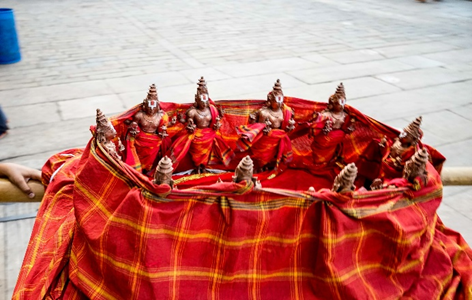
This is the picture of dhaSa mUrthis in SrIrangam – there are 10 personalities (nithyasUris) who are generally taken in procession everyday during the 4 main uthsavams, before perumAL’s procession.
Q. Is subhadhra an avathAram of any Goddess?
Not specifically shown as such by any of our AchAryas.
Q. In Srimadh bhagavadh gIthA, bhagavAn says that we take suitable to body exhaust karma, based on our past karma. If it is that way, we have not done so much puNya karma that we get para bhakti. Without his nirhEthuka krupa, we cannot get it. In such a case, is bhagavAn selective or partial?
There are different rules for different people based on the process they take up. For some advanced personalities, they will go through different stages of bhakthi step-by-step. For general prapannas, they will be given para bhakthi, para gyAnam and parama bhakthi, just before ascending to paramapadham. All of these are under the condition that the person is going to paramapadham at the end of this life.
Q. What is the purpose of gOpuram?
gOpuram, maNdapams etc are part of Silpa SAsthram and are part of temples to add beauty to bhagavAn’s abode.
Q. Can the pArAyaNam of SrI suktham, nArAyaNa suktham, nILA suktham, bhU suktham, and purusha suktham can be done by everyone? Can upanishaths and their sthuthis be recited by everyone?
Anything from vEdhas should be recited by dhvijas. upanishaths are also part of vEdhas.
Q. Can gOpAla sahasranAmam be recited?
gOpala sahasranAma is not in practice.
Q. Is it true that if we perform prAyaSchiththa arghyam late evening or late night it will go to asuras?
Not heard about it like that. If one has missed due to laukika reasons, prAyaSchiththa arghyam has to be given.
Q. It is sometimes seen that some bhagavatas have a woollen shawl or stole with them apart from AdharIyam and uththariyam. What is the purpose of it? And does everyone have adhikAram to wear such fabric?
A third vasthram (towel) is used for convenience purposes. It is not mandatory, but for those who are in kainkaryams, it is quite useful.
Q. It is said in purANas that the age and height of a person reduces on succeeding yugas. It is said that in the end of kaliyuga, the maximum height of a person would be 4 feet. But right now, using advanced genetic technology and ex-situ embryo development, we can set the height, IQ etc for the baby . How to understand this?
We have only crossed 5000 years in kaliyuga. Another 427000 years to go. So, there is still a long way to go in this yuga. Lot of changes will happen over so many years.
Q. Is there a pramAnam in vAlmIki rAmAyaNam/our pUrvAchAryas grantham that rudhra, pArvathi, gaNapathi, and other dhEvathAs took part in SrI rAmA’s pattAbhishEkam?
No direct reference. But in the final chapter of SrI vAlmIki rAmAyaNam – yudhdha kANdam, it is mentioned that all the dhEvathAs were there to celebrate his coronation. Specific mention of indhra and vAyu are seen there.
Q. If all people of ayOdhyA went to vaikuNtam, then whom did kusha and lava rule?
All should be understood as all those who accepted SrI rAma’s offer and went along with him. Just like hanuman refused, there might have been many others who preferred to stay there.
Q. Can vaishNavas keep remains of yagya bhaspam in the forehead, which is considered as one of the 7 types of snAnam?
Generally, not in practice.
Q. Can widows keep manjal prasAdham in forehead given in thAyAr sannidhi?
Generally, not done.
Q. Can non vaishNava watch while samASrayaNaparas eating prasAdham?
In temples, there is no restriction. But in private places, it is better to avoid.
Q. For someone who has recently joined the sampradhAyam and wants to learn more, what to learn and where to start from?
* Start with https://ask.koyil.org/startup-kit/ . This gives all the essential information we need to know through basic lectures. They are available in English and thamizh languages.
* Urdhva puNdra dhAraNam (applying thilak) is explained in https://pillai.koyil.org/index.php/learn-urdhva-pundra-dharanam/
* thiruvArAdhanam details are fully available in https://pillai.koyil.org/index.php/learn-thiruvaradhanam/ .
* We have a comprehensive santhai/lectures repository in https://pillai.koyil.org/index.php/2017/11/learners-series/ . You can start with learning nithyAnusandhAnam which covers compulsory daily recital of pAsurams.
* We have published plenty of books and they are available in https://books.koyil.org – you can get the books you require from us, by placing other through whatsapp and the books will be delivered by courier.
* If you have any doubts, you can check in https://ask.koyil.org where hundreds of questions are already answered. If you have further doubts, you can post in this group.
* One of the most important factors for steady progress, is committed learning. Everyday minimum 1 hour should be spent in listening to lectures. Another 30 minutes for learning pAsurams/sthOthrams in the traditional santhai format. Another 30 minutes for practicing whatever is learnt. Finally, whatever is learnt, we have to try to apply slowly and steadily in our day-to-day life. This will ensure steady progress.
Q. If we have some digestive issues and doctor suggests to eat overnight fermented rice as first thing, can we take it?
For medical reasons, if we have to do something, we need to do it. eating fermented rice was allowed in exceptional situations – due to poverty in previous generations, many people survived by that only. but we should not make it a habit.
Anything done for critical situations should not be justified and made a rule at all times. we have to seek forgiveness for bhagavAn and do it, as long as it does not involve harming other living beings. If it involves harming other living beings we should avoid.
Q. I have a vigraham which is nearly 7-8 inches. I have heard that heard that the size of the vigrahams in our sannidhi should not exceed the size of finger of grihapathi. So I have kept the vigraham in showcase. Is this right to do so?
Yes – showcase is fine. vigraha thiruvArAdhanam is complicated with many rules. Better to avoid unless its vigrahams coming in family lineage.
Q. A family member had prapatti done when they were a child. But now they have decided to not believe in bhagavAn and have turned atheist. They still follow their dharma and don’t pray to any other Gods. Will they still achieve mOksham?
mOksham is attained only if one has taste towards it. also, it is bhagavAn’s decision – no one can say what happens in the end. our duty is to follow our pUrvAchAryas – if we follow our pUrvAchAryas, we will be good SrIvaishNavas. otherwise, we will not be good SrIvaishNavas.
Q. Can SrIvaishNavas keep conch at kOyil AzhwAr?
Not kept in kOyil AzhwAr – some SrIvaishNavas use it for thirumanjanam and keep it outside.
Q. Even though bhIshma pithA maha had very good knowledge and gave us vishNu sahasranAmam, and knew krishNa was paramAthmA, why did he fight in opposite side of paramAthmA?
Everyone in this world is bound by karma. They also have a little bit of freewill. If they misuse their freewill, they will end up in the wrong side. That is what happened in bhIshma’s case too.
Q. Why one should not have head bath with shampoo on auspicious days? Is there any reason.
Usually, it is not good to use shampoo – we can use natural solutions if necessary or plain water is sufficient. Shampoo etc have too many chemicals, some of them may have forbidden ingredients.
Q. Can ladies chant ŚrI suktham?
No. Anything from vEdham should be recited only by those who have yagyOpavItham, that too after learning from a guru. There is a view that even ithihAsas and purANas should be recited by thrivarNikas only. pUrvAchAryas SrIsUkthis are always preferred over ithihAsas and purANas and they can be recited by all.
Q. What are the alternative SlOkas which can be recited instead of purusha suktham and SrI suktham for people who do not have the adhikaram to recite them?
pUrvAchAryas sthOthrams such as chathu: slOkee, SrI sthavam, etc can be recited.
Q. Do SrIvaishNavas celebrate thai pushyam at home?
Yes – it can be celebrated as bhagavath rAmAnuja’s dhivya mangaLa vigraha prathishtA dhinam in SrIperumbUthUr.
Q. As per sampradhAyam conduct, we are not allowed to offer obeisances, show anjali etc. or use words like “swAmy” toward non-prapannas or those who don’t have full dedication to sath sampradhAyam – because we are meant to emulate the example of parama ekAntins. Is there a respectful word we can use toward vaidikas or vaishNavas who are from other sampradhAyams?
When there is some good quality like generosity, devotion etc – SrI or SrImAn prefix can be used for males. SrImathi can be used for married women and sowbhAgyavathi can be used for unmarried women.
Q. In SrImath bhAgavatha mAhAthmyan, we learn that bhakthI, vairAgya, and jnAna were manifested in vrindAvan, however they are intangible feelings and qualities, so how were they able to interact with nArada muni?
Every aspect we see have a particular dhEvathA who is in-charge for that aspect. That is what is known as abhimAnini dhEvathA. Any physical interactions would be with such dhEvathA.
Q. Please explain the vishNu-vrindha situation and help reconcile it?
There are so many incidents which are shown in ithihAsas and purANAs. We need not analyse every one of those. We can focus on the essence of the scriptures by studying our pUrvAchAryas literature and progress upwards in our spirituality.
Just like vEdham is present for people of different guNas, ithihAsas and purANas also have sections for people with different guNas. Those who are in sathva guNa will need to focus on sAthvika sections of SAsthram.
Finally, some people may try to blame bhagavAn for certain acts such as rAsa krIdA, stealing the clothes of gOpikAs etc. But the truth is bhagavAn’s acts are not bound by the rules of this world. While he plays by the rules of SAsthram in general, he cannot be controlled by them. For us, whatever he does is correct and for the well-being of jIvAthmAs.
Q. Who are “thrivarNikas?
thrivarNikas are those males who are born in brAhmaNa, kshathriya, vaiSya families, and underwent yagyOpavItha samskAram with proper vaidhika rituals. They need to proceed with basic vaidhika adhyayanam and at least be performing thrikAla sandhyAvandhanam.
Q. Is it true that kambar lived during nAthamuni’s time, or was it actually after rAmAnujar’s period?
There are two views – 1) he was a follower of nAthamunigaL 2) he was a follower of parASara Bhattar. But no concrete evidence.
Q. Is it true that kambar had vision of nammAzhwAr and hence he could compose the kamba rAmAyaNam in thamizh?
It is said that when kambar went with to present rAmAyaNam, bhagavAn asked if he had sung and glorified nammAzhwAr. kambar then glorified nammAzhwAr in his SatakOpar andhAdhi. Then he back to perumAL who accepted rAmAyaNam happily.
Q. In our sampradhAyam we see all the sanyAsis have thridhandam in their hand? Apart from thridhaNdi sanyAsis are there any different kinds of sanyAsis in our sampradhAyam?
Only thridhaNdi sanyAsis.
Q. Does jIyar and sanyAsi mean the same?
Nowadays it means the same. But jIyar means great, sanyAsi means mendicant.
Q. Is it correct that for beginners SrI bhAshyam is very tough to understand?
Yes – we should go from basics and learn in a step-by-step manner. Without basic knowledge in samskrutham, it will be very difficult.
Q. It is said that arjuna took next birth as a bhakta kanappa to get mOksham by shiva after donating his two eyes to shiva. Is this correct?
It is not authentic – there is no such mention of it by any of our pUrvAchAryas.
Q. In uthara bhAratha dhESam bhAgavatham saptaham is done very widely and that too in naimishAranya dhivya dhEsam, it said by many scholars that bhAgavatham will grant mOksham if we listen to it properly for 7 days. Why our pUrvAchAryas didn’t mention this practice of bhAgavatha saptaham or generally involving in bhAgavatham?
For SrivaishNavas, it is important to avoid 3 aspects:
- dhEvathAntharam – other dhEvathAs – because SrIvaishNava means by definition, one should not worship any other dhEvathAs.
- upAyAntharam – we should not engage in any other means/process to attain bhagavAn. Only bhagavAn is the means.
- prayOjanAntharam – we should not seek any other benefit than eternal kainkaryam.
If we accept that listening to bhAgavatham will lead to mOksham and start practicing it with that attitude, that means we engage in upAyAntharam. Hence our pUrvAchAryas did not engage in such acts. Further ithihAsas/purANas are vast and have some portions of them fully focussed on bhagavAn and other portions focus on various other aspects. Hence, we stick to dhivya prabandham, rahasya granthams, sthOthrams done by pUrvAchAryas, and their commentaries.
We do engage in pravachanam (lectures), but it is done as kainkaryam and to increase our nishtai in bhagavath vishayam.
Q. When we become mukthAthmA in vaikuNtam, can we also get dharshan of archAvathAram perumAL in SrIrangam, thirupathi etc or only nithya sUris are allowed?
In general, it is said that vaikuNtam means the abode where there are no shortcomings – so everything should be possible there. But there are 2 aspects:
- It is said that when nithyasUris, mukthAthmAs desire to see bhagavAn’s simplicity, they come to thirumalA, SrIrangam etc.
- It is to be understood that there will be no separate desire for individual in paramapadham. they will fully follow Bhagavan’s desire only – so, there is no question of individual desires.
Q. Since chakkarathAzhwAn is a nithyasUris what is the reason behind celebrating his thirunakshathram?
Each nithyasUri will have a particular star as his birth star, so that we, the followers can do some celebration for them.
Q. What is the meaning of “ SrImathE rAmAnujAya namaha”?
It simply means “We seek devotional service to rAmAnujAchArya who is having abundance of devotional service towards bhagavAn/AchArayas”.
Q. How do we understand that bhagavAn is the means to attain him?
Very simple – If you seek something from me, whose consent/approval is most important? It is mine – so, if we have to attain bhagavAn, his consent/approval is the most important factor.
Q. Is order of yuga changed only in this chathuryuga or it’s always like this order?
yuga name is not related with number sequence.
Q. Is there any reason why in pandhari and puri the mUla svarUpa is shown on cameras but in tirupathi/ SrIrangam/ badhrinAth the mUla mUrthy is not shown?
In general, mUla mUrthi of any kshEthram is well protected and photography will be prohibited. But overtime some shrines have become more open for public viewing through photography. Since photography is new, we won’t find any rulings against it in SAsthram – it is mostly imposed by individuals/organisations in control.
Q. Would nithyasUris incarnate in this 21st century too amongst us?
Yes – there is a possibility of nithyasUris incarnating anytime.
Q. During krishNa’s time the demons like puthana, kamsa, shakata etc many were killed. They were materialistic and evil minded, but being killed by krishna and they were liberated? What is the reason for this?
Yes – it is generally said that those who are killed by bhagavAn directly, will get good result (even mOksham directly). That is because – usually, when they come in close contact with bhagavAn they will realise his greatness, beauty etc and change in the last moment. SiSupAla’s case is a very good example – https://divyaprabandham.koyil.org/index.php/2018/09/thiruvaimozhi-7-5-3-ketpargal-kesavan/
Q. If one dies as a vaishNava, does one bury or burn? If they burn, do they have to carry the ashes to gangA or kAvEri and do last rites there?
Usually its cremation (burning) only. No need to carry the ashes to gangA or kAvEri, it can be dissolved in nearby water body.
Q. What kind of salt is used in bhagavAn’s bhOgam in SrIrangam?
Mostly the traditional one (old style crystal salt). its sea salt only – but not the powdered one, the big crystals.
Q. If gAyathri dhEvi is saraswathi then why do we chant gAyathri manthra instead of hayagrIva SlOkams?
gAyathri manthra fully focusses on bhagavAn SrIman nArAyaNa only – so it has an important place in vaidhika rituals.
Q. Can vishNu purANam be read by SrIvaishNavas?
Certainly – it is greatly celebrated and is often quoted in commentaries. https://divyaprabandham.koyil.org/index.php/2016/12/sthothra-rathnam-4/
Q. Are parihAra pUjai and rituals mandatory? For example, special pithru dOsha parihAra bali in Nasik thrayambakEshwar temple, etc.
None of these will be relevant/applicable – unless it is specifically ordained in SAsthram as nithya/naimiththika karma.
Q. In rAmAyaNa thaniSlOki, it was mentioned that even if we are in danger whilst outside, we shouldn’t say bhagavAn nAmam as it would indicate we don’t think he will save unless called out. It is an instinct to think of God when in trouble. If we can’t call out his name for help, can we say it to pacify the scared/disturbed mind? When we are in trouble shouldn’t we ask bhagavAn for help?
If we recite bhagavAn’s names as a normal routine it is fine to do as kainkaryam. But if we recite it for protection, then that implies that bhagavAn will only protect prapannas if they recite the names – that will bring bad name for him. That is the essence.
Though it is not apt to do so, because we are not fully purified, we will naturally end up doing it. But slowly, we have to improve from that stage to always reciting guru paramparai and dhvayam – so that it is not done just as upAyam, but as routine kainkaryam.
We should seek his help only. But it should not be transactional – i.e. I seek help and he protects me and then I do something for him in return for the favour. It should be natural – because we are totally surrendered to him, we seek his help, and he protects us because he is our lord.
Q. When we say adiyEn rAmAnuja dhAsan, it means “me who is an adimai, is dhAsan to rAmAnujan”. What is the difference between the words adimai and dhAsan?
adimai is thamizh, dhAsa is samskrutham. Same meaning.
Q. If a pathnI is not following basic daily duties of a SrIvaishNavite, even after decades and not improving, then can the pathi desert/ leave her graciously to her destiny? Does it bring SAsthralopa or pApam to pathi?
As long as basic vows/duties are fulfilled by the spouse, the person too should continue to fulfil his basic responsibilities. It is not about severing, but trying to improve/help each other through sath sangam etc.
Q. For beginners, dhivya prabandhams or rahasya granthams should be learnt first?
https://youtu.be/P6kcrxT47wc and https://youtu.be/BGkrcvwv_g8 . In general, one should have clear understanding of mumukshuppadi – that could be studied soon after samASrayaNam. For young children, it will be good to start with dhivya prabandhams, and when they become somewhat mature enough, rahasya granthams can be taught.
Q. Just like after we wake up, we need to chant hari nAma, is there anything recommended before sleeping?
No specific ones. Usually, we can recite uragal uragal uragal pAsuram and go to sleep. This pAsuram is recited while placing perumAL in Sayanam (making him go to sleep) – since he is present in us as antharyAmi, we can request the same before our sleep also.
Q. Does our sampradhAyam recognize devil possession? How can we tell if someone is under evil spirit or evil magic? If we think someone is cursed, can we suggest visiting a local temple which has several SrIvaishNava priests?
Yes – it is recognised – we see many incidents in the past. But nowadays, these may be happening very rarely. It’s better to check for medical conditions before jumping into any conclusion on possession.
Q. What is the main reason SrIvaishNavism is not spreading in tulu, north Karnataka and Maharashtra regions?
Over time lost the fervour for prachAram and AchAryas could not reach out.
Q. Where is the mahAbrundavanam of vAnAdhri yatishwarar located?
vAnamAmalai itself.
Q. If one is studying in a college that arranges a historical building trip for learning purposes which also includes Siva, Jain, Buddhist buildings, what can we do?
Difficult to say. Better to avoid. But if you must go, then you can avoid worshipping anything there and accept AchArya SrIpAdha thIrtham for atonement.
Q. Are pancha AchAryas of SrI bhAshyakArar avathArams of pancha pAndavAs?
No.
Q. They say a child should not be born in the month of chithirai, yet we see that many revered AchAryas were born during this time. How should we understand this?
No such restrictions – We need not believe these “they say” things.
Q. Can we apply gOpi chandhan if thirumaN SrIchUrNam is not available at the place we live?
We need to use SvEtha mruth (white soil) for thirumaN and red SrIchUrNam (turmeric/lime combination). Some one can help you get it – it is abundantly available in SrIrangam, ayOdhyA and Melkote. It may also be available online.
Q. If someone lives away from bhAratham where, in winter sun only comes up around 7:30-7:45am, can mAdhyAnika be performed before the sun is directly on top of us and do we need to perform prAyaSchiththam for early arghya pradhAnam?
In places outside bhAratham, its difficult to say what is correct and what is not from vaidhika perspective. We just have to try to do our best.
Q. Can a prapanna consume thithi prasAdham of a relative who has passed away but they are not a SrIvaishNava?
No.
Q. In iyal sathu, why does AzhwArs name listing and order differ from the order in which they incarnated? Why does madhurakavi AzhwAr’s name does not appear in the list. The last pAsuram in iyal sathu mentions all AzhwArs and udayavar, but not madhurakavi AzhwAr?
For poetic goodness, sequence is sometimes changed. this is similar to bhutham sarascha thaniyan – https://divyaprabandham.koyil.org/index.php/thaniyans-invocation/. Whenever nammAzhwAr is spoken, madhurakavi AzhwAr is included/implied there.
Q. Why is mannArkudi rAjagOpAla swAmi’s ears have different earring on each side?
periyAzhwAr sings in periyAzhwAr thirumozhi 3.3.1 “seelaikkudhambai oru kAdhu oru kAdhu senniRa mEl thOnRip pU” – krishNa is decorated with a small piece of cloth in both ears(to ensure that the pierced hole is not lost over time) by yaSOdhA. When he goes to the forest, he removes one of them and wears a flower there instead. It is krishNa’s style of having two different decorations in two ears.
Q. Is it true that Siva after the event that happens with maharshi mArkaNdEya, he shows maharshi his matted hair and says he’s also following bhakti yoga, so he guides maharshi to perumAL if maharshi wants mOksham?
Not heard about Siva following bhakthi yoga. He does guide mArkaNdEya towards perumAL and subsequently mArkaNdEya becomes a great devotee of perumAL.
Q. Is it correct that prapannas should also not prostrate towards pindas of the deceased family member who aren’t SrIvaishNavas?
That is correct.
Q. If a disciple trespasses the rules with willingness and is doing nishidha karma with willingness, what can he do for the prAyaSchitham?
He needs to ask for forgiveness from perumAL. If his actions caused harm to bhAgavathas , he should ask forgiveness from them also. He should never repeat that mistake again. He can then accept SrIpAdha thIrtham from AchArya and focus on whatever he should do.
Q. These days, thuLasi is being used for mundane purposes such as tea etc without having been offered to bhagavAn. What is the stance in SrIvaishNava sampradhAyam relating to that?
I think even in the past, it was used as medicinal herb. In any case, we just cannot consume anything which is not offered to perumAL.
Q. Why is thirumanthram known as “manthra rAja”?
thirumanthram is said to be manthra rAja – because it is king amongst manthras – which means it is the best among all manthras.
Q. Why do we refer to dhvayam as “mahA manthra”?
dhvayam is said to be mahA manthra, since it is more explicit in describing the means and goal, with clear identification of SrI mahAlakshmi’s role.
Q. Did AdhiSankara refer/quote/write anything about dhivya prabhandham?
mudhal AzhwArs time dates back to end of dhvApara yugam and yuga sandhi – this has been previously explained. It is far back in time compared to AdhiSankara’s time. AdhiSankara did not get access to dhivyaprabandhams – hence could not understand and promote them with deeper clarity.
Q. Is the SlOkam- “asmad guru samArambhAm yathi SEkhara madhyamAm lakshmIvallabha paryanthAm vandhE guru paramparAm”, recited by SrIvaishNavas of some specific lineage or it’s just another guru paramparA SlOkam?
It is not commonly recited across all SrIvaishNavas homes. But it’s a nice one – I believe it was given by anathAzhwAn or his descendants.
Q. Why is bhagavAn depicted in blue colour?
Because blackish-blue is said to be his natural colour.
Q. Isn’t bhagavAn’s dhivya mangaLa vigraham completely black coloured like in many dhivyadhESams?
Yes – in most dhivyadhESams, that is the case for mUla mUrthi.
Q. What does our sampradhAyam say about suicides?
In general, suicide is not an option for an AthmA. Even sIthAp pirAtti was so distressed when sent away to forest when she was pregnant. But she tells lakshmaNa “since I am parathanthra (totally dependent on SrI rAma), I have no right to take my life”. Hence it is not an option for anyone to do it.
However, some people do it due to extreme pressures. In general, that will lead to bad results only for that AthmA. As a devotee, we should be caring towards everyone around us and bring about a positive environment. If someone needs counselling or moral support,, we should always be ready to do it, sparing our time. If a person commits suicide and departs, we can simply pray to bhagavAn that the AthmA is given kainkaryam opportunity.
Q. Since perumAL has created rahu kAlam, why is it recommended to avoid it for starting something. Why would perumAL create something which is not right?
Its not about right or wrong. Creation is a process in leelA vibhuthi – it happens based on karma and choice of individual AthmAs. Hence there are variegated aspects in this world. What we see as good or bad are only different facades of the same entities. For example, shawl is good in winter but the same is bad in summer, for an individual. A person who likes icecream when he was young totally rejects it after becoming old. These things are part of this world only. On the other hand, since everything is driven by bhagavAn’s desire in nithya vibhUthi, everything remains good always.
Q. In general, we don’t say praNavam in public but in bhagavath gIthA krishNa has said the praNavam can be said in public. Why is this so?
Sometimes it becomes unavoidable and one has to spell it out. It is ok to recite them in public as part of kAlakshEpam or pArAyaNam, which happens in public places like temples. Even in upadhESa raththina mAlai, it is spelt out “vEdhaththukku Om ennum adhupOl” – in such cases, it can be recited.
Q. How do we understand the verse – “ना गायत्र्याः परो मन्त्रः” (for SrIvaishNavas it is thirumanthram)?
In SAsthram, different aspects are glorified at different places/times. Each has its significance. We need to understand our pUrvAchAryas’ conclusive statements regarding philosophy and apply them.
Q. Were there any exalted devotees of bhagavAn in female body in SrIvaishNavas other than gOdhA dhEvi ?
Plenty of them are there. Just to identify/name a few : selvanambi’s dharmapathni, yAdhavaprakASa’s mother who was devoted to rAmAnuja and convinced her son to become a disciple of rAmAnuja, aththuzhAy daughter of periya nambi, dhEvakip pirAtti daughter of thirukkOshtiyUr nambi, ANdAL who is kUrESa’s dharmapathni, ponnAchchiyAr who is dhanurdhAsa’s dharmapathni, kongil pirAtti, paruththikkollai ammAL, thripurA dhEva, kandhAdai thOzhappar’s dharmapathni, and countless women who were well versed in sampradhAya principles who guided their families in the past 1000 years or so, during/after rAmAnuja’s time.
Q. If garudAzhAwar’s father is kashyapa. But he was always there with vishNu and is eternal. How do we explain this?
garudazhwar incarnates in this world as the son of vinathA and kashyapa. In any case, these are incarnations – just like Bhagavan incarnates into this world, nithyasUris also incarnate. They always remain in paramapadham in their full svarUpam. AdhiSEsha also incarnates – notably, he incarnated as bhagavath rAmAnuja and maNavALa mAmunigaL.
Q. What is the meaning of the term “sadhas”?
sadhas means an assembly where different topics are discussed. For example – there is “vEdhAntha sadhas”, “bhagavath vishaya sadhas”, “rahasya thraya sadhas”, “vyAkaraNa sadhas” and so on. Scholars will be able to discuss and question each other in these debates/discussions.
Q. If swAmiguru is clearing spiderwebs or pest control, is that a sin in vaishNavisim?
Yes – but they are unavoidable. bhagavAn’s residence (temples, homes etc) must be kept neat and clean – for that purpose it can be done. We should feel remorseful for having to hurt tiny living beings and seek forgiveness for the same from perumAL.
Q. Can we recite sthOthrams of non-SrI vaishNava AchAryas? Ex: ranganAthashtam by Adhi Sankara? They have nice lyrics.
When we have so much from our AchAryas, why should we seek anything from someone else? Sometimes, the lyrics may be nice/pleasant. But we don’t know the real intent of the author. If we are clear about the author’s intent in praising bhagavAn without any other expectation and not contradictory to our sampradhAya principles, we can recite.
Q. In the mahAbhAratham we see vidhura was of mixed caste and was a minister of the king. Did he study the vEdhas?
Though he was an exalted devotee of krishNa, most knowledgeable and was highly glorified, there is no clear mention about his studies in our pUrvAchAryas’ works as far as I remember. Hence, it cannot be clearly answered.
Q. rAvaNa was a detractor of vishNu, but he studied the vEdhas. Although he fell from his brahmin status through his actions, he studied the vEdhas despite being a detractor of vishNu. So, even though I am a devotee of vishNu, a vegetarian, and lead a moderate life, can I not study the vEdhas? Is rAvaNa more qualified than me for the vEdhas?
Whenever we set out to do something, we should analyse the purpose of it. We know bhagavAn through SAsthram. That same SAsthram has placed certain restrictions. Why not accept those restrictions too? Our pUrvAchAryas have followed these principles properly with deep respect towards those traditions – so it is apt for us to follow their actions, if we are their followers. Whatever can be accomplished by studying vEdham, can be accomplished through alternate means which are allowed for everyone. Why not accept those alternate means?
Q. What is the thilak of thirukurungudi nambi?
kasthUri thilakam.
Q. Is kaliyuga only for India or entire world?
Entire world.
Q. Can we take picture of mUlavar?
There were paintings of mUlavar in the past. So, I don’t see any specific reason to not allow photography. But there are practical issues – as in the case of uthsavar, sometimes we see more people clicking photos than worshipping him. If that would happen in mUlavar sannidhi which is already cramped usually, it will be huge problem. Since photography is a recent invention, there would be no specific mention in SAsthram barring it.
Q. Is vEl an Ayudha of perumAL?
Not a standard one. but as part of leelAs, he may take up one. As explained in thiruppAvai anRivvulagam pAsuram.
Q. Is garuda’s form like a complete eagle or is it how we see in temples?
It should be as we see in temples. He may have different types of manifestations as well.
Q. We have few of our friends have had SamASrayaNam done at a young age and recite ashtAkshari and dhvaya mantra daily but do not wear puNdram or follow AhAra niyamam. They mock us for following the vaishNava principles and say we have blind faith for following strictly; and they also take part in dhEvatha worship. We tried to educate but they are not willing. How do we respond to people like this?
It is the responsibility of the parents, AchAryas, elders to guide the young ones. If they are not having proper SrIvaishNava appearance physically, you can inform them. If they mock at you, you need not become disheartened – we have to remain strong and be confident about our faith.
We need to remain friendly and compassionate towards them and try different methods to correct them. For that, first we should be properly following our sampradhAyam and also remain compassionate. If they observe dignified behaviour in us, there is more possibility of them listening to us.
Q. What can do if we are in places where there are no temples with AzhwArs and AchArya sannidhis or there are temples with other dhEvathAs? Completely skipping those temples will lead children to not have exposure to temples. So how can we can have dharshan of thAyAr and perumAL in those temples?
Yes – its a bit challenging – ideally, we should move to a place where there are SrIvaishNava temples. We can also try to create local sathsangam with like minded bhAgavathas – some effort is needed to find and gather such persons. If we have no other choice, then we can go to temples where perumAL is the primary/main deity. We need not go to other dhEvathas sannidhis and need not accept prasAdham if there is mix of other dhEvathAs remnants also.
Q. If we are arya vysya, and in our community it’s customary to have one’s upanayanam done immediately before the marriage ceremony, is this acceptable, or should we instead aim to have upanayanam done before turning 24, as is customary for vysyas?
If possible, you can get it done before marriage. but you need to follow the customs properly, after getting upanayana samskAram done.
Q. Is pAncharAthra Agama taken as pramAnam?
Yes.
Q. Did vAlmiki rAmAyaNa happen in this chathur yugam?
It is from one of the past chathur yugas, not this one. In thiruchchandha viruththam 73rd pAsuram commentary, periyavAchchAn piLLai shows this. https://divyaprabandham.koyil.org/index.php/2024/01/thiruchchandha-viruththam-73/
Q. Do jaya and vijaya get cursed by brahmA’s sons every 4 yugams ? Is it a loop?
Not every chathur yugam. No specific frequency. These are all variables in each aNda at different times.
Q. What kind of avathArams is in the next kalpa?
There is no specific information available.
Q. Is SrI yanthram worshiped by SrIvaishNavas?
Not specifically by general SrIvaishNavas – there may be some Agama based significance for it.
Q. What is the difference between the thirunAmam rAmAnujan and rAmAnujam?
Grammatically rAmAnujan in thamizh means name of a person, while rAmAnujam means name of an object.
Q. Does “SrI” in SrIyanthram mean “thAyAr mahAlakshmi” or is it a general sanskrit word used for highly revered things?
In general, as far as I enquired, these are commonly pursued by dhEvathAnthara worshippers. There is no such practice highlighted in pUrvAchArya vyAkyAnams.
Q. Can a SrIvaishNava consider thAyAr and perumAL as his own biological parents?
We can – they are the real father/mother. but as long as we are in this world, we are still connected to our actual parents and we need to fulfil our duty towards them.
Q. In most of the case why nArAyaNa is found with SrIdhEvi and bhUdhEvi but not nILA dhEvi? nArAyaNa stays in vaikuNtam with SrI, bhU and nILA dhEvi, so why nILA dhEvi is not present in most of the cases?
In all of the 5 states of bhagavAn, i.e., para, vyUha, vibhava, antharyAmi and archA, there are different situations. In paramapadham, bhagavAn has all 3 primary dhEvis and many more dhEvis too. In kshIrAbdhi, he has SrI dhEvi and bhUdhEvi. In avathArams, it depends on the particular avathAram – no particular standard, but mostly SrIdhEvi will be present. In antharAmi – he is with SrIdhEvi in the heart of the yOgis. In archA, it depends on each temple and the will of bhagavAn – minimum SrIdhEvi and bhUdhEvi will be there, in most cases.
Q. In our sampradhAyam, Adi swathi or garuda panchami, is important?
Adi swathi.
Q. ‘Even if dhaivam is not the only one, the effort will pay off’. How to understand this thirukural?
These kinds of moral words like proverbs are meant to encourage hard work, dedication, sincerity etc in the tasks we do. We need not take them as philosophical conclusions.
Q. What is the relation between mahAlakshmi (four handed form of thAyAr), gOdhA dhEvi and the two handed SrI, bhU and nILA dhEvi forms that are beside bhagavAn? Why does thAyAr take so many forms ?
SrI mahAlakshmi is the primary consort of SrIman nArAyaNa. She is SrIdhEvi. bhudhEvi and neeLA dhEvi are the other important consorts. SrI mahAlakshmi is the only nAchiyAr who is a direct devotee of bhagavAn and she is also his divine consort, hence she is to be served along with bhagavAn, by everyone. All dhEvis are said to be servitors of SrI mahAlakshmi and they also serve bhagavAn and SrI mahAlakshmi together. gOdhA dhEvi is an incarnation of bhU dhEvi.
Q. Why back portion of gomAthA considered auspicious and also why in the morning, for perumAL back portion of gomAthA is shown?
It is said that all the dhEvathAs have place in gOmAthA’s body. And moreover, SrI mahAlakshmi also is present. Hence gOmAthA is brought for viSvarUpam.
Q. We have been hearing often from different corners (from scholars in discourses & common people) that due to kali yuga kolAhalam the dharma, nyAya keep on deteriorating year by year, day by day etc. How can we learn/ do so many readings, practices when majority of our surroundings including family members who are SrIvaishNavas are involved in loukiks, workplace?
Within our potential, we have to try and do as best as possible. If we go along with the general population and fall in the trap, then we cannot be saved.
Q. When we have dharSan of gOmAthA, do we also have to see tail?
It is for perumAL only. We don’t specifically worship or seek dharSan of gOmAthA.
Q. As a service can we offer grass to cow?
Yes – certainly. But without expecting any results, benefits.
Q. Why is our sampradhAya people going in wrong paths?
Certainly, there is lack of education and cultivation of discipline, right from the young age. Most of the leaders of the society, I.e., AchAryas, particularly, are working within a very limited scope of self, family (if applicable) and their establishment. Only some AchAryas are showing their concern about the current and disturbing situation, and are working for remedies. Naturally, over time, things will deteriorate only. We should try to do our bit for the sampradhAyam and see how we can help those who are helping the society in this stage. The situation is getting worse day by day and most of us are least bothered about the society. This need to change.
In general, people do not appreciate what they have and lack gratitude for what they get. Becoming a SrIvaishNava and getting connected to our guru paramparai, are the biggest advantages/benefits we get. One has to appreciate that and recognise the value fully. One should be grateful to bhagavAn and AchArya – bhagavAn leads to AchArya and AchArya leads to bhagavAn. Hence we should be ever grateful to both of them. Here AchArya indicates our paramparai and our mentors who shape us in our spiritual journey.
If we have such gratitude – then two things will happen. 1) we will have our existence for them and serve them to our fullest capacity (bhagavAn and AchArya). 2) we will pay it forward as well – that is we will share the knowledge with others so that they will also get the same benefit.
Q. How can we celebrate Adi swathi at home?
We can do some special food preparations and offer in thiruvArAdhanam. Also, if possible, additional pasurams can be recited.
Q. At what stage does the AthmA enter the child in the mother’s womb?
AthmA enters the female body through the sperm.
Q. Does each individual sperm carry an AthmA? Does the AthmA enter into the sperm as soon as the sperm is generated?
https://divyaprabandham.koyil.org/index.php/2023/02/saptha-kadhai-pasuram-3/ – panchAgni vidhyA is the process explained in chAndhOgya upanishath for the journey of the soul from one body to another.
Q. After undergoing SamASrayaNam, while reciting abhivAdhanam during sandhyAvandhanam, should we add “rAmAnuja dhAsan” to the name?
rAmAnuja dhAsan is not added during abhivAdhanam. Whenever we see SrIvaishNavas we introduce ourselves as rAmAnuja dhAsan. It does not change our abhivAdhanam.
Q. What is avathArikai in SrIvaishNava parlance?
Introduction to a commentary. It is like preface.
Q. Which object is indicated by the word “rAmAnujam”?
It can indicate many things. For example – AzhwArs’ pAdhukA is said as SrI rAmAnujam.
Q. We read about mEru parvatham in various purANams. What is this mEru parvatham? It is said it connected all the lOkams and we can’t see it physically existing. But SAsthram has mentioned it. Is it metaphorical or really present?
Really present. it is one of the anchoring mountains – but not visible to us.
Q. Is medically-assisted dying accepted in our sampradhAyam. In these scenarios is our prapatti undone and remove your ability to reach vaikuNtam?
Yes – we don’t have the right to take our life and commit suicide. But again, we need to see this in compassionate grounds. Just as so many violations are done by prapannas in their day-to-day lives, this is one more such violation. Since bhagavAn is most merciful – he may still accept such AthmAs, if they had previously surrendered truly.
Q. As per our sampradhAyam every form has an AthmA. 1) If a stone has an AthmA is it stuck in that stone till praLayam happens? 2) what happens to the AthmA in the stone which becomes a mUrthi in temple?
1 – Not like that. If that stone breaks or completely get destroyed, it may be freed from it. The process is complicated.
2 – The AthmA still remains in that stone. When that stone becomes archA vigraham, bhagavAn takes control of that stone, and that AthmA becomes fortunate. But still, the AthmA has to remain there until that vigraham is there.
Q. Can we take prasAdham/ thIrtham from a bhAgavatha who didn’t got samASrayaNam from 74 simhAsAnAdhipathis or jIyars? 2. Can a SrIvaishNava touch instrument dubki?
1 – Ideally, no.
2 – Probably not required to do so.
Q. Recently a swAmi performed shiva lingam abhishEkam and applied tripund on the forehead. Is this practice allowed? Why is he not provided a show cause?
Absolutely not allowed – completely against our sampradhAya principles. Ideally – yes, the AchArya should teach the Sishya about these things and correct when the Sishya goes wrong. But in reality – AchAryas are not correcting and Sishyas are not ready to be corrected.
Q. When we do prathishtai, the vigraham becomes perumAL. So will the AthmA get mOksham?
vigraham does not become perumAL. vigraham becomes the thirumEni of perumAL.
Q. If AthmA has to remain in the vigraham, then is it that in vigraham are there two persons, paramAthmA and a jIvAthmA?
In any object/entity we see, there is both jIvAthmA and paramAthmA.
Q. It is said by some people actually krishNa did not speak all the verses in bhagavadh gIthA — it was vyAsa who edited them. Is this true?
Not like that. It was krishNa’s words (and words of sanjaya, arjuna et al) only documented by vyAsa.
Q. When AthmA travels to paramapadham, does it go straight to paramapadham or through other lOkams?
We will go through the archirAdhi mArgam (many lokams) – but travel will be very fast.
Q. Is rAmESvaram part of the chArdhAm for SrIvaishNavas?
Our chArdhAm is – kOyil (Srirangam), thirumalai (thiruppathi), perumAL kOyil (kAnchipuram), thirunArAyaNapuram (mElkOtE). SrIvaishNavas have nothing to do with rAmESvaram, specifically. We can go to thiruppullANi which is near rAmanAthapuram. That is a dhivyadhESam.
Q. yOga vasishta says that there are two hearts; the one is samvit; and the other the blood-vessel. Is this true?
There is no specific discussion about 2 hearts in our body, by any of our pUrvAchAryas.
Q. Is there any procedure to go on sanyAsam?
One has to approach a sanyAsi, reveal one’s desire to become a sanyAsi, and on his acceptance of that idea, remain with him for some time, follow his guidance and get trained in the sanyAsa practices. If that sanyAsi then grants permission, one can then become a sanyAsi.
Q. Are there sanyAsis other than jIyar swAmys?
jIyar and sanyAsi are synonyms at present. Also, in general, all sanyAsis are giving pancha samskAra dhIkshA these days. This is in the limited sanyAsis who are well known. But there may be many sanyAsis who are just preaching and living austere life.
Q. In our sampradhAyam do we have the practice of tying araNa kayaru for boy babies?
It should always be there. We have to tie the kaupInam in that only.
Q. In bhAgavatha purANam it is mentioned that hiraNyan went on a huge conquest of the 3 worlds and enjoyed all his pleasure wealth for thousands of years yet when he came back come prahlAdha was still 5 years old. How is that possible?
Those days, life spans were different, and biological aspects may also have been different.
Q. prANan means life force. Since it’s not a physical entity that can be seen, how is perumAL present in that?
Though prANan cannot be seen – it is still felt. Any entity which is perceived by any sense – eyes, ears, nose, mouth and skin – they are all achith and are having bhagavAn as antharyAmi.
Q. Is coconut given in thAmbulam?
Yes – it can be given.
Q. Is it correct that in many sperms produced by human body, only one interacts with female cell and becomes embryo? Does the AthmA resides in that particular sperm or in all?
Yes – in all sperms – again they have to go through the process of going up in the sky, falling as part of rain etc.
Q. Just like there are 3 categories in almost all fields– good, better and best, ie, uthama, madhyama, adhama paksha, in prapatti too can these categories be applicable?
There are some brief explanations in this regard:
- prapaththi done due to ignorance, knowledge and devotion are explained in SrIvachana bhUshanam 43 and subsequent sUthrams – https://granthams.koyil.org/2021/02/09/srivachana-bhushanam-suthram-43-english/
- Thinking “prapaththi is upAyam” – is basic level and “Bhagavan is upAyam, prapaththi is just my acceptance of that fact” – is ultimate level.
- Doing prapaththi for worldly benefits is basic level and for eternal kainkaryam is ultimate level
- Doing prapaththi through one of mind, speech and body is basic level (which is sufficient) and doing prapaththi with all 3 of them is ultimate level (like the state of AzhwArs).
Q. Can SrIvaishNava do gau dhAnam?
Yes – it can be done.
Q. Why is sometimes AvaNi avittam celebrated in Adi?
Depends on the calendar which is used,
Q. Is it true that kAmadhEva is the son of vishNu?
Yes. He also incarnates as pradhyumna as krishNa’s son.
Q. Is it true that Siva burnt kAmadhEva with his eyes?
Yes – but these are leelAs. Also, not all sons of bhagavAn in his incarnations are divine.
Q. Can we keep a 1.5 to 2 ft height brass idol of radhe krishNa in a swing in our home showcase?
Yes.
Q. If a jIvAthmA gets mOksham and reaches vaikuNtam, will the jIvAthmA remember it’s past lives?
Yes – mukthAthmA has all the knowledge about all the past lives – but will not have any scope to think about those aspects, because bhagavAn will give total anubhavam for the mukthAthmAs. For example, we know so many things, but we only think about things which are relevant for us at each moment. Similarly, once AthmA reaches SrIvaikuNtam, bhagavAn will be the only relevant thought for him.
Q. Did all the vraja gOpikAs with whom bhagavAn performed leelA, have amSam of mahAlakshmi in them?
In general, all male forms are having SrIman nArAyaNa’s features and all female forms are having SrI mahAlakshmi’s features. I cannot remember any specific quote from pUrvAchAryas saying that the gOpikAs had SrI mahAlakshmi’s amSam (feature). But certainly they were very dear to krishNa and were totally surrendered to krishNa. Hence the gOpikAs are seen as exalted devotees of krishNa. ANdAL nAchiyAr, nammAzhwAr, kulaSEkarAzhwAr, periyAzhwAr, thirumangai AzhwAr were all deeply inspired by the devotion of gOpikAs, and manifested the mood of gOpikAs in their pAsurams.
Q. If prapannan does everything as a kainkaryam to bhagavAn, where does the fruits of those actions go? Will bhagavAn take those either of good or bad?
Even after prapaththi, our actions will have natural result. For example – if I do some kainkaryam very well, I will be rewarded. If I do some mistake, I will be punished. It can be understood using perception itself. But we have to develop an attitude of detachment. We should not expect results while engaging in actions – rather we should try to do only those actions which are ordained in SAsthram.
For a prapanna, ascending to paramapadham, his remaining puNya and pApa will be distributed to those who are favourable to him and unfavourable to him, respectively.
Q. After the rituals like samithA dhAnam what do we do with the burnt samithA?
We can dispose them into places where people do not walk.
Q. Sometimes we feel this life is boring/void/vague. Do bhAgavathas who constantly engage themselves in kainkaryam ever feel like that?
Most certainly – everyone goes through different experiences at different times. There will be highs and lows. Wise people handle such highs and lows with a better mindset. Others get bogged down due to such highs and lows. We have to see the overall picture of being a SrIvaishNava, getting kainkaryams, executing them and longing for more and more kainkaryams. Not only in material life, even in spiritual life – we should not be over-excited or over-dull. We should be peaceful to handle things in moderation.
Q. Regarding yagyOpavItham dhAranam — for brahmachAris, it is said to be 1 thread, and for gruhasthas, 3 threads. Is this correct?
In practice, we see that brahmachAris wear 1 thread and gruhasthas wear 2 threads. Even the sankalpam we use nowadays goes “gruhasthASrama sidhyArtham dhvithIya yagyOpavItha dhAraNam”. Some gruhasthas wear 3rd thread, which is said to be a replacement for uththarIyam. Except during final rites, gruhastha should never be without uththariyam – that is, a gruhastha should always be with two vasthrams – dhoti and uththariyam. If one wears a 3rd thread, in that case, even if uththariyam is not there, it is fine. But this is not a standard practice – i.e. it is not taken as a route to avoid wearing uththariyam.
Q. In some temples we find vishwaksEnar in form of gajAnan (having elephant head). Is that worshippable for SrIvaishNavas?
Even in famous temples, over time different sculptures may come in, due to influence of kings, administrators etc. Even sculptors themselves do some sculptures due to their affiliations. We cannot consider these as authentic. This is not a worshippable deity for SrIvaishNavas. vishvaksEna does not have elephant head. One of his subordinates have elephant head. But that is not the same as the gaNapathi who is worshipped in this world.
Q. Who are the female guards in mahAlakshmi temple? Does thAyAr have guards in her temple?
Yes – they are the servitors for thAyAr.
Q. Is it right that for men, shaving hair was a rare occasion in the old days?
No – unless there is a specific reason to grow beard (like death of father/mother, wife is pregnant etc), one should shave atleast once every 2 months or so.
Q. What is meant by the word smArtha?
smruthi based is “smArtha”.
Q. Was hanumAn a bramhachAri or married?
brahmachAris.
Q. What is the difference between ISvaran and bhagavAn in Sanskrit?
You can look up the literal meanings from samskritha dictionary. Generally, ISvara means controller. bhagavAn means one who possesses 6 qualities – gyAna, bala, ISvarya, vIrya, Sakthi and thEjas.
Q. What is the meaning conveying by prostrating at dhvaja sthambam?
Usually, we prostrate in front of bali peetam which is along with dhvaja sthambam. dhvaja sthambam signifies bhagavAn’s victory over everyone. bali peetam is where dhEvathAs are given bhagavath prasAdham every day.
Q. Why do dome sanyAsi (jIyars) perform chAthurmAsyam on certain period of months and others on different period of months?
In our sampradhAyam – chAthurmAsyam is observed by our sanyasis not based on strict dates, but as per convenience for 2 months, within the 4 months period. As kainkaryam is priority, some of these observances are done as per convenience.
Q. Similar to celebrating SrI jayanthI, vAmana dhvAdhaSi, rAma navami, can we celebrate sIthA and rukmini thirunakshathram?
No specific celebrations shown by our elders. But nothing wrong in celebrating by reciting pAsurams/sthOthrams, making some special food preparations etc.
Q. SrIvaishNavas have to avoid dhEvathAntharam, upAyAntharam and vishayAntharam. All three of these are destructive for the svarUpam of the jIvAthmA. Out of this, is there any ranking which classifies the destructiveness of these three? (i.e., from most destructive to least destructive)
It depends on the context. Certainly dhEvathAntharam and vishayAntharam are more destructive than upAyAntharam.
Q. Can we attend brAhmaNArtham? What are the rules to follow when visiting these?
Depending on different sthAnam (position) in thiruvadhyayanam etc, there are specific rules to chant as many gAyathri manthram and also avoid sitting in the sthAnam for so many days. Doing it on a daily basis is not correct. Doing it as kainkaryam for other SrIvaishNavas is good. It has to be done without expectation. karthA also has to honour such swamys generously. We need to know about who is the deceased person and their nature. Without knowing anything, we should not just go and attend that.
Q. Is today’s srilanka same as rAmAyaNa’s time lanka? The distance mentioned in rAmAyaNam and today’s distance is not matching.
Yes – because it involves millions of years, the geography is probably changed. Certainly, the distance shown in SrI rAmAyaNam is not matching what we see today.
Q. What is the procedure for puNya nadhi snAnam for advija prapannas?
For prapannas, puNya nadhi snAnam does not involve any sankalpam etc. Just honour the thIrtham, by first doing prOkshaNam while/before stepping into the river and start bathing as per the standard bathing method/rules.
Q. What would happen to kaivalyArthi AthmAs during praLayam?
kaivalyArthi means someone who is seeking kaivalyam and not attained yet. He will also be treated the same way as any other AthmA in samsAram. The one who has attained kaivalya mOksham will be in outer area of paramapadham, which is still paramapadham, hence they will not be disturbed by praLayam since praLayam in only for samsAram.
Q. Can human hair that is offered in thirumalA be used for making wigs for mUrthis of the Lord?
Not sure about the actual reference in SAsthram for offering hair to bhagavAn as done in thirumalA and many other places, nowadays. Without that clarity, it is difficult to determine other aspects. Generally, in vaidhika dharmam, full tonsure of hair is not allowed – one should keep shikhA. But somehow, everyone is engaged in this activity now, including SrivaishNavas. It is a challenging situation.
Q. Sometimes thiruvadi and periya thiruvadi are also seen with Sanku, chakram and thirumaN. What does this represent?
They represent his countless servitors – it tells that bhagavAn with pirAtti and such gyAnam, Sakthi is not alone, but is served by great devotees.
Q. What does the lotus flower which is often held by pirAtti, represent?
It is her play toy.
Q. If a prapanna has full faith in nArAyaNa nAmam that chanting hari nAmam cures the disease of this body then is it sensible for a prapanna to say that he need not take any AyurvEdhic medicine orally to get his disease cured?
prapanna means one who is surrendered to bhagavAn. mumukshu means seeker of eternal kainkaryam in paramapadham. SrIvaishNavas are a combination of prapanna + mumukshu. Such SrIvaishNavas should not do anything to protect/uplift self and fully depend on bhagavAn’s grace for both basic/bodily needs and spiritual needs.. If one chants hari’s name to cure diseases, he is not a SrIvaishNava as per strict definition of SrIvaishNava, since he is seeking bodily comfort.
That said, a prapanna should also follow scriptures on doing the daily routines such as taking bath, getting trained in some profession according to one’s varNa, doing that profession with service attitude towards bhagavAn etc. Taking medication [Ayur vEdha only] to cure one’s body is generally considered as having less faith in bhagavAn and more faith in such medicines – hence our AchAryas did not prefer taking specific medication. But in general, we should consume healthy/sathvik AhAram to reduce the possibility of getting diseases.
Q. In case a SrIvaishNava gets some severe disease then what should he do?
He should consult a doctor. These are aspects which depend on the individual who is going through such situation and what bhagavAn tells him from within his heart. And even more, what the close family/relatives do is more important, because in many cases, they will take the decision for the suffering individual. Let us just pray that we can be in kainkaryam without any hindrance as said in “ozhivil kAlamellAm …. vazhuvilA adimai seyya vENdum nAm”.
Not everyone is highly evolved as a true prapanna. We claim that we are prapannas but we hardly are in its true sense. Sometimes I wonder about our identity of being a prapanna – we talk high philosophy etc – but at the end of the day, a person who has good devotion towards bhagavAn (without this added identity of “prapanna”, “mumukshu” etc) may be better than us who fall in the trap of thinking “Oh! I am a prapanna. I have surrendered to bhagavAn” and acting contrary to that thought. Even being a prapanna/mumukshu combination is quite challenging. In that sense, it is easier to be under the shade of an AchArya who can guide us and if we are simply able to follow that trustworthy AchArya. That is what our pUrvAchAryas have practiced – it is comparatively easier since even in this world we see people take the advice of mentors and follow as per that guidance and succeeding in life.
Q. There are various stories about a Muslim devotee of perumAL who loved him as her husband. Some claim that’s it’s about SrI rangam dhivyadhESams, while some say it’s about mElkotE and some say it’s about vEnkatEshwara swAmy. Also, different names are heard like thulaka nAchiyAr, bibi nAcharamma, Surudhani. What is the real story or were there different devotees in these three dhivyadhESams?
There is mention about thirunArAyNapuram incident and SrIrangam incident in some of the granthams, vyAkyAnams. But not so sure about the thirumalA one. Names like thulukka nAchiyAr, bibi nAchiyar are commonly used for such muslim princess.
Q. What is the position of rishi panchami in our sampradhAyam? Do we celebrate it?
No.
Q. Can we join groups that are performing lingAbhishEkam, but imagine perumAL as we chant?
Of course – Strict No.
Q. It is heard that bhagavath rAmAnujAchArya took so much time to comment on mAndukya upanishaths than other upanishaths. He also added that if the mAndukya upanishad is interpreted directly then it will give mayavAdic meanings. Whereas it needed to be understood in the correct way which is very tough for us and also rAmAnujAchArya took risk for correctly interpretating the Upanishad. Why mAndukya Upanishad is tougher than the other Upanishads?
There is no specific reference to commentaries by bhagavath rAmAnuja for upanishaths, in the well-known granthams. So, it is really not possible for us to comment on this.
Q. We understand that bhagavAn is the upAyam and not the prapatti we perform. prapaththi is just a vyAjam and it is our svarUpam to execute the prapaththi. Such being the case, what is the reason to mention svagatha svIkAram as we are not doing prapaththi by our effort but due to perumAL’s grace so it seems like it is always a paragatha svIkAram?
Though the truth/fact is bhagavAn leading AthmAs to prapaththi, some AthmAs understand/accept that. But there are other AthmAs who think that they have done it themselves and consider that prapaththi to be the upAyam. Those are the ones doing svagatha svIkAram.
Q. According to our pUrvAchAryas who wrote mahAbhAratham?
vEdha vyAsa.
Q. Did ganEsha write the mahAbhAratham?
It is not clear – while most of the recent editions of mahAbhAratham appear to suggest so, our pUrvAchAryas have not mentioned anything like that in their works.
Q. An acclaimed SrIvaishNava scholar shared in a discourse that pAdha puja is to be done to parents/elders as per SrIvaishNava sampradhAyam. Since bhagavAn the supreme personality isn’t it wrong to equate bhagavAn’s thiruvadi to others and perform pAdha puja offering flowers, dhupam etc? Is this followed in our sampradhAyam?
https://divyaprabandham.koyil.org/index.php/2016/12/thirumalai-42/ – Great devotees (SrIvaishNavas) are considered at par with bhagavAn as per the words of bhagavAn himself as well as AzhwArs/AchAryas. So they must be worshipped at par with bhagavAn. This is why we see that AzhwArs/Acharyas uthsavams are also celebrated at par with bhagavAn’s uthsavams. This is why we see that present day AchAryas and uththama SrIvaishNavas are also worshipped in the same manner.
Q. Does one need initiation to recite sudharSana mUla manthram? Is initiation of mUla manthram a prerequisite to learn sudharSana Sathakam?
Any manthram should be received from an AchArya – only then it will be valid. sudharSana Sathakam is taught even without sudharSana manthram initiation.
Q. Some SAsthras which prescribe these rules are written by sages, what about in times which predate these sages when these rules did not exist? Also swamy is there any explanation and reasoning provided in SAsthras for these rules?
Sages reveal what is already existing only. They meditate upon the meanings and reveal. The principles always existed.
Q. We hear that previously, even non-brahmins used to recite dhivya prabandham along with brahmins. Is it true? If yes, why did that practice stop?
There are so many restrictions in temples. Individually, we can sing any pAsurams in front of namperumAL. But as a temple policy, only araiyars can sing pAsurams inside AryabhattAL entrance – irrespective of one’s varNa, no one other than them can recite there – this has been prevailing for quite some time. Many such rules exist in temples. Many such rules came about over time. We just obey such rules for the overall well-being of the sampradhAyam. Even the issue of dhivyaprabandham recital changed over time – these rules have been there for quite some time and have some purpose for them in current situation. Individually, if we sing softly, without making too much of a scene, no one will stop us.
Similar to restrictions in temple, mostly in dhivyadhESams, pAsurams are recited in the gOshti only by brAhmaNa SrIvaishNava members. This is the current practice. But outside dhivyadhESams and where there are not a sizeable gOshti, these rules are relaxed, according to the situations and also depending on the leader of the activities there.
Q. What is the significance of manthrAkshathai we get as blessings from jIyar swAmy?
Usually, akshatha which is a mixture of unboiled rice, turmeric and ghee, is said to be auspicious
Q. After attaining samASrayaNam, can we wear astrological gemstone ring?
No – we should not be wearing anything like that.
Q. Why are temples closed during eclipse?
Not all temples are closed. In some temples, during grahaNam, special thirumanjanam is done for perumAL.
Q. In our regions there are many jIyar mutts. Some mutts are at largely organised. Can anyone work for in consideration of salary in such jIyar mutts, especially if such jIyar graced us with initiation and made a path to liberation?
Yes. It can be done without expectations for salary. Whatever is given voluntarily, we can accept happily and humbly.
Q. In North India, why everyone including brahmachAris wear pancha kachcham?
When it comes to certain basic practices – different regions have different ways. These may have supporting pramANams. We can just practice what is seen in our tradition.
Q. We see “aum” before namah shivAya manthra in the vEdhas. Does this glorify vishNu as well as shiva means auspicious?
There are manthras dedicated to different dhEvathAs such as rudhra, indhra, brahmA et al. As we have seen before, on the face, they glorify those dhEvathAs. But deep down all manthras glorify SrIman nArAyaNa only. Still, as SrIvaishNavas, we should only follow the manthras which are shown by our pUrvAchAryas.
Q. Nowadays everywhere in social media, we find ladies chanting gayathrI manthram and teaching varoius gayathrI manthra. Can ladies do that?
No. Anything from vEdham, Upanishads etc should be recited only by men, that too only after yagyOpavItham and learning from a guru properly.
Q. From the manthram ‘sUryAscha mA manyushcha’, it seems that the gods will remove our pApam. If pApam is really removed then in prAradbdha karma only puNya should remain and that person doing sandhyAvandhanam should be happily doing kainkaryam of bhagavAn without any pain. Is this correct?
Not all pApams will be removed at once. The purpose of sandhyAvandhanam is explained clearly by our elders.
- If we do sandhyAvandhanam we don’t get any specific puNya, but if we don’t do, we will get pApa.
- Any karma shown in vEdham, when performed properly, the side-benefit is, a portion of our sins will be eliminated, clarity in mind will be acquired and this will lead to positive spiritual growth.
Q. In practice, how can we consider our AchAryan as the 5 forms of bhagavAn?
It is explained in pAsurams in rAmAnusa nURRandhAdhi like “ninRa vaN kIrththiyum”, “iruppidam vaigundham vEngadam” etc. AchArya truly understands and accepts that he is the abode of bhagavAn and spends his life doing guNAnubhavam of bhagavAn in various states like para, vyUha, vibhava, antharyAmi and archA, and kainkaryam for such bhagavAn. Because of such AchArya’s nature, bhagavAn also willingly and joyfully resides in the divine form of the true AchArya, in an observable manner, through the AchArya’s mood, expressions, speeches and activities.
We would see the same divinity in the AchArya. Whatever we desire to do for bhagavAn’s pleasure, we would do the same for AchArya’s pleasure. That is – we would become mangaLASAsanaparas and work to fulfil the desire of the AchArya in uplifting the AthmAs and making them mangaLASAsanaparas. That will be our primary motive. periyAzhwAr and emperumAnAr are our ideal examples here as shown in SrIvachana bhUshaNam.
Q. Can pancha samskAram be done only by brAhmaNa or other varNa people such as vaiSyas can also do?
Anyone can accept pancha samskAram from an AchArya. But the AchArya who gives pancha samskAram must be a brAhmaNa.
Q. At the start of mahAbharatham, why vyAsa pays respect to saraswathi? Should prapannas recite the mangalacharana of mahAbharatha?
When we do pArAyaNam of a grantham, we cannot eliminate any SlOkams especially the ones in the beginning. But rather than doing mahAbhAratha pArAyaNam, we should focus on dhivyaprabandhams, pUrvAchArya sthOthrams, rahasya granthams etc for pArAyaNam. vyAsa would have done as a general salutation for saraswathi since she is known as the dhEvathA for vidhya, in general.
Q. Some people make pictures of perumAL with AI on social media and make 6 packs on him. They say that he is purushOthaman and so he should have abs. But these are not seen on the archAvahAarams in the dhivyadhESams. Is this correct representation of perumAL?
perumAL can be represented as best as possible. But you are correct – he need not be fit in to modern masculinity, since these perceptions/views change over time.
Q. Is there a pithru lOka? If so, will a prapanna reach there & be there till a certain time or will immediately reach bhagavAn’s lotus feet once the jIvAthmA leaves one’s body?
Certainly, there is pithru lOka. But prapannas, i.e., those who have surrendered to bhagavAn and who desire to reach paramapadham, and who are connected to our AchArya paramparA, especially bhagavath rAmAnuja, and understand such relationship with AchArya/bhagavAn, act according to such bhagavath/AchArya will, and who do not commit great apachArams, are most likely to reach paramapadham, immediately after leaving the body.
Q. If the food that is offered to perumAL becomes prasAdham, then what is the necessity to do parisEshaNam to purify it again?
It is not necessarily seen just as a purification ritual. It is an offering for antharyAmi bhagavAn who is present within us, before our consumption of that prasAdham.
Q. Are kaivalyArthis those who accept bhakti and reject moksha? Aren’t those who seek AthmAnubhavam kaivalyArthis?
bhakthi yOgam will not lead to kaivalya. Usually, it is said that gyAna yOgam may lead to kaivalyam if that is what the gyAna yOgi desires intensely.
Q. When performing kainkaryam, if we are expressing greatfulness for allowing us to perform kainkaryam, is that acceptable? Not with the thought that it’s my body and senses but with the thought that ‘he gave me body and senses and ensured it is used for his kainkaryam’. Thus, express gratitude for showing karunai and making us inclined towards bhagavath vishayam?
Certainly, it is acceptable. Even AzhwArs have expressed their gratitude to perumAL in this manner. For example, nammAzhwAr says in https://divyaprabandham.koyil.org/index.php/2018/11/thiruvaimozhi-7-10-5-malaradip-podhugal/ – palaradiyAr munbaruLiya Nam pAmbaNaiyappan – bhagavAn chose me and blessed me to sing these prabandhams while there are other great personalities present.
Q. Some people consider krishNa or ranganAtha as their husband. Is this bhAvam permissible in our sampradhAyam?
Nothing wrong in that bhAvam – in fact, that is the correct bhAvam for every AthmA, whether the AthmA is in a male or female body. But that cannot be cited as an excuse to avoid our responsibilities. To elaborate a little further, both in laukika as well as bhagavath vishayam, we have some commitments. As a daughter, son, wife. husband etc, we have some commitments. As a kainkaryapara, we have some commitments. These cannot be skipped citing that I have this bhAvam. The bhAvam is for the mind. But the body’s ordained activities must be performed without fail.
Q. In thirumalA they are selling agarbathi that is made with flowers used in the temple. It is correct that the flowers can be reused for pooja again?
Nothing wrong in doing that. Reusability/recycling is a concept which is seen in our dharmam in many places. For example, leftover food and vegetables will be fed to cow, cow will give cow-dung which will be reused as fertilizer and purifier, and so on. We just need to make sure that the flowers reused were offered to perumAL only and not to other dhEvathAs, if that can be confirmed, such agarbathi can be used.
Q. Can we reuse the thuLasi used for perumAL archanai later for naivEdhyam?
Yes.
Q. In charama SlOkam bhagavAn says “mAm Ekam Saranam vraja.” However, AchAryas say that first SaraNAgathi has to be done to thAyAr and to emperumAn in her presence. We also see in thiruvAimozhi that the SaraNAgathi which worked was along with thAyAr. Also, rAmAnujAr first surrendered to thAyAr. Isn’t it contradictory to charama SlOkam?
It is explained by our AchAryas that in charama SlOkam, bhagavAn manifests his full svAthanthrayam (freewill) in uplifting the AthmA. Also, it has to be seen as an explanation for dhvaya mahAmanthram, where pirAtti’s purushakAram is already explained. Here the 1st line explains the method of surrender which involves complete abandonment of other means and total surrender unto bhagavAn.
Q. How do we approach the stray dog issue through our sampradhAyam? While it’s agreed that we don’t raise pets at home, is it considered jIva kArunya if we feed animals outside on the road?
Certainly jIva kAruNyam is very important to consider. But not at the cost of causing danger to children and general public. With the increase of stray dogs nowadays, its difficult to know which ones are dangerous and which ones are not, and also when a quiet dog will turn violent.
Possibly building dog shelters outside the towns may be a good idea. In the olden days, dogs would not enter in to the town. They would be kept outside. In the past, leftover food (served on someone’s plate and not consumed) would be eaten by dogs and other animals. Leftover food (which was not served on someone’s plate and still in main pot) will be served to cows. But these are not happening these days. But its certainly a big challenge to deal with.
BTW – strict sampradhAyam view is – one (those would like to be pure) should neither see nor touch dogs. This is explained by none other than maNavALa mAmunigaL himself in the commentary of mumukshuppadi 62nd sUthram – https://granthams.koyil.org/2020/06/21/mumukshuppadi-suthrams-60-70-english/ .
Q. What is the thAthparyam behind narasimha swAmy behind chakkarathAzhwAr?
They both represent the great power. Also, there may be some Agama Vidhi for keeping them together.
Q. Is vyAsa considered an bubukshu?
He is not a bubukshu. But rishis are in general not paramaikAnthis always like SrIvaishNavas.
Q. Is it correct that even cows also not allowed to enter into one’s house?
Cows are usually held in the backyards in the past. The cowshed (goshala) is considered to be the purest place at home. It is ok for them to enter our home. Touching cows can be done only on absolute need basis – not casually and not forcefully.
Q. Has bhagavadh rAmAnuja told not to pray to other gods other than emperumAn, or has emperumAn told clearly that he is supreme and to pray him only? Where can we find justification?
Please go through the link which has been provided. https://granthams.koyil.org/2013/12/21/virodhi-pariharangal-2/. To summarize, bhagavAn, SrIman nArAyaNa has explicitly spoken about worshipping only him in SrI bhagavath gIthA. SAsthram also encourages everyone towards mOksham and only bhagavAn can grant mOksham. Worshipping others is just distraction and contradictory to true nature of a mumukshu who seeks mOksham. All our AzhwArs and AchAryas, have clearly shown that we should not worship other dhEvathAs and it is one of the most important principle of our sampradhAyam.
Q. Is it true that shiva meditates on vishNu and vice-versa?
This “shiva meditates on vishNu and vishNu meditates on shiva” is not an authentic quote accepted by our AchAryas. Anyone can come up with any statement – but being a SrIvaishNava that statement is valid for us only when recommended by our AchAryas.
Q. What is mAviLakku?
Lamp made of flour, jaggery and water are mixed and made as thick batter (like chappathi flour).
Q. Can those who haven’t had pancha samskAram hear saptha kAdhai?
dhivyaprabandhams, sthOthrams, rahasya granthams – all of these are meant for those who seek mOksham to perform eternal kainkaryam to bhagavAn. That intent is revealed by an individual by undergoing pancha samskAram. If one is hoping to get pancha samskAram, one can learn, with sincere commitment.
Q. Can we give the food offered to perumAL at home to the person who has menstrual cycle?
We can give that to them also. no such need to cook separately. But traditionally, they will be given prasAdham in the end, after everyone consumes at home.
Q. Can we give kOyil prasAdham to the person who has menstrual cycle?
Yes – we can give. Some people think that temple prasAdham should not be given – but I don’t see any reason for not giving them temple prasAdham. But same procedure to be followed.
Q. Do we perform mahAlaya paksha?
pithru/mahAlaya paksha tharpaNams are not done by everyone. It is considered by our pUrvAchAryas as kAmya karma which means it is not mandatory – that is why it is not done by a lot of SrIvaishNavas. But there are some SrIvaishNavas who perform it.
Q. Are there any granthams or sthuthi on nILA dhEvi?
nILA dhEvi incarnated as nappinnai. There are many pAsurams on her. But not aware of separate granthams.
Q. Even though brahma sUthras are not Sruthi, why is it forbidden for adhvijas?
There is a traditional view that even ithihAsas and purANas should only be directly studied by dhvijas only. Others can only learn the meanings only from AchAryas.
Q. What are the names and forms of thAyAr as nava dhurga?
No specific worship prescribed like this for SrIvaishNavas. We just do our daily thiruvArAdhanam.
Q. If we are unable to observe thirunakshathram of Acharyas/AzhwArs/perumAL due to factors like ASoucham or unavoidable travel, when can it be observed?
Same nakshathram in the subsequent month, can be celebrated at home in a grand manner.
Q. Do we celebrate navarAthri and golu at home?
These are not applicable for SrIvaishNavas. We celebrate navarAthri at temple with whatever special routine is there. At home, to engage children spiritually golu is kept – but it is not compulsory and there is no specific pUjA associated with golu.
Q. Can SrIvaishNavas do kArthika dhIpam in whole kArthika month? Should we do dhIpam in temple of bhagavAn every day in kArthika month?
As part of thiruvArAdhanam, we do dhIpa hAraththi every day. Yes, in kArthikA mAsam, usually, lamps are lit throughout the month in our homes and on the paurNami day, more lamps are lit. kArthikA mAsam, paurNami day is celebrated as thirkkArthikai dhIpOthsavam.
Q. If in a month, star appears twice which one is considered as thirunakshathram?
Usually the 2nd one is taken.
Q. 1) Can adhvijas (e.g. women and etc) attend traditional kAlakshEpam of SrI bhAshyam? If yes, is Sri viLAnjOlaip piLLai an example of this? 2) If an adhvija SrIvaishNava wishes to author books related to sampradhAyam, vEdhantham and etc, can he or she do so?
1 – Yes. Traditionally, vEdhAntha kAlakshEpams will be given to dhvijas. But adhvijas can attend too. It is said that there must at least be one dhvija in the audience. Possibly.
2 – certainly sampradhAya books can be written. viLAnjOlaip piLLai is probably the pioneer in that aspect. In subsequent times, many adhvijas have written sampradhAya books, most notable, SrImAn purushOththama nAidu who did simple thamizh commentary for eedu and rahasya grantham vyAykyAnams. There has not been many precedence for vEdhAntha books written by adhvijas. But I don’t see anything wrong in doing that as long as it is a simple edition without any pramANams (quotes from vEdham etc).
Q. Can we add thuLasi plant in thAmbUlam for ladies during these navarAthri with the intention of that they can use in their daily thiruvArAdhanam?
Yes – we can give it. But it may be checked if they will use it. Also, thuLasi should not be offered to other dhEvathAs. We need to ensure before giving it.
Q. When a new baby is born, what are the rituals and procedures to be followed as a SrIvaishNava? Is it true we cannot do pUja or go to temple? Can others (other than mother) touch the baby? During naming ceremony can others touch the baby?
Yes – depending on the relationship with the baby, the parents, grandparents and paternal relatives will have 10 days ASoucham for 7 generations. During this time, we cannot do pUjA, go to temple and mingle with others. Once the ASoucham is over, we need to purify the place and then resume regular routine. The mother of the baby will usually have ASoucham for 48 days or so.
Usually during this time, baby will be taken care by mother only. Someone will obviously be assisting the mother. Occasionally others can take the baby, clothes should be removed from baby and the baby can be given to others without coming in to contact with the mother. The purpose of this period is to avoid external contact for both baby and mother, since infections could easily affect both of them.
Naming ceremony day, that 1 day is exception. Purification is done on that one day and it is valid only for that day for the mother.
Q. As per our sampradhAyam, can we perform some basic exercise at home like doing push-up / arm exercise for 20 to 30 mins on daily?
Yes – we can do some basic exercises to keep ourselves active so that kainkaryams can be done well for long time.
Q. If we have deity as Uppiliappan, can we offer food having salt content to him?
We have to offer everything we consume at our home to our home perumAL. We have to consume what is allowed for us only. No restriction on using salt for oppilyappan. Though he is said casually as uppili appan and there is a history behind it, AzhwAr’s mangaLASAsanam is “oppili appan” only (that is, the lord who has no match).
Q. Does SrIvaishNava sampradhAyam give significance to ayyappan?
Absolutely no significance and we should completely stay away from that personality.
Q. What is the difference between the term adiyEn and ‘adiyOngaL’?
adiyEn is singular (I, the servitor). adiyOngaL is plural (We, the servitors).
Q. Can we request bhagavAn to enable us to surrender to him and, for vairAgyam, once having surrendered?
Yes – we can desire/pray for gyAnam, bhakthi and vairAgyam solely for the purpose of doing kainkaryam matching our true nature.
Q. What are the rules and regulations for plucking thuLasi leaves?
- thuLasi leaves are very dear to bhagavAn. It is sometimes said as thiruththuzhAy AzhwAr and thiruththuzhAy nAchchiyAr.
- thuLasi leaves have to be plucked by men only. Better to use home-grown if available, instead of getting from the shop.
- While some restrictions seem to be present on when to pluck thuLasi, when it comes to kainkaryam, we can pluck and use fresh thuLasi only. Usually, we can pluck in the early morning, after doing our anushtAnams and just before thiruvArAdhanam and keep it for the evening also – for that day, it will be fresh.
- Generally, we should pluck thuLasi stems with 4 leaves.
- thuLasi is always pure – hence if we run out of it and unable to pluck fresh ones, it can be reused in our thiruvArAdhanam (we can collect the thuLasi leaves which were offered and again use it in next day thiruvArAdhanam). We can also use old thuLasi in our thiruvArAdhanam. We can use the thuLasi leaves, stem, root or the soil on which it grew, in our thiruvArAdhanam.
- thuLasi can be eaten, if given as prasAdham, but we need not consume a lot. thuLasi can be worn as flower in our hair, but should not be kept on the ears.
- thuLasi can be used for thAyAr and AzhwArs/AchAryas thiruvArAdhanam also.
- As bhagavath prasAdham, we can wear thuLasi garland. thiruppallANdu – thoduththa thuzhAy malar sUdik kaLaindhana sUdum iththoNdargaLOm. https://divyaprabandham.koyil.org/index.php/2015/11/thiruppallandu-9-uduththuk-kalaintha/
- To dispose thuLasi, as we dispose flowers etc – by putting in ground as fertilizer.
Q. In nava vidha bhakthi, the last one is Athma nivEdhanam. Is it same or different to prapatti/SaraNAgathi?
Somewhat similar. SaraNAgathi is the aspect of accepting bhagavAn as upAyam and placing the responsibility on him to protect us. Athma nivEdhanam is an outcome of that. They are closely related. When one is in confused state of considering separate identity for AthmA, one will do Athma nivEdhanam. When one realises that he is merely the property of bhagavAn, he will repent for offering bhagavAn’s property to him as if he owned it. This is a continuous process till we reach paramapadham.
Q. Who invented thamizh?
thamizh is also an eternal language similar to samskrutham. agasthya muni rejuvenated it. https://granthams.koyil.org/2024/04/04/acharya-hrudhayam-41-english/ – This sUthram explains it.
Q. Why didn’t perumAL taken financial assistance/support directly from mahAlakshmI instead of kubEra for his marriage?
It’s part of a leelA – he wants to respect the dhEvathAs who are present here and bring them some fame, so normal people will have faith in them.
Q. If we want to offer saree or vESti for SrI ranganAchchiyAr, what is the size to offer?
Usually 6 gajam for uthsavar and 9 gajam for mulavar.
Q. How to do charity, if grahaNam applies to a nakshathram? Do we have to offer separately for each nakshathram?
1. We can approach kainkaryaparas in temples and offer the dhAnam. Usually lentils, coconut,, plantains and cash are offered. You can check with your family purOhithar for details. 2. Yes.
Q. What is AsthAnam?
In general, AsthAnam means a particular mandapam where perumAL will be seated and enjoy thiruvArAdhanam.
Q. What does the Upanishad say about nyAsa yOgam?
nyAsa means SaraNAgathi. It is spoken in many places. Example: SvEthAsvathara Upanishad 6-18 “yO brahmANam vidhadhAthi pUrvam yO vai vEdhAmScha prahiNOthi thasmai l tham ha dhEvam Athmabudhdhi prasAdham mumukshurvai SaraNam aham prapadhyE ll” (I, desiring to attain mOksham (SrI vaikuNtam), surrender to that supreme entity, who initially created brahmA and who instructed him all the vEdhams).
Q. Is there any specific mention or explanation about sAmAnya dharma in our dharma SAsthram?
thaiththirIya Upanishad talks about many important aspects like sathyam vadha, dharmam chara etc and many important instructions.
Q. Is it possible for a mukthAthmA to be absorbed in the mUrthi of bhagavAn?
ANdAL and thiruppANAzhwAr were absorbed by bhagavAn in his divine form in SrIrangam.
Q. Did thiruppANAzhwAr and ANdAL have sAyujya mOksham?
As per our sampradhAyam, SrIvaishNavas get sAyujya moksha only. sAyujya means to be eternally together with bhagavAn. That is the goal which is attained by all.
Q. What is the meaning of thiruvandhikAppu?
hAraththi to eliminate evil eyes.
Q. Is the experience of ANdAL who is absorbed in bhagavAn’s form and the AthmAs outside bhagavAn’s form experience bhagavAn in the same way? ie there is no greater bliss if you are absorbed in the form or if you are outside?
It is totally different. Devotees feel great bliss while others have no specific feelings. Also, in the case of the devotees like ANdAL, thiruppANAzhwAr, they went into bhagavAn’s divine form, but all AthmAs are sustained by his svarUpam in general.
Q. Is kolhapur mahAlakshmi, SrI mahAlakshmi thAyAr?
I have heard that SrI mahAlakshmi is only present in Kolhapur. But due to non-SrIvaishNava practice of worship is used there, they do decorarations/activities which are not practiced in our tradition.
Q. How to determine if a kshEthrams is a SrIvaishNava kshEthrams?
In general, a SrIvaishNava kshEthra means the abode where SrIvaishNavas preside over the kainkaryams as per system established by SrIvaishNava sampradhAyam.
Q. Did arjuna take rebirth as bhaktha kannappa and go to Siva lOkam?
No such reference is quoted by our AchAryas/Elders. Anyone can create such narratives – we need to be cautious in not believing in any of those which are not shown by our AchAryas.
Q. Does one need to get initiation from a guru for every mUla manthram to recite?
SrIvaishNavas should only recite guru paramparA manthram and dhvaya mahA manthram. No other manthram is meant for our chanting, usually. But if as part of some vaidhika rituals, if one has to recite a manthra, he should have learnt it from a guru.
Q. During muslim invasion of SrIrangam , can we assume that the 1200 SrIvaishNavas that were massacred went to paramapadham for their sacrifices? How do SrIvaishNavas defend themselves from such atrocities?
12000 SrIvaishNavas. Yes – they would have been granted paramapadham by bhagavAn. Not merely for their sacrifices, but even before that, for being connected to the parampara and having rAmAnuja sambandham and most importantly being good SrIvaishNavas (having the noble mind to stand up for the sake of bhagavAn).
SrIvaishNavas can defend themselves only by having a good environment, where all kinds of people understand the value of our sampradhAyam and be supportive to each other. We should nurture such environment through prachAram (preaching) and our own compassionate conduct.
Q. Does bhAgavatham speak about Siva perumAL too?
shiva is not perumAL. He is only a dhEvathA. perumAL is a term used only for bhagavAn SrIman nArAyaNa (and in some cases AzhwArs). Usually, purANams will talk about different dhEvathAs including shiva.
Q. In order to have a proof, has any soul who has attained sAyujya mOksha communicated to us on earth that they have attained mOksha and we too can practice and attain mOksham?
Generally, paramapadham is place of no return. So mukthas will not return here and tell. emperumAnAr came from paramapadham and gave us the message – we believe in him.
Q. How does one approach their AchArya to request for their pAdhukAs? Are there any special requirements on what type of pAdhukAs are to be submitted? Is it compulsory to be samASrayaNam AchAryan or even gyAnAchAryan pAdhukAs can be kept in thiruvArAdhanam? Should the pAdhukAs be washed daily by chanting guru paramparA followed by dhvayam and taken as SrIpAdha thIrtham?
We have to submit pAdhukAs to him, with prior permission. Once he wears them and gives them, then we can keep it in our thiruvArAdhanam. Generally, plain wooden pAdhukAs are preferred. Even gyAnAchAryas pAdhukAs can be kept. We need not wash the pAdhukAs daily – touching with water is sufficient. There is a method to prepare the SrIpAdha thIrtham. We have to touch the water from a small bowl and then touch the pAdhukAs as if we are washing the feet, reciting the thaniyans of our AchArya paramparai. Then that sacred water can be accepted as charaNAmrutham.
Q. What is the importance of the saptha rishis?
Usually, rishis have been the guiding force in our dharmam. They have studied SAsthram deeply and have explained the deep principles through guru-Sishya paramparA. dharma SAsthram, smruthis, ithihAsas, purANas are propagated by the rishis. saptha rishis are the most important among the rishis.
Q. What is the importance of kArthika mAsam in SrIvaishNava sampradhAyam?
Very important month. All of these below make the month very special.
- kaiSika EkAdhaSi celebration. The greatness of bhagavAn’s devotees irrespective of their varNa/ASrama is understood from this incident where nampAduvAn (a singer and one who does not belong to any of the four varNas) relieved the curse of a brahma rAkshasa, by sharing the result of his song on thirukkuRungudi nambi.
- kArthikai dhIpOthsavam – kArthikai mAsam paurNami thithi. The end of this day marks the commencement of anadhyayana kAlam. Lots of lamps are lit on this day, and throughout the month.
- thirunakshathram celebrations of thirumangai AzhwAr, nampiLLai, aruLALap perumAL emperumAnAr, paravasthu pattarpirAn jIyar.
Q. At home, on a daily basis should we light lamps as a pair or just one lamp for God?
No specific count – we can lit as many lamps we like.
Q. Is it mandatory to lit lamps in temple in kArthika month?
No – it is not mandatory. But we can do it on kArthikai dhIpOthsavam, if they allow in the temple.
Q. For kArthika month, solar and lunar calendar will be different, which one to be followed?
In our dhivyadhESams, it is during middle of November to middle of December.
Q. Where can we get temple style recital of dhivya prabandham?
Our koyil.org santhai teaching videos are based on that only. But in different temples slightly different style is followed. Need not worry about each style. Our goal is to learn dhivya prabandham – once we learn it properly, whenever we visit dhivyadhESams, we have to adapt according to the recital there.
Q. Can a kshathriya become a sanyAsi?
In our sampradhAyam, sanyAsa ASramam is limited to brAhmaNas only. Even that is pursued rarely due to the difficulty in following that dharmam. Whichever position one may be in, one should focus on living a detached life, dedicated for kainkaryams.
Q. Do we have to perform “rudhra shrap vimochan” before doing vishNu sahasranAmam pArAyan?
We should not do.
Q. Is SrI vaikuNtam and paramapadham different or same?
Both are same only.
Q. As per mahAbhAratham king parikshit built castle and he ruled from castle. There is no mention of shuka story, but as per bhagavadh purANam king parikshit went to banks of ganga and heard the story of lord in 7 days. Why there is contradiction?
ithihAsas and purANas are happening in different universes repeatedly, and on different days of brahmA. So minor variations here and there may be due to kalpa bhEdham (difference in occasions).
Q. Usually in bhAratha dhEsam, wife is at the left side of husband but in SrIvaishNava temples, why is pirAtti is at the right of perumAL?
It is our culture to have wife in the right side only.
Q. Why is SrIdhEvi pirAtti always to the right of perumAL and bhUmi pirAtti on the left?
Because the primary consort gets right side and others in left side.
Q. Is sIthA pirAtti is on the left to rama because lakshmaNa is there on the right?
Sometime she is in the left and sometimes she is in the right.
Q. Why vaiSya are considered to be pApa yOni as they have rite to perform vEdhic rituals?
These kinds of statements are contextual. Actually, everyone who is present in samsAram is having pApams. But often times that fact is ignored and we are focussing on specific statements only. Please see the explanation in https://githa.koyil.org/index.php/9-32/
Q. https://m.youtube.com/watch?v=ulP4_EKe4ac&list=PLcJLpGJlP9mpx4WtTh-w7PXq4LgVHNYb-&index=57&pp=iAQB : In this video link, it is said that generally we have seen that vaiSyas can engage in bhakti yOgam, but since vaiSyas are not qualified to perform the sathra yAgam, they have been included in this category of papa yoni along with women & Sudhras. However, at other points in this video & in the link it has provided recently, it is said that vaisSyas are not qualified to engage in bhakti yOgam. Please reconcile this apparent contradiction & clarify whether vaiSyas are allowed to engage in bhakti yOgam or not?
In general, it is stated in many places that vaiSyas can engage in bhakthi yOgam, since they get upanayanam and brahmOpadhESam. But here it is stated differently. may be this is an exceptional situation – if one has to perform sathra yAgam and since vaiSyas are unallowed to do it – they become disadvantaged.
In any case, we need not worry about performing bhakthi yOgam since it is not something which is practiced in our sampradhAyam – we focus on SaraNAgathi thru AchAryan only. Also, there is hardly any bhakthi yogis today.
Q. Once jIvAthmA attains vaikuNtam, will they have same or different forms?
It is not uniform. There are different forms for different AthmAs. While entering. one will get four-handed form like nArAyaNa – but after that each AthmA will get different/multiple forms too.
Q. Why is there difference in rAmAyaNam text across India i.e thulsidAs rAmAyaNams, rAmacharithmAnas, etc? Since we mainly follow vAlmiki rAmAyan, does it mean events in vAmiki rAmAyan are slightly different in other kalpa’s? In the same kalpa, how is it that there are different versions of rAmAyaNa?
Not specifically – we can only say that with regards to contradictions in literature which is accepted by all sampradhAyams. For example, if there is a contradiction between padhma purANa and SrI rAmAyaNa, we can say that there is a possibility of kalpa bhEdha. Not with different versions by later day personalities.
Q. It is not ideal for someone totally dedicated to bhagavAn and AchAryas to seek for treatment in case of a general disease. But, can we get treatment, if we know that not getting treatment may be a hindrance in kainkaryams?
Yes – one should be engaged in kainkaryam as much as possible. For that kainkaryam to continue uninterruptedly, one can undergo necessary treatment.
Q. Is there any particular significance for offering lemon or is it similar to offering any other acceptable native fruits?
Lemon is considered to be auspicious – this is shown in these sUthrams. https://granthams.koyil.org/2021/06/07/srivachana-bhushanam-suthram-123-english/ https://granthams.koyil.org/2021/06/08/srivachana-bhushanam-suthram-124-english/
Q. What is the practice of worshipping pithrus in our sampradhAyam and why should we do it? Considering, ananya bhakti, if we worship pithrus how do we have ananya bhakti towards bhagavAn?
All our worship is based on SAsthram. Whatever is the order of SAsthram, we have to follow that. Hence our elders performed nithya and naimiththika karmas. Within those karmas, dhEvathAs, pithrus et al are worshipped as SarIram of bhagavAn. Hence, they would not violate ananyArhathvam.
Q. Would it be correct to say that inspite of listening to kAlakshEpams and reading granthams meanings, if we still have situations when we are not able to perform kainkaryam with love then its due to: 1. We haven’t clearly and deeply realised the greatness of perumAL; 2. We haven’t truly realised the lowliness of worlds things. 3. We haven’t practiced to develop sathva guNam for which primarily follow strict Ahara niyamam.
It is not an end but a constant process, where we have to improve our devotion. Like how AzhwArs went from para bhakthi, para gyAnam and parama bhakthi, we have to start from no bhakthi, little bit bhakthi, little bit more bhakthi and so on. If we are sincere, we will admit that we are no way close to the high standards. If we are not sincere, we will think that we are already a great devotee. 1, 2, 3 – all are true. On top of AhAra niyamam, AchArya bhakthi, sath sangam (or lack of it) also plays a major role in how we progress in devotion.
Q. It is heard that narakAsuran is the son of bhU dhEvi and varAha perumAL. How can perumAL’s children be demons?
This is to prove that whoever it is, wherever one may be born, with freewill, good/bad influencers and circumstances, one may go in good or bad ways. Hence one should be very careful in samsAram to always exercise one’s freewill in good ways and remain in sathsangam.
Q. Is it true that the worship of the cows is necessary because they are creations of bhagavAn?
Cows are not necessarily worshipped by SrIvaishNavas. But are considered as sacred since SAsthram says so.
Q. How to obtain the pAncharAthra dhIkshA? Can we worship narasimha bhagavAn following pAncharAthra?
Generally, archaka dhIkshA (becoming a priest) is restricted based on the family one is born. It is mostly hereditary. But nowadays, brAhmaNa SrIvaishNavas are given pAncharAthra dhIkshA after undergoing proper training in few dhivyadhESams. Yes, narasimha bhagavAn can be worshipped as part of pAncharAthra – there are many dhivyadhESams where he is worshipped.
Q. Can we do nagula chaviti in our tradition?
No such practice.
Q. What does the archaka dhIkshA process involve?
Deep study of the Agama and training under an already practicing archaka who is an Agama paNditha.
Q. Are vaikhAnasa followers also SrIvaishNavas ? Do they also have rAmAnuja sambandham?
The term SrIvaishNava refers to one who accept SrI mAhAlakshmi and SrIman nArAyaNa together as the ultimate/only goal. In that case, since vaikAnasas are also in that category, they are also SrIvaishNavas. vaikAnasa is an Agama and they practice that Agama in a hereditary basis.
There are many vaikAnasa followers who are very dedicated to emperumAnAr, AzhwArs and AchAryas. There are some who accept pancha samskAram also, as rAmAnuja sampradhAyam followers do. There are some who don’t accept pancha samskAram like we do. But there are different views even within that community regarding these aspects.
For further details, please refer to https://www.srivaikhanasa.org/ which seems to be an authentic site maintained by vaikAnasa archakas from thiruvallikkENi.
Q. In AzhwAr and AchArya sannidhis, is it strictly pAncharAthra or sampradhAyam vidhi or a mix of both?
Mix.
Q. Since pancha samskAram is a procedure of pAncharAthra Agama, will vaikAnasa go through pancha samskAram?
Yes.
Q. If we had arranged everything for the darshan of thirumala, but due to some unforeseen reason, we couldn’t have dharSan. Is this because of our karma or did we make any mistake? Why we face such difficulties?
In samsAram, such things happen. we should not give up. we should try again and engage in such activities like dharSan, kainkaryam etc, even if we fail a few times.
Q. For those who are unable to take the thUla dip, can they perform prOkshana (sprinkling water) on their head instead?
Everyday, we should bath early in the morning – men usually before sunrise and women after sunrise. If we are bathing at home – we should think that we are bathing in kAvEri which is having connection of periya perumAL by reciting the pAsuram “gangaiyil punidhamAya kAvEri” – https://youtu.be/7FJW4BDN9Wo .
Q. If a non-SrIvaishNava greets a SrIvaishNava saying “namaste” or “namaskAram”, how is a SrIvaishNava meant to respond?
We can always respond as per our standard – “adiyEn rAmAnuja dhAsan”, “adiyEn”, “dhAsan” etc only. Even for avaishnavas, we can say “adiyen rAmAnuja dhAsan” because that simply means we are servitors of rAmAnuja and his followers. But simply “adiyen” need not be said to avaishNavAs.
Q. In thirumalA, on special days dharSan takes around 24 hours, if we sleep in compartment for some time, do we become impure? In such case is taking dharSan of perumAL is fine?
Inside the temple, usually theettu, vizhuppu etc don’t affect. It is usually said that for inside the dhvaja sthambam. In SrIrangam, saptha prAkAram used to be like that – but nowadays many impurities have come. In thirumalA, since the whole mountain is AdhiSEsha or bhagavAn’s form, no such defects are there.
Q. If we don’t accept the prasAdham from other sampradhAya temples, would that be considered as disrespect of perumAL?
No – it is not disrespect. We are following certain rules that we will accept prasAdham only from those who rAmAnuja sambandham. We are not disrespecting the prasAdham – it is just not suitable for us to consume.
Q. How to celebrate thuLasi festival?
We don’t celebrate thuLasi festival. It is of no significance for us.
Q. Why is thuLasi offered to perumAL in worship?
It is dear to him.
Q. Can a SrIvaishNava worship the Sankha chakra gadhA form of mahAlakshmi with garuda vAhanam?
We recite AzhwArs pAsurams and pUrvAchArya sthOthrams and meditate on bhagavAn, SrI mahAlakshmi etc through them. We don’t do random dhyAnam.
Q. Is it permissible to chant SrIman nArAyaNa’s SlOkams composed by non-vaishNava devotees?
There is no need to pursue such works even if it is on bhagavAn, since we may not know what intention the poet/composer may have had for such works. Our AzhwArs/AchAryas have given us plenty to learn, recite and study. Only when something is lacking in our sampradhAyam, we should seek that in other sampradhAyam. Since our sampradhAyam is already complete, we need not seek knowledge and devotion from outside.
Q. Can we chant SrI suktham every day?
Yes, it can be chanted every day.
Q. Are the following comments true? “yathra Isha nindana bhadre, thathra No marmit vratham” says vishNu. “yathra Isha nindana bhadre thathra No marmit Vratam”. That is why Shankaracharya also clearly said — “The Supreme Soul is one. He is the one who blesses us in many forms.” No matter in which name one worships God, it is not right to lead to conflict and argument with each other. We should all realize that there is one Supreme Soul and one truth.
No such incident is shown by our pUrvAchAryas. there are probably many such unauthorized quotes/incidents – no need to believe these.
Q. It is said that if a SrIvaishNavan doesn’t live as per the dictates, he may have to be born again and bhagavAn will give opportunity to the person to perform SaraNAgathi again. Since SaraNAgathi is done only once, how does that apply here?
There are different rules mentioned in different places. Yes, SaraNAgathi should be done only once. At the same time, SaraNAgatha should live up to the basic standards at least. If he/she fails to do so, the SaraNAgathi will become nullified.
Q. What is the difference between SlOka and manthra?
SlOka is a verse/passage which could be conveying different things. But manthra is specifically focussed on protecting/helping the one who chants it.
Q. What actions of a person can cancel SaraNAgathi? After SaraNAgathi why does a person get into the traps of wrong actions that undo the SaraNAgathi?
More than the question of SaraNAgathi cancellation/nullification, these affect the svarUpam (true nature) of a SaraNAgatha
- kruthya akaraNam (not doing what is ordained in SAsthram)
- akruthya karaNam (doing what is forbidden in SAsthram)
- bhagavath apachAram (offending bhagavAn)
- bhAgavatha apachAram (offending bhAgavathas)
- asahya apachAram (unbearable offenses)
To be truthful, in spite of engagement in any of these acts, bhagavAn’s freewill can override those and grant mOksham for a person who committed such offenses. But the issue here is, it weakens the progress of the jIvAthmA towards mOksham and can nullify his SaraNAgathi which could result to being samsAram again. Hence, we should ensure that we preserve our svarUpam – so that we go through the “good case scenario” where things are smooth and we get eternal kainkaryam.
Q. Can someone who has not received pancha samskAram, recite “SrImathE nArAyaNaya namaha”?
Yes.
Q. In our temples perumAL thiruvadi is seen on south side. Is this applicable for all temples?
Not every where. Usually, for Sayana thirukkOlam (reclining posture), thiruvadi image/sculpture will be placed in the direction where the thiruvadi is.
Q. What is the significance of conch in our sampradhAyam? Can we worship conch as thAyAr along with Salagrama mUrthi?
No such practice. Conch (SrI pAnchajanyam) is one of the primary weapons and identity of bhagavAn. It represents bhagavAn’s knowledge. ANdAL nAchchiyAr enjoys its proximity to emperumAn’s divine mouth and highlights that in nAchchiyAr thirumozhi karuppUram nARumO padhigam.
Q. Even if someone has not undergone pancha samskAram, can they still gain benefit by observing thiruppAvai practices during dhanur mAsam, including daily recitation of each pAsuram etc?
As SrIvaishNavas, we should engage in kainkaryams which are ordained for us. We should not do it with the expectation of any results. Results will be considered as a by-product and if they are favourable for kainkaryam, such results can be put to use for kainkaryam. If they are from non-SrIvaishNava background, they may benefit, if they do it with sincerity – but that is not what thiruppAvai’s goal is. The goal is to engage everyone in bhagavAn fully.
Q. Is it okay for someone who has already undergone samASrayaNam to read and chant any portion of the pAncharAthra Agamas? Is there any rules that should be observed chanting such portions?
Instead of reading on our own, it is always better to learn from Agama scholars and then recite. Similar to vEdhams, there may be some restrictions.
Q. If a prapannan wants to recite SrI narasimha manthra rAja padha sthOthram or lines from samhithAs should they learn it under a vidhwAn first?
Yes.
Q. Why there are separate thAyAr if there is SridhEvi bhU dhEvi on both sides of perumAL? Why we don’t see nILA dhEvi with perumAL like SrIdhEvi and bhUdhEvi?
SrIdhEvi and bhUdhEvi are bhagavAn’s primary consorts. nILA dhEvi is present in paramapadham along with SrIdhEvi and bhUdhEvi. In archAvathAram, Separate thAyAr is present in each dhivyadhESam – this thAyAr is usually SrIdhEvi’s incarnation. There could be specific leelA behind the separate thAyAr in each temple.
Q. Can we worship nILA dhEvi with perumAL in SrIvaishNava sampradhAyam?
Certainly. In some dhivyadhESams like AzhwArthirunagari, nILA dhEvi is present in archA form also.
Q. What is the meaning of ‘archA’ form?
Deity form. archAvathAram – deity incarnation.
Q. Can we say pAsurams aloud without taking bath after the sleep?
Yes.
Q. Why only “SrI” is used for gurus? Why “aum” is not used for any gurus?
SrI has multiple meanings like pirAtti, wealth, honour etc. praNavam (aum) is vEdha manthram which means jIvAthmA is an exclusive servitor of paramAthmA. In context of AchAryas, they all have kainkaryaSrI (wealth of kainkaryam) hence Sri or a variance of Sri like SrImath, SrImathE are prefixed. aum is exclusively meant for manthras related to bhagavAn, though it is used as a mark of respect for some dhEvathAs in their manthras.
Q. Are nILA dhEvi, SrI dhEvi, bhU dhEvi, and other consorts of bhagavAn, mahAlakshmi?
All of them are not SrI mahAlakshmi. Only the primary consort is SrI mahAlakshmi – others are individual entities. But in general, it is said that all male forms of SrIman nArAyaNa’s manifestation and all female forms are SrI mahAlakshmi’s manifestation.
Q. Why do some people say “aum asmath gurubhyO namaha”?
No – it is not part of the manthra. asmath gurubhyO nama: is the proper way. I have noticed some people saying that, but it is not correct practice as per our pUrvAchAryas.
Q. Is there any reason why perumAL and thAyAr have four hands, instead of two?
No specific reason is given. In general, it is said that he is always having chakra and Sankha in his hands. periya thiruvanthAdhi 87 “eppOdhum kaikazhalA nEmiyAn nam mEl vinai kadivAn”. https://divyaprabandham.koyil.org/index.php/2019/02/periya-thiruvandhadhi-87/ . If he is always having 2 hands occupied, he will need two other hands for his other activities. Though, upanishaths and SAsthram say that he does not need legs to walk and hands to do things, it will look incomplete with hands which can do all normal things.
Q. What factor determines a AthmA leave in achEthanas body?
All bodies are achEthanas only. Some has short life-span other bodies have long life-span. When the body perishes or gets dismantled AthmA will leave the body.
Q. Can Sudhras and avarNa prapannas get kAlakshEpam of SrI bhAshyam? Also, can they get kAlakshEpam of upanishadhs?
Usually vEdhAntha kAlakshEpam will be done for dhvijas. But adhvijas can listen to such kAlakshEpams along with dhvijas.
Q. Can a SrIvaishNava sampradhAya follower adopt a child? Is this allowed in SAsthram? If it is allowed, what should one do after adopting?
Yes – adoption is allowed in SAsthram. svIkAram is the official term. There are certain restrictions. Adoption should be done within same varNa. It must be done when the child is at a very young age (i.e. for dhvijas, it should be done before upanayana samskAram). One’s adopted, the child will get the same position, responsibility and rights as a direct child, in the family.
Q. Can advijas attend such kAlakshEpam in the form of lectures on Youtube?
That is fine – most likely, such vEdhAntha kAlakshEpam would have been done for some dhvijas.
Q. Which is considered superior, “hari nAma” or “hari” himself?
This is explained in mumukshuppadi very clearly. bhagavAn’s dhivyanAma is greater than bhagavAn. Yet, as prapannas we hold on to bhagavAn more than his dhivyanAma, since we are firmly placed in the understanding of bhagavAn being upAyam and upEyam, both. Please see https://granthams.koyil.org/2020/06/10/mumukshuppadi-suthrams-13-15-english/
Q. Can we attain bhagavAn by being completely reliant on his “dhivya nAma”?
dhivya nAma sankIrthanam is shown as an authentic means to attain bhagavAn – but our AchAryas have rejected every upAyam including nAma sankIrthanam and recommended SaraNAgathi through AchArya only. All other upAyams have a tinge of self-effort. jIvAthmA’s natural disposition is to be a servant who fully depends on paramAthmA only.
Q. Can advijas learn laukIka sanskrit or ashtadhyayi?
Basic Sanskrit language can be learnt. But beyond that systematic study of vyAkaraNam cannot be done.
Q. Are bhU-lOka or bhU-mandala described as flat in the puraNas?
Yes – bhU lOka is said to be flat at times. All lOkas are within the oval-shaped universe and they seem to be described as flat. But at times, we see that bhUmi is depicted to be round in shape too.
Q. If the present birth is due to the karma of our previous births, then what is the necessity of heaven and hell?
Hell is for those who engage in cruel crimes and heaven is for those who engage in very noble deeds.
Q. In the bhAgavatham it is said that a person can never do completely good deeds and can never do completely bad deeds in his entire life. Therefore, a person has to go to both heaven and hell after death. What does that mean?
Yes – these are basic beliefs in our vaidhika dharmam. puNya leads to good life, pApa leads to bad life. Great puNya leads to heaven and higher planets. Great pApa leads to hell and lower planets.
Q. Can we call ourselves vaishNava without being initiated? Can we still wear Urdhva puNdram on the forehead?
Yes – one can call oneself an aspiring SrIvaishNava, even before initiation. One can wear thirumaN/SrIchUrNam on the forehead, with reverence and devotion. We can apply the thirumaN/SrIchUrNam meditating upon bhagavAn and bhagavath rAmAnuja, praying for their connection.
Q. Can we chant ” SrImathE rAmAnujaya namaha” and “SrImathE nArAyaNAya namaha” together until getting pancha samskAram?
SrImathE rAmAnujAya nama: can be chanted since it is not a manthram from vEdham. But SrImathE nArAyaNAya nama: is a vEdha manthram (part of dhvayam), hence it can be chanted only after pancha samskAram. We can simply recite the name “rAmAnuja” also continuously.
Q. What manthras can one should recite when watering a thuLasi plant?
There is a SlOkam which is recited while plucking leaves. Probably same SlOkam can be recited.
thulasyamrutha jaNmAsi sadhA thvam kEsavapriyE | kEsavArththam luNAmi thvAm varadhA bhava sObanE ||
https://granthams.koyil.org/2014/12/26/srivaishnava-thiruvaradhanam-pramanams/
Q. Where there is a shortage of flowers in our gruham, and when we do thiruvArAdhanam, we use akshadhai also. Can we gather those akshadhai, when we remove nirmAlyam and use that akshadhai in our thaLigai?
Such practice is not seen. If there is no flowers, we can just leave it and offer it in mind.
Q. Can SAsthram be amended according to appropriate time, place and circumstance?
Amendments to SAsthram has to come from bhagavAn through great AchAryas. That too AchAryas like bhagavath rAmAnuja whose decisive words will be acceptable to all scholars. It cannot be done by other individuals. Let us leave it at that.
Q. Can dhvijas travel outside India?
According to SAsthram, mainly for brAhmaNas, travelling outside bhAratha dhEsam is to be certainly avoided. Moreover, in the present day, with the availability of technology and online tools, physical presence is not required. Having said that, it is up to the individuals to think about its necessity and pursue such acts.
Q. Since bhagavAn is sarva antharyAmi, why is travel outside bhAratha dhEsam not allowed? There are temples even in countries like America, which is outside of bhAratha dhEsam.
Temples may be present anywhere. Even in different lOkas, temples may be present. Those who are there may certainly worship the bhagavAn there. The question is about how SAsthram instructs someone born in bhAratha dhEsam to live and conduct themselves. It is also not about devotion – you are right – someone in America may be more devoted than someone in bhAratha dhEsam. But those who are here should focus their energy/devotion in dhivyadhESams and other holy abodes in bhAratha dhEsam.
Q. What is the source of definition of bhakti yoga?
vEdhantha.
Q. Why have AchAryas given maximum references from SrI rAmAyaNam to explain the concepts from dhivya prabandham and not any other granthams like mahAbhAratham etc?
Because SrI rAmAyaNam is filled with apt examples on how we should live a disciplined life, how we should obey elders, how we should serve bhagavAn and bhAgavathas etc. Also, the concept of SaraNAgathi is quite well explained and demonstrated than anywhere else. Hence it is referred more often than any other granthams.
Q. Can we recite vishNu sahasranAmam during anadhyayana kAlam?
Yes.
Q. If we don’t attain bhagavAn at the end of the current birth then do we have to go into all 84 lakh birth in different species for human form?
Not necessary – depends on one’s karma, again there will be human birth even immediately. It all depends on the karma.
Q. Is it correct that for a bhakti yOga nishtan, bhagavAn removes sanchitha karma and he still has to suffer the prArabhdha karma – that is he has to take repeated births to fully exhaust it?
Yes.
Q. If the bhakthi yOga nishtan remembers bhagavAn in his last moments, will he get mOksham or does he have to take births again to exhaust his prArabdha karma?
mOksham is only after exhausting prArabdha karma.
Q. Can SrIvaishNava prapannas do vidhESa yAthra?
Better to avoid.
Q. If one follows SAsthram, and lives and performs one’s duties accordingly as prescribed for SrIvaishNavas and gets pancha samskAram, forever indulges in bhakti towards perumAL and udayavar, realises and asks forgiveness for one’s sins, refrains from sins, and performs total surrender to perumAL, will prArabdha karma get exhausted in the same birth? In rAmAnuja nURRandhAdhi and bhagavath gIthA excerpts such was mentioned.
Of course yes. Certainly, such persons will reach paramapadham at the end of the current body itself.
Q. On thirukkArthikai dhIpam, do we have to light lamps early morning or in the evening?
Evening.
Q. If we are preparing ourselves for dhIkshA by doing kIrthan, hari smaraNam, and even nAma japam, but occasionally there comes a point where it all comes down to zero; no bhakti, no kIrthan, nothing at all, how to stick to it without any distraction or break ? How to stay consistent in all these?
Most important aspect it to be closely associated with a good mentor and take personal guidance. That will bring a change in our perspective. Other aspects are good – but without proper guidance, if we try on our own, there will be setbacks and hurdles.
Q. If a SrIvaishNava (who has had pancha samskAram done 20 years back and is well educated in SrIvaishNava aspects) is not attracted to other sampradhAya subjects, how to bring them back to our sampradhAyam?
There was a SrIvaishNava named uyyakkoNdAr (not the OrAN vazhi AchArya) in bhagavath rAmAnuja’s gOshti. Even after hearing from emperumAnAr himself about prapaththi, he was inclined towards bhakthi yOgam only even though he could understand the greatness of prapaththi. emperumAnAr said to him “Since you are a scholar, you accept the greatness of prapaththi. But since you are unfortunate, you are not having the taste towards it. So be it” and let him go in his own ways. (https://granthams.koyil.org/2021/01/03/mumukshuppadi-suthrams-261-270-english/)
Similarly other incidents where AchAryas have sometimes brought back devotees who have gone away, due to their overwhelming mercy. Sometimes devotees have left to other sampradhAyams out of freewill. We can pray for their well-being and try our best to bring them back.
Q. Can someone who has qualified pancha samskAram, do mangaLASAsanam of bhagavAn and bhAgavathas who are senior to him?
Yes.
Q. Can we recite kanakadhArA sthOthram?
Usually not recited.
Q. dhivya prabandham is a sarvAdhikAram text and from thaniyans to vAzhi thirunAmam has no vEdha manthrams. But why in most temples sAththAdha SrIvaishNavas are not allowed to take part in gOshti and sEvAkAlam?
Yes – it is certainly sarvAdhikAram. But sarvAdhikAram has to be understood in proper context. It means it can be learnt and recited by all. But temple norms/customs sometimes limits recital of pAsurams. One explanation given is – dhivya prabandham is equivalent to vEdham in one sense and its recital is part of thiruvArAdhanam. Hence in dhivyadhESam/Agama temples, brAhmaNa SrIvaishNavas are only allowed to recite it. At homes and other places where everyone is allowed, everyone can recite. An example can be seen – during araiyar sEvai, only araiyars can recite the pAsurams. Even though others may know it, they still should not recite along with araiyars.
In any case, pAsurams can be recited softly or in the mind by anyone, even in temples where such restrictions are there – there is absolutely nothing wrong in doing so, in my opinion.
Q. Are all non-brAhmaNa SrIvaishNavas called sAththAdha SrIvaishNavas?
Those who don’t have yagyOpavItham are called sAththAdha SrIvaishNavas.
Q. Is kArthikai dhIpam important or the beginning of anadhyayana kAlam important?
Both are important.
Q. Do we need to have a cow vigraham at home?
No need for cow vigraham at home.
Q. Doesn’t the mention of coins lead to the fact that manu smriti is not the same smriti that Manu created? Because we see historically that copper coins (pana) were not used by civilisations until recently.
manu is a post which is held by different AthmAs. There is a manu for each manvanthara (Approx 71 cycles of the four yugas). Coins etc (some form of money) was always present. Modern historians may paint a different picture of reality. We need not get confused about that.
Q. Do we have to do prANa prathishtA of home idol perumAL and kOyil AzhwAr?
No specific prANa prathishtA for kOyil AzhwAr. But for the vigrahams, if we desire to get prANa prathishtA done, it can be done.
Q. Is it right to add the name of the community and birth place with our names?
varNa, native town etc identification is not necessary for SrIvaishNavas. Yet, we see that some AchAryas also have native town added in their thirunAmam such as in the case thirukkachchi nambi, thirukkOshtiyUr nambi, komANdUr iLaiyavilli AchchAn et al. They are mainly added to easily identify them. So any of these names like native town etc are simply added for easy identification of a person that is fine. But if it is to claim some pride, greatness, it is not recommended. From sampradhAya perspective, rAmAnuja dAsan is our identity.
Q. Is it essential to follow varNa Ashrama dharma for mOksham?
It is necessary for our svarUpam (true nature) of being servitor of bhagavAn, to obey his words. mOksham is granted by bhagavAn based on his wish only, not based on our actions. But we should not disobey SAsthram in general, which will come as a hindrance for our progress.
Q. What is the sampradhAya perspective on: – Speaking negatively about someone, either directly to their face or behind their back, can impact our positive deeds and good karma. – Choosing not to react negatively to someone’s rudeness, whether in person or when speaking about them to others, can earn us positive karma, and the other person may face the consequences of their actions
Yes – We should not waste our time and energy in speaking bad about others. But it is not about good/bad karma. We are not trying to do/accumulate good karma. But we are trying to do what is ordained in SAsthram as shown by our AchAryas. Because good karma also binds us in this world more. Hence, we focus on kainkaryam which matches the true nature of the AthmA. Naturally, there may be good effects for good deeds, which will be enjoyed by us, at some point of time in this life itself, just like we have to experience the results of our bad deeds.
Others will face the consequences for their actions. In fact, the highest state of consciousness to show compassion towards those who offend/hurt us also.
Q. Is it true that the mUlavar’s power will decrease if they take photos?
Not at all true.
Q. Does bhagavAn drive the life of a SaraNAgathan after samASrayaNam?
If one is totally surrendered – does not care about food, water, family, comforts, enjoyment etc like how AzhwArs were, then bhagavAn will drive the life of that person. Otherwise, one’s life will be based on one’s own choices.
Q. Why do sAthAdhAr and sAthinar sit in different row?
This is done for easy management of crowd and to avoid anadhikAris to mingle in inappropriate manner.
Q. What are the rules for keeping dhIkashA?
dhIkshA (beard/moustache) should not be grown unnecessarily. Usually once every 30 to 40 days, we may get apt date for kshouram.
Q. Is there reason for leaving the dhIkshA when the pregnancy is known or during the death of parents?
No.
Q. Does the word dhIkshA have multiple meanings based on context of question?
Yes – here it is in contact of growing moustache/beard. But it is not limited to that. Even in this context, dhIkshA means having an austere lifestyle during such time, where one would sleep on the floor, not consume betel nuts/leaves (enjoyable aspects) etc.
Q. During mArgazhi thiruppAvai nOmbu, should we avoid curd also?
Such practice of avoiding milk, ghee etc is not followed – it is only her mAnasIka anubhavam that milk, ghee are not consumed.
Q. pANdavAs ate meat and didn’t follow SrIvaishNava sampradhAyam, then how did they have close association to krishNa? How can we get association with bhagavAn?
In past yugams, varNASrama dharma was properly followed by all varNas. So, kings/warriors would eat meat according to the rules and regulations. It is not just random meat eating which happens like today. pANdavas may have also eaten in such manner. bhagavAn incarnated as krishNa to fulfil many aspects and one such aspect was to show his easy approachability which he manifested in his bAla leelAs and towards pANdavas.
Nowadays, proper varNa based lifestyle is not practiced by most people. So, people are not able to atone and compensate for acts such as meat eating., Moreover, we are focusing on prapanna dharma which means full focus on bhagavAn and eternal kainkaryam to him. We are getting bhagavAn’s association through archAvathAram and bhAgavathas. We should never think that we are far from bhagavAn.
Q. Can women recite the bhagavadh gIthA SlOkams as a chanting practice every day? If not, what can we recite instead?
Generally, not done. dhivya prabandha pAsurams and pUrvAchArya sthOthrams can be recited instead.
Q. Is perumAL in home called kOyil AzhwAr?
kOyil AzhwAr means perumAL sannidhi. Not perumAL himself.
Q. Will different hanumAn appear in different kalpas, or is the same hanumAn present in all kalpas?
There will be different hanumAns in different kalpas and different brahmANdas. Each kalpa, aNda has their own incarnations and devotees.
Q. yathirAja sambhandhis and prapannas will inevitably attain paramapadham. Those who aren’t prapannas won’t attain paramapadham. So, what is the plight of such people?
Yes – if one is truly a yathirAja sambandhi – then one will get paramapadham certainly. But if one is yathirAja sambandhi for name-sake and engage in worldly activities, there is no guarantee of attaining paramapadham. Also, bhagavAn can grant mOksham to anyone pursuing any path or even voluntarily – we cannot limit who will be granted mOksham. It is completely bhagavAn’s choice.
Q. Why do we need to show hArathi to our house perumAL when there is no chance of dhrishti?
Even our own dhrishti may affect him – all of these are done out of overwhelming love.
Q. Why in south vaishNava tradition there is no bhagavath saptAham popular as it is in north?
Our focus is on dhivya prabandham, rahasya granthams and their commentaries only. That is why these are not so common here.
Q. Our whole life runs as per prArabdham, and when we get sick it is also due to prArabdham and death will also come through prArabdham. Then why to take medicine? And, if we don’t take medicines wont the diseases be an obstacle in kainkaryam?
Yes – that is very true. Spiritually well evolved people would remain like that only – without taking any medicines, and just let the body go thru the diseases.
Yes – but it is temporary obstacle only. As originally pointed out, it is based on prArabdham only. If not in this way, one has to experience the suffering in some other way.
Q. Why should we do namaskAram in front of the garuda sthambam?
Usually garuda sthambam and bali peetam are in the front entrance. In front of bali peetam one should primarily offer obeisances.
Q. Please explain the importance of margazhi mAsam in our SrIvaishNava sampradhAyam & how one should observe?
This month is very significant since we try to engage in as much devotional activities during this month, based on the instructions we have received from ANdAL nAchchiyAr and AchAryas.
Q. Is it true that one should not perform upanayanam, hOmam or marriage during mArgazhi month?
Usually, mArgazhi month will be busy in temples – hence other activities are avoided.
Q. Is it true that once the soul attains vaikuNtam, it will understand the complete meaning of all the vEdhas within 1 second?
A mukthAthmA’s gyAnam will become fully expanded as soon he crosses virajA river. So, not only vEdham, but everything will be clearly known.
Q. Can kondai be worn by other thAyAr like rukmini thAyAr, sIthA pirAtti?
Its not done usually – but I don’t think there is any restriction.
Q. In uthara kandam, vaSishta is seen asking meat to king kalmashpada. A rakshasa took cook’s body and prepared nara mamsha. Why did vasishta can ask for meat?
In previous yugas, people were eating meat as part of their dharmam. If someone does it, it does not mean all should do.
Q. Since SAsthram says that sannyasis should not use fire, how do jIyar swAmy perform pancha samskAram?
They will do it with the help of a SrIkAryam (assistant). That is, for the thApa samskAram, his SrIkAryam will do the necessary procedure, and then jIyar swamy will imprint the Sankha and chakra.
Q. Since both nithya vibhUthi and leelA vibhUthi have no end or boundary, how can we say nithya vibhUthi’s size is 3 times of leelA vibhUthi?
It is only to indicate the greatness – not necessarily the actual size. nithya vibhUthi is said to be 3 times bigger than leelA vibhuthi (3 : 1 ratio).
Q. What to do with the book with the rAma nAma written on it? How to store or discard the book respectfully?
While I appreciate your devotion and commitment, these are new practices. Some times, we see that these books are accepted and placed underground, in the foundation area, as part of constructing temples etc. If that option is not available, you may please offer the same through agni.
More importantly, many bhAgavathas are missing this important life-style aspect. In our sampradhAyam, we must spend our time listening to kAlakshEpams, studying sampradhAya granthams from elders and engaging in kainkaryams which are apt for us. Also, our remembrance should be fully on guruparamparai and dhvaya mahA manthrams. All other aspects like these are distractions from our main purpose, as SrIvaishNavas.
Q. Other philosophy scholars explain that the quality of the elements such as water, fire etc are constant from which the element can be identified. Since the samsAram is said to be constantly changing, but the reasoning seems to have logic, how do we understand this?
Though the elements are changing, the nature of the element does not change. For example, fire will always burn, water is naturally cool etc.
Q. Is kodai an ansh of bhUdhEvi or SrIdhEvi? Also in vaikuntha, do both of them are present or only lakshmI dhEvi?
gOdhA is an incarnation of bhUmidhEvi. In SrIvaikuNtam , she will be in her original form of bhUmidhEvi.
Q. Why do we see in the pictures only lakshmI dhEvi doing kainkaryam to vishNu?
More than local pictures, we have to go with SAsthram. Azhwars pAsurams, AchAryas works such as SaraNAgathi gadhyam, emphasise the presence of 3 main consort – SrI, bhU, nILA dhEvis.
Q. What are the identification marks of a vaiSya which clearly help to differentiate a vaiSya from a brahmaNa?
Actually, no specific identification mark physically. brAhmaNas, kshathriyas and vaiSyas would have almost identical physical appearance/attire. SUdhras too, will only be missing yagyOpavItham – otherwise no specific difference. each one has to find out what is apt/inapt and act accordingly. These things will be easier when we are in sathsangam – where there will be guidance from elders on such matters.
Q. In thirumala only brAhmaNa SrIvaishNavas are allowed for sARRumuRai? So, if one is not a bhArhmaNa, then should they attend the gOshti?
Yes – This is meant for brAhmaNa SrIvaishNava gOshti only.
Q. If Ideally pratilomas should perform kainkaryam outside of the temples then why did perumAL insist on letting thiruppANAzhwAr inside?
AzhwArs are special – they were divinely blessed by bhagavAn himself. Exceptions cannot be considered as rules. That too, if we look at the sequence of events, he went in and ascended to paramapadham directly.
Q. Is there any reference to “nAnE thAn Ayiduga” in dhvApara yugam, like bharathAzhwAn in thretha yugam?
Not specifically known. vidhurAzhwAn and dharmaputhra were having such qualities.
Q. Can we reuse thuLasi as it would have become prasAdham once offered?
thuLasi is exempted from that rule. thuLasi’s glories are brought out in this pAsuram – https://divyaprabandham.koyil.org/index.php/2021/02/thiruviruththam-53/ . Any aspect of thuLasi can be offered to perumAL – leaves, stem, root and even the soil in which it was grown. That is why this exception is there for thuLasi.
Q. Is abortion considered as a sin?
Acts like abortion when done intentionally to kill the foetus, will certainly lead to sin. If it is done as part of saving the mother’s life due to complexities, it may not be as bad.
Q. Is SaraNAgathi and prapatti same or different?
In general, they’re the same. The terms are interchangeable
Q. Will people having devotion to hanumAn will lead them to vaikuNtam at end?
If they are having interest for mOksham and they follow the SrIvaishNava sampradhAyam under the guidance of an AchArya, they will get. Otherwise, it will stop with general well-being.
Q. When we read/listen to some wrong comments about sampradhAyam, bhagavAn or AzhwArs/AchAryas, it disturbs our mind and we feel sad that such comments are passed and helpless as we cant stop these kind of wrongdoings. What should and can we do in such situations?
We have to fully depend on perumAL and AchAryas and have great faith in them that they will take care of different situations. When we see negative comments on our sampradhAyam, in social media or our circles, if our words will have any value, we can give positive thoughts. But if our words will go in vain, it is better to ignore and move on. Whatever little we are doing for the benefit of our sampradhAyam is also due to their blessings only and not out of our own intelligence/ability. If we understand that, then we will have less burden on us.
Q. Is there any scientific reason why women should not recite gAyathri manthram?
“Science” as we see now is a very recent phenomenon. In general, it is said that the svaram (pitch) in recital of vEdham is very intensive and is not recommended for women and those who are not properly trained in it for several years as part of gurukulam learning. But we need not look for extra validation – as Asthikas, we should try to accept the rules of vEdham as it is.
Q. Can a vaishNava of Sudhra varNa read SrI bhAshyam, vEdhArtha sangraham, vEdhAntha dhIpikA and other books of rAmAnujA?
Those granthams cannot be studied directly on one’s own effort. If an Acharya teaches the meanings willingly, that can be learnt. Usually, traditional AchAryas will teach to dhvijas, and SUdhras can participate along.
Q. Do I need to learn thamizh to understand and study dhivya prabandham?
If we learn thamizh, we can understand deeply. With the English translation, we can still get a good understanding.
Q. What are the different rAmAyaNa which SrI sampradhAya accept as authentic and follow in practice or use as a reference during any bhAshya?
vAlmeeki rAmAyaNa is the primary source for vaidhikas and the most authentic. Other rAmAyaNas have to be seen in light of vAlmeeki rAmAyaNa. Some of the rAmAyaNas rendered in different languages may be considered authentic – each one should be checked proper SrIvaishNava scholars who are familiar with our sampradhAyam thoroughly and the local language also. For example, kamba rAmAyaNa is said to be authentic as it was first released in SrIrangam temple in front of mEttu azhagiya singar sannidhi and thAyAr sannidhi. Many SrIvaishNava scholars who are experts in our sampradhAyam and thamizh language have acknowledged that. The same authenticity cannot be confirmed for other language renderings since some of those are known to have variations from the original.
Q. Has udayavar set out any rules for mutts and establishment of mutts?
Accepting sanyAsam is different from becoming a SrIvaishNava AchArya. Nowadays, they are seen together. But they are not mutually inclusive. A person may become a sanyAsi due to various reasons – but will not qualify to become a SrIvaishNava AchArya unless, he is authorised by an existing SrIvaishNava AchArya. Also, while SrIvaishNava AchAryas can initiate disciples to our sampradhAya, not every SrIvaishNava AchArya is empowered to make others as AchAryas (even if the other person is a sanyAsi).
Q. Are we currently in yuga sandhi of kaliyuga or actual kaliyuga period?
Actual kaliyuga.
Q. When does yuga sandhi occur?
yuga sandhi will happen in the beginning and end of each yuga.
Q. Will emperumAn give his sAkshAth darshan in kali yugam for those who desire?
Yes. He can – there is nothing stopping him from doing it. In the life of our AzhwArs/AchAryas, bhagavAn/thAyAr appearing in one form or the other, in many cases. thirumazhisai AzhwAr blessed by perumAL/thAyAr after being born as a lump, thirukkuRungudi nambi coming in the form of vaduga nambi to assist emperumAnAr, periya perumAL appearing as a small child in front of mAmunigaL are few examples.
Q. In vAlmikI rAmAyan it’s mentioned that vishNu immersed himself in all 4 brothers. Do we worship all the four brothers?
We worship all 4 of them. They are present together in some dhivyadhESams – mainly thiruvallikkENi – all 4 brothers are present in a separate sannidhi.
Q. Are all the four brothers (SrI rAmA, lakshmaNa, bharatha and Sathrugna), parabrarmam and have qualities equal to vishNu?
No. SrI rAma is bhagavAn vishNu’s incarnation. lakshmaNa, bharatha and Sathrugna have Sakthi AvESam of bhagavAn.
Q. Would lord narasimha appears to his devotees with sharp nails & teeth or it is only for his enemies? How lord narasimha will be with his devotees?
While the weapons and features of bhagavAn will look fearsome for unfavourable persons, for the devotees, they appear like ornaments and are desirable.
Q. What do our AchAryas say about aSvamEdha yagya?
These yagyas have no relevance now. These were practiced very very long time ago. Our AchAryas never focussed on these yagyas. Our focus is SaraNAgathi and kainkaryam only.
Q. Did Anjaneya eat surya dhev?
He did not eat. As a child, he tried to do it playfully.
Q. Why akshadhai is only made of rice and not any other grains?
Since rice is the main food item for our survival and also considered as auspicious.
Q. Can the ganesha idols we see in SrIvaishNava temples be worshiped?
ganesha worship is not allowed in SrIvaiahNava sampradhAyam. In some temples, gajAnana, a nithyasUri, is present. He is not the same as ganesha. In some temples, ganesh image may be present, due to influence of outsiders. SrIvaishNavas need not worship such images.
Q. If we were born to a brAhmaNa in a particular gOthram but raised by another brAhmaNa of different gOthram (due to remarriage), what should we consider our gOthram as (biological father or the father who raised us)?
Your gOthra will be that of your birth father only.
Q. What happened to mahAbali after the incarnation of vAmana?
It is said that he was sent to one of the lower worlds below bhUlOkam, where he will remain and rule that world which is more opulent than svargam, for a long time.
Q. How to recognise a great bhAgavatha?
Mainly by their words and actions. These are some indications:
If one keeps bhagavAn as upAyam (without any engagement in self-effort) and bhagavAn as upEyam (always engaging in kainkaryam).
If one engages in discussing about bhagavAn and bhAgavathas, and is engaged in kainakaryams for bhagavAn and bhAgavathas.
If one is compassionate to help others constantly in making others good kainkarayaparas and mangaLASAsanaparas.
To some extent, one has to connect to the bhAgavatha and interact with the bhAgavatha (either directly or thru available communication channels) to understand that bhAgavatha’s true nature. We cannot determine the true nature of a person just by knowing the person superficially or hearing some speeches. Alternatively, one should have a credible history in engaging in sampradhAya kainkaryams for a good length of time.
Such bhAgavatha should also be free from dhEvathAnthara sambandham in any form or shape, ego/pride based on knowledge, wealth, birth etc.
Q. Why do we any anya dhEvathA sannidhis in SrIvaishNava dhivya dhESa temples?
Some of these might have come up in SrIvaishNava temples during the regime of certain kings who were not fully respecting SrIvaishNava tradition and had other dhEvathA affiliation. There is no worship for “thumbikkai AzhwAr” also in our sampradhAyam as such – this also is a later time adaptation.
Q. What is the significance of chanting ‘SrImathE rAmAnujAya namaha’ manthra ?
“SrImathE rAmAnujAya nama:” is a manthra which means “I would like to serve bhagavath rAmAnuja, for his pleasure”. Although it is used as a greeting by many SrIvaishNavas nowadays, that is, many people start their conversation saying “SrImathE rAmAnujAya nama:” – its purpose seems to be different. One can pray to bhagavath rAmAnuja reciting this manthra, requesting him to accept oneself as his servitor.
We can start the conversation, identifying oneself as “adiyEn rAmAnuja dhAsan”, that is “I am a humble servant of bhagavath rAmAnuja”. Or “AzhwAr emperumAnAr jIyar [jIyar] thiuvadigaLE SaraNam” indicating that we are surrendered to such and such personalities. (There is a video on this chant).
Q. Nowadays we see people purchasing vehicles and do vAhana pUjA typically involving anya dhEvathas. For SrIvaishNavas how to approach this to offer our vehicle to perumAL in request it should be used for kainkaryam. If there are no SrIvaishNavas there to perform this pUjA, how can we ensure it reaches perumAL?
No need to do any pUjA for vehicle. We can offer the key to our perumAL in our home and accept it as his prasAdham.
Q. Is ashtavakra gIthA considered as a SrIvaishNava grantham?
These are not generally studied in our sampradhAyam. Those who are undergoing SAsthram studies may study these as part of their syllabus.
Q. During uthsavams it is noticed that during perumAL or AchArya puRappAdu, recitation of pAsurams during sEvAkAlam or ghOsti in AchArya thirumALigai is temporarily stopped to do mangaLASAsanam for perumAL or AchArya. In some cases, they even put the thiruvArAdhanam or kAlakshEpam or upanyAsam on hold for same reason. Did our pUrvAchAryas follow the same? If not then what needs to be done in such scenarios?
This is correct practice – whatever we are doing, we should take a break and come out and welcome perumAL/AzhwArs/AchAryas in their procession. They deserve utmost importance,, especially when they come towards our way.
Q. There are some videos where abhishEkam is offered to bhagavAn’s tirumEni but through the cow directly urinating on the tirumEni. Is this allowed as per dharmam?
Such practice is not shown by our pUrvAchAryas.
Q. How to celebrate narsimha jayanthi?
Not much celebration done at home, usually, for narasimha jayanthi. But if you would like to do it, you can fast till evening and do a special thirurvArAdhanam in the evening, with special preparation of pAnagam (lemon, cardomom, jaggery mixed with water). Morning thiruvArAdhanam can be done as usual.
Q. What does thiruvizhA or chithrai thiruvizhA mean?
thiruvizhA = festival. chithrai thiruvizhA – chaithra festival.
Q. Out of the 74 mutts established by rAmanujar, several has thiruvArAdhana perumAL as lakshmI narasimhar. Inspite of this what is the reason narasimha jayanthi is not celebrated much?
As part of our home worship, we have to do our nithya thiruvArAdhanam. That is our primary responsibility. In most places, especially dhivyadhESams, all the uthsavams will be celebrated in the temple itself – so everyone will attend these uthsavams in the temples rather than at home. Except for a few exceptions, this is the case for all uthsavams. In this way, there is always a community feeling, togetherness, elimination of inequality in the way festivals are celebrated at different homes etc.
Q. Is chithrakoot a dhivyadhEsam?
chithrakoot is not a dhivyadhESam – it is an abode dear to bhagavAn. If we have good sathsangam we can stay there.
Q. Is prayAgrAj a dhivyadhEsam?
No.
Q. Is an AchArya or guru always infallible in terms of conduct and SAsthram?
True AchArya or SrIvaishNava will always think about himself to be lowly and filled with faults. He will also be very fearful of samsAra, where one can easily slip or fall down, due to power of the sense enjoyment. Hence, he will be praying to pUrvAchAryas and bhagavAn continuously to be protected from such materialistic influence.
A disciple on the other hand, will have great respect towards his AchArya and consider his AchArya to be higher than god himself. Even if the AchArya engages in normal materialistic activities (for food, clothing, shelter) due to the connection/existence in this samsAra, he will not consider that to be a fault. Rather the disciple will look up to the AchArya and assist him in the basic material needs of the AchArya, so that the AchArya need not feel helpless in fulfilling his basic needs. Buf if the AchArya violates SAsthram and engages in aspects which are very contrary to SAsthram and sampradhAyam, such as engaging in other dhEvathAs worship, going behind money too much, being with great pride/ego etc, the Sishya should pray to bhagavAn to have that AchArya corrected and stay away from him, to avoid being dragged in to the same mistakes.
Q. How can we consume the pachaikarpUram that we receive as prasAdham from temples?
It can be added in thirtham a little bit everyday, at home and consumed.
Q. Should we donate blood only during emergency or can we donate on regular basis?
Yes – it may be done during emergency situations, instead of expecting such situations. In any case, the end result is the same – it is just how we see the situation. Each one can decide based on their desire in this case – since these are beyond general instructions.
Q. Is the concept of kundalini yOga present in pAncharAthra Agamam?
Our AchAryas have not focussed on such aspects and explained about them
Q. If we wish to come out of materialistic life fully and as soon as possible but the materialistic life seems to prolong for years because of family, will bhagavAn release us from samsAra gradually or we have to be in samsAra till death?
Glad to see your interest in engaging in kainkaryams. We can fulfil our responsibilities towards others and still focus on our spiritual progress. We need not wait for the responsibilities towards others to complete before making a lot of progress. We can actually fulfil the real responsibilities to our family in the best manner, if we remain as a good SrIvaishNava, following our sampradhAya principles.
Anyway, samsAra is eliminated only at the time of death, that too, only if we are ascending to paramapadham. Otherwise we will remain in samsAra only. But even while being in samsAram, we can engage in bhagavath, bhAgavatha, AchArya kainkaryam. One should connect with an AchArya who can guide and request personal guidance from him. This way, one can make steady progress.
Q. In SrIvaishNava sampradhAyam why do male and female devotees have different thilak?
Male devotees carry SrIman nArAyaNa’s lotus feet and SrI mahAlakshmi, on the peetam. Female devotees carry SrI mahAlakshmi and her peetam. Perhaps, it shows the inclination of devotees based on gender of their body. Male devotees serve both bhagavAn and SrI mahAlakshmi. Female devotees serve SrI mahAlakshmi exclusively.
Q. If someone is very materialistic in our family and if we pray to bhagavAn/AchArya for their spiritual progress, will it have an effect? Or is their spiritual progress based on only their sanskAr and karma?
Prayer always have effect. Especially prayer of sincere devotees will have effect. But the effect cannot be tangibly observed with our limited abilities. Overall, everyone’s spiritual progress depends on their karma and also blessings of advanced devotees, AchAryas and bhagavAn.
Q. If someone is in death bed and if they are feeling guilty that they were unable to complete their duties properly in the right way(for example not fulfilled the duties as a parent etc.) will that feeling bind them in samsAra?
Any attachment towards worldly/bodily relatives will lead to bondage in samsAra only. Hence one should get over such emotions.
Q. Why do we close the door/screen for perumAL when he is having bhOgam?
Eating is private activity – hence doors are closed or screen is closed. Even in mutt, thirumALigai also, during naivEdhyam, door or screen is closed only. But, in some places, if no one else can enter the home from outside, and if the pUjA room is not visible from outside, the door is not closed.
Q. Is it true that SrIvaishNava jIyars are gruhasthas and other mutt heads are brahmachAris?
Not necessary – brahmachAris can also become SrIvaishNava sanyAsis skipping gruhasthASramama. ponnadikkAl jIyar (1st vAnamAmalai jIyar), embAr jIyar are good examples of those who took up sanyAsam from brahmacharyam.
Q. When we go on any yAthrA, are we allowed to bring sacred water of that river, soil/sand & small stones? For eg., bringing stones of gOvardhan mountain to our home?
Yes – sure. Some devotees have the habit of bringing the soil/sand and spread that in their koyil AzhwAr, so that perumAL will have the same feeling as in vrindhAvanam etc.
Q. If guru doesn’t take sambhAvanai, will the knowledge we gained from such guru fade away because we didn’t learn it by giving proper respects to guru?
Intentions are more significant than the action. If our intentions are there to give to him and he does not want, that will not affect the knowledge. But we see in today’s world, most people lack the intention to serve the guru – because knowledge is coming very easily, people don’t value it. Even more pathetic is, people don’t even understand the concept of a guru in reality, as shown by our AchAryas. A real guru is the one who gives true knowledge and practical inspiration by personal example which lead to mOksham and such guru should at least be treated at par with bhagavAn, if not more.
Also sambAvanai is not the only way to serve the guru. We need to find out his needs and serve accordingly. In fact, if we serve the sampradhAya genuinely, that is also a service to guru.
Q. Can we keep the SAlagrAma which was broken into pieces?
That is fine – the broken pieces will become individual SalagrAma mUrthis. We can keep all of the mUrthis. Note: We should not intentionally break the mUrthis to get more.
Ques: What is the difference between an AchArya and mentor?
Almost the same – AchArya is the term in samskrutham with broader meaning. AchArya means one who learns SAsthram/sampradhAyam from elders, live according to that and teach others and reform them. Mentor is the term in English which mainly focusses on a person who guides others. But to guide others, one should be knowing the subject and living according to it.
Q. Why is thiruvadhyayanam also called as thIrtham?
Usually thIrtham is given at the end of any event. And it is sacred. Hence the day a SrIvaishNava ascended to paramapadham is celebrated as thIrtham.
Q. Can SrIvaishNavas consider kamba rAmAyaNa as authentic?
All rAmAyaNa versions, other than vAlmIki rAmAyaNa should be treated on case-by-case basis. The work may be appreciated by scholars of our sampradhAyam and may be accepted as authentic. Still, no author gets a free pass. If the principles shown in such versions contradict vAlmIki rAmAyaNa and our sampradhAya principles, that portion should be ignored.
Q. Why is there a difference in the calendar for North and South India?
There is sauramAna (solar) and chAndhramAna (lunar) calendars. Usually, in thamizh region we follow sauramAna calendar. If we go to north also, we can follow our calendar – there is nothing wrong in that.
Q. What is significance of the mythical being called yAzhi?
I am not aware of any specific reference. It is said to be a very powerful wild animal and hence it is portrayed in the temples architecture quite often,
Q. Is there a story where maNavALa mAmunigaL cremated someone and others refused to come there. However bhagavadh parshadhas came and participated along with mAmunigaL?.
No such incident is shown in the granthams we follow.
Q. Are the words Ishti, yagna, hOmam/havan same or different?
They are similar, there may be some practical differences.
Q. Is widow remarriage allowed in our sampradhAyam?
Not allowed.
Q. Why is taking a photo of perumAL in kOyil not permitted? Is there any agama rule for this?
Some people are sensitive about clicking pictures in temple – better not to argue with them. Just stop doing that.
Q. Is the sankarshaNa upanishath, which is said to mention AdhiSEsha incarnating as SrI rAmAnuja in kali yugam, an authentic and accepted source in our sampradhAyam?
No specific reference to that in the popularly known granthams of our pUrvAchAryas.
Q. Why is rAdha kalyANam celebrated widely?
rAdha kalyANam is done by various bhajana mArga sampradhAyams. It is not celebrated in our sampradhAyam. It is celebrated based on the wish of such sampradhAya followers.
Q. Are we right in doing wedlock for rAdhA and krishNa when krishNa and rAdha are united by divine love and not by wedding?
They do it out of love and longing for such incident to happen. These are matters of anubhavam (experience) rather than philosophy. As long as it stops as an anubhavam and not extended into philosophy, it is fine. In devotion, such types of anubhavams will be present in each sampradhAyam in different form or shape.
Q. Though krishNa and rAma were born on ashtami and navami tithis respectively and we celebrate them, why are other ashtami/navami days generally not considered by people for starting any auspicious activities?
Because of the same fact like rAhu kAlam etc. as part of jyOthisha SAsthram, there are some days apt for certain aspects and some days are inapt. We need not check those for every step, but we should also not be like nAsthikas who reject these concepts and intentionally start activities on those days.
Q. How should a SrIvaishNava respond upon hearing AchArya nindhanam (insult)?
AchArya nindhA:
First thing – control emotions – emotional outbursts will obstruct the truth and our proper communication.
* In front of us.
— If we don’t have the ability to argue or if the opponent will not listen, just leave the place.
— otherwise, analyse if it is philosophical or personal, and analyse if there is truth in other’s view.
— If other person is lying – state the correct position and handle it in a dignified manner.
— If other person is speaking truth (rare case) – we can admit that we are not able to defend and leave.
— If personal, we should highlight that such nindhA is not in line with the conduct of our elders, and can state the truth.
— If philosophical – state the correct position and handle it in a dignified manner.
* online nindhA
— If we can respond with correct response as highlighted previously, directly in the source or where it is spread, we can do it.
— In any other case of slanders, we cannot respond to everyone of them. better to focus on propagating the truth ourselves and spreading that widely so that misinformation will be countered properly.
Q. If there is a SrIvaishNava who regularly does thiruvArAdhanam, has limited sacred dhivya prabandhams and almost nil AhAra niyathi adherence and on the other hand another SrIvaishNava, who is absolutely inconsistent with thiruvArAdhanam, but has good knowledge of dhivya prabandhams, even teaching to quite a few; adherence to AhAra niyathi to a great extent– Who is better amongst the two?
Each person is unique – we need not compare. we need to see the good qualities in each person and appreciate that.
Q. Is anjali not different from ArAdhana? anjali is done out of respect to elders who may not be vaishNavas. Even within our relatives, friends, we have a lot of elders whom we do anjali. Please clarify.
Yes – anjali is different from ArAdhanam. But when we become SrIvaishNavas, our outlook has to change. In general, age is a reason for respect. But age alone cannot be the reason. The purpose for any activity should be thoroughly analysed, in our sampradhAyam. anjali is infact held as the highest mudhrA of respect – such act is reserved only for practising SrIvaishNavas.
If we go through and study pUrvAchAryas’ literature/works, we will understand these principles clearly.
Q. We are connected to many avaishNavas (80%) by family relations, business relations, for kids education, and for so many other laukika reasons. When we meet such people, it is but obvious that we have to reciprocate somehow. In our case how should we reciprocate for their anjali? If we don’t do anjali then what should we do?
While practically we face such issues of having to deal with avaishNava family members, friends and relatives, if we have to be a true SrIvaishNava, we have follow our pUrvAchAryas’ instructions. Ideally, we should avoid unnecessary interactions with avaishNavas – only for essential dealings we have to interact with them. We should not have any love/affection towards avaishNavas. We certainly can have compassion and can help them in their spiritual progress, if they are willing to learn and change,
The main problem is our own attachment to friends, relatives et al, knowing well that our interactions should be only within a sathsangam not in asathsangam. We have to slowly come out of such circles. The only exception for our interaction with them is to help them in sampradhAya progress.
If we come across avaishNavas performing anjali towards us, we can acknowledge and reciprocate it with a smile, a hand waving sign or something along the lines, anything other than anjali.
We, SrIvaishNavas, do many impractical things with ease, which are difficult for others. We have a disciplined life style, wake up early, do our daily anushtAnams, eat prasAdham only, engage in bhagavath/bhAgavatha kainkaryams, study sampradhAyam/SAsthram etc. Many of these routines are considered impractical for general people or even those who identify themselves merely as hindus rather than identifying themselves based on a proper sampradhAyam.
We will not be able to change everything on a single day. We have to change our mindset and lifestyle – slowly and step-by-step.
For example, initially, if we tell our friends or relatives that we won’t have food in their place since they don’t follow proper vaishNava method of preparing prasAdham, there will be lot of protest, insults etc. But after 4 or 5 times, people will understand and respect our discipline. Either they will change to accommodate us or they will stop forcing us.
Q. Is it appropriate to have a stuffed toy (plushie) of bhagavAn?
Yes.
Q. Do parents’ sins impact children. As SrIvaishNavas how should we respond to it?
Parents committing sins. If parents commit sins, that will have an impact on the children. First of all, the children will be visibly disturbed. Due to sinful activities of parents, the children may also indulge in some of those activities. Hence there is a chain reaction. If it is possible and where it is permitted legally, one should stay away from bad parents too. Nowadays, we hear about parents abusing children sometimes – in such situations also, the children should stay way if possible or seek help from other relatives.
Q. Is pithrudhOsha in a kulam matter of concern for SrIvaishNavas (does it even exist for SrIvaishNavas)?
Usually, in a true SrIvaishNava family which is in the sampradhAyam generations together, there is no scope for pithrudhOsha, because the ancestors would have ascended to paramapadham.
If by chance someone from the ancestry had not reached paramapadham, that person’s impact would not do anything, if we remain proper SrIvaishNavas.
Simiarly, if we ourselves are new to SrIvaishNavam and our ancestors were not, if we are conducting our lives as per our sampradhAyam, such impact would not anything to us.
If we are not living up to the basic standards of our sampradhAyam – we will have to go through our karma along with the impact from such dhOshas.
Q. Can mixed varNa or sampradhAya marriages and marriage with people of foreign origin cause pithrudhOsa?
We, SrIvaishNavas, who are firm on our principles and following proper upadhESam from a proper AchArya, need not worry about pithru dhOshas. For others, they may be caused due to various reasons – I am not sure about the comprehensive list of reasons.
Q. In regards to some jIyars and upanyAsakas who travel to foreign countries for doing samASrayaNam and kAlakshEpam do they incur sins? Are they doing prAyaSchiththam after every travel?
Regarding brAhmaNas (jeeyars and upanyAsakas) who travel to foreign countries – yes, certainly, there will be sins incurred – as per standard understanding. Because it is akruthya karaNam – doing what is prohibited in SAsthram. Each one has to face the consequences of the same. Also, we need not pick on just travelling to foreign countries – there are so many things done which are against SAsthram, even while being in bhAratha dhESam.
prAyaSchiththam is done with the intent of not repeating the same mistake again. If the same mistake is repeatedly done after repeatedly doing prAyaSchiththam – that is not purposeful.
Q. Can we go to mukthinAth temple in Nepal, which is also a dhivya dhESam?
It is also part of ancient bhAratha dhESam only.
Q. Even when krishNa revealed charama SlOka and importance of SaraNAgathi to arjuna why did he not practice it? Did arjuna not understand it? When emperumAn knew that arjuna is not going to follow SaraNAgathi why did he consider arjuna to be worthy of githA?
arjuna is only a vyAjam (an excuse) to reveal gIthOpanishath SAsthram to everyone.
https://githa.koyil.org/index.php/preface/
sarvOpanishadhO gAva: dhOgdhA gOpAlanandhana: |
pArthO vathsa: sudhIr bhOkthA dhugdham gIthAmrutham jagath ||
All the upanishaths are cows. The cow-herd boy who milks the cows is krishNa. arjuna is the calf. The wise are the ones who drink the (sweet) milk. The sweet gIthA is the milk.
arjuna understood as much as he wanted to understand. He is known to have had great detachment and sense-control. But he was not destined to be a SaraNAgatha.
Q. Why arjuna is considered as nara in nara-nArAyaNa avathAram if he is not a nithya-muktha jIva?
It is only an AvESa avathAram. In AvESva avathArams, emperumAn chooses certain badhdha jIvas also and accomplishes specific tasks through them. Because both in nara-nArAyaNa and arjuna-krishNa – same kind of Sishya-AchArya bhAvam is found and highest principle is taught by the AchArya to the Sishya, arjuna is considered as nara.
Q. Do we follow mAviLakku practice in our sampradhAyam?
mAviLakku practice is not part of our sampradhAyam – some families do that – probably copied over from other sampradhAyams, overtime.
Q. Do we follow chAthurmAsyam in our sampradhAyam?
chAthurmAsyam is observed to some extent by SrIvaishNava sanyAsis. It may be difficult to practice fully as it was done in the past. It is not practiced in general, by gruhasthas and brahmachAris, in our sampradhAyam.
Q. How did our munnOrgaL know when it was brahma muhurtham? Were there indicators that told them when they needed to wake up?
Mostly based on sun’s presence/movement only. Also, rooster’s crow is generally used as wake up call. As a standard, we can aim for 4.30 am waking up. When there is a strict routine, the body-clock itself will wake us up on most days, unless we are very tired.
Q. In today’s era AI is integrated in almost everything and we also use it in day to day tasks. But the Data Centers on which AI runs also brings adverse and harmful effects on bhU dhEvi thAyAr too. What measures can we adopt as an apologetic prayer to bhU dhEvi?
There is too much of adharmam in every one of our activities. There is so much inter-linking of various things that no activity can be claimed purely dharmic. We just need to try our best to simplify our life and be as honest and as sincere as possible.
Everyday, we need to pray to bhagavAn and bhagavath rAmAnuja and seek their forgiveness for all our mis-deeds.
This is one of the reasons, why we need to consider ourselves absolutely unworthy for anything but for bhagavAn and bhagavath rAmAnuja’s mercy.
Q. Why does pAnduranga have a Sivalinga on his head symbolizing harihara is equal?
He appears to have gopi chandan applied on his forehead. It is possible that the followers of bhagavAn there, had an understanding that his thilak represents a shivalinga. By folklore such information might have become propagated. Anyway, it is not a dhivyadhESam or abhimAna sthalam or ancient puNya kshEthram. So, there is no compulsion/necessity for SrIvaishNavas to go and worship bhagavAn there. In fact, we should not go to places which are not directly connected with AzhwArs/AchAryas.
Q. Nowadays we see some SrIvaishNavas leave their AchAryan even after samASrayaNam and follow some other hindu rituals and even accept some unknown person as their guru just because they say spells. It really hurts to see such things. How can we stay calm in such situations?
Yes – getting pancha samskAram is a great blessing and only a very small percentage of entire population are getting it. But even after getting that, if one does not understand the importance of being devoted to our AchAryas, our sampradhAyam, study our literature and follow our principles by putting them in practice, they are literally wasting the golden opportunity.
As a saha-vaishNava, we should point out to them in a gentle manner, when they are deviating and try to convince them to stay in our pUrvAchAryas’ path. If they still go, we can only pity them and pray for emperumAnAr’s mercy on them.
Q. Does prapannas devotion/kainkaryam inherently include the nine forms of navavidha bhakti, or is navavidha bhakti a separate concept?
Yes – navavidha bhakthi as part of prapannas’ day-to-day life also. We do all of that without expecting anything in return from bhagavAn.
Q. 1. We know how kauravas were born. Can we call it as test tube baby process? 2. Also, the birth of pAndavAs is mysterious. Did they take birth from womb by staying in womb for 9 months or did they just appear in a basket as shown in serials? 3. It is said that dhraupadhi & dhristhadhyuma were born from fire. Does it literally mean like this or any pAyasam was obtained by dhrupadha from yagya?
These were from purANas – we cannot literally compare them with modern technologies though there may be similarities. Better to observe them as purANas instead of analysing them in modern tech view point.
Q. Non-believers try to show mahAbhAratham and rAmAyaNam to be mythology & that they not reality (which did not happen in history). What can we say to them in the name of scientific temperament to silent such people?
We need not worry about the non-believers. They will turn into believers when they are destined to. We should present the noble ideas from SAsthram, both by teaching and personal demonstration – this will convince people more than trying to give scientific explanations. Because purANas are beyond modern science.
Q. Is it a woman’s dharma to pray for her husband’s well-being for both bodily and AthmA?
As a SrIvaishNava, our dharma is to live according to SAsthram – men and women are bound by the rules of SAsthram. Praying for welfare of others is additional aspect – we do have a general prayer as part of our sARRumuRai in the end “kadal sUzhndha mannulagam vAzha” (Let the whole world which remains forever, live comfortably).
As explained few times before, our actual/constant prayer should be only for continuous kainkaryam – both for self and others. Everything else such as health, wealth etc will be included in that single prayer.
Yes – if one’s close relative like father, mother are going through physical suffering, naturally one will wish for speedy recovery, but it can be done in context of kainkaryam, instead of just physical focus.
Q. Is it true that it is not appropriate to wear a wristwatch on the hand?
In some temples, especially in pArAyaNam gOshti, they would ask people to remove the wrist watch. But in many temples, they don’t bother nowadays. It is not a rule per se. The fact is, it was a new invention and was not traditionally worn – hence it was probably stopped. In fact, we carry mobile phone, wear neck-chains with locket etc – so, I don’t see any specific reason for wrist-watch to be improper.
Q. What should SrIvaishNavAs do when others make fun of them or SrIvaishNavam?
We should not worry about that. We should be steadfast in our principles and practice. We have taken the best path – so we should be happy about it. Looking at our confidence, they will change.
Q. Should a vaishNava trust or depend on sAmudhrika SAshthra (incorporated within garuda purANa) for understanding their prArabdha and future?
We don’t engage in such analysis. We should focus on developing our noble qualities, so that whatever comes by our way, we will be able to accept and live in a satisfied manner.
Q. What is the right way to approach learning SAsthrIya sangItham? Is pure devotion enough to practice this art?
There are bhagavathas who do free flow singing of pasurams with nice tunes. We can try to connect with them and learn.
Q. Why are Saturdays considered important for SrI venkatEshwara perumAL? Also what is the importance of Sravana mAsa?
No specific reason, according to our sampradhAyam, every day is special for all forms of perumAL in all dhivyadhESams.
SrAvaNa mAsa also has no specific importance – other than the thirunakshathrams and festivals which occur during the month.
Q. A lemon plant has grown and became a mini tree in short space of balcony in a flat for the past 8 years, and gave fruits few years but unable to grow further and is fading, dying. What is the remedy?
If no impact to the building let the tree remain. if the structure will be impacted, the tree can be taken out.
Q. In our sampradhAyam, do we address the residence of all AchAryas as “thirumALigai”? Some say that the place where the vigraham given by emperumAnAr is present and where thiruvArAdhanam is performed is called “thirumALigai”. Please advise.
Yes – residence of AchAryas as well as SrIvaishNavas with proper anushtAnam, are to be said as “thirumALigai”. Naturally, in such places proper thiruvArAdhanam/anushtAnam will be maintained. In some cases, AchArya may have two places – one for thiruvArAdhanam and residing, other for kAlakshEpam. Both need to be referred to as thirumALigai only.
Q. 1. How should we reconcile with the idea of ‘bhArath mAthA’ which is an imaginary personification of bhAratha bhUmi in the form of Goddess by modern nationalism?
2. Since we worship bhU dhEvi in the form of our motherland, how should we understand this idea of bhAratha bhUmi as our motherland?
3. What if one salutes achith elements like Nation’s flags/symbols etc.
These are new ideas which got created over the past century or so. Yes, generally bhAratha bhUmi is glorified due to its sacred nature, which is fit for performing vaidhika karmas. But other than that, affiliation with city, country, nation etc are again body based affiliation only. Whatever the “Law of the land” says, we have to adhere to that, beyond that, there is not much scope for any such indulgence.
Q. How do SrIvaishNavas within the same family address each other within a home?
Yes – generally, elders will address younger ones, casually only. Within siblings, irrespective of age, one may address other person casually. Children may also address parents casually. Ideally, at least, younger ones should address elder ones respectfully. And Husband, father should be addressed as swAmy. In some families, we can see that they maintain decorum and speak about others in the family (irrespective of age) respectfully.
Q. pancha samskAram / SaraNAgathi happens due to bhagavAn’s grace. bhagavAn knows if someone will continue with anya dhEvatha pUjai or not, post SaraNAgathi. Why would bhagavAn give pancha samskAram opportunity if he knows someone is going to continue with anya dhEvathas? Is he hoping or knows the person would change? If its a ‘hope’ then why not grace for everyone with the same hope?
At any particular point in time, bhagavAn knows what will be the future as per that moment. But since the AthmA has freewill, he can change his course of action. As he does that, bhagavAn will know that also since bhagavAn is inside the AthmA – its a continuous process, not a fixed one.
Q. Is dharbAr a proper word to use as it has persian origin and was used in court of mughal kings? What are the alternatives we could use?
Some words have become commonly used in our sampradhAyam – though they are not from samskritham/thamizh, in the past few centuries. One example is dharbAr – this is used in some dhivyadhESams as well during navarAthri and other occasions. sabhA is a proper alternative for the same in samskritham. In thamizh, Olakkam is the proper word.
Q. What is the difference between japam and recital?
japam – proper manthram is chanted within our lips so that only the reciter can hear. nAmam – can be said loudly and repeatedly to be heard by all.
Q. Do annamAchArya kIrthanams align with SrIvaishNava sampradhAyam?
Though he is considered as a great bhaktha of thiruvEngadamudaiyAn – he cannot be taken as an authority on our philosophy. For sampradhAya principles, we have to go to AchAryas/Scholars who are recognised as authority on philosophy. So, even if there is a slight doubt in the meaning of his songs, it is better to stop listening to those songs.
Q. Who was akaLanga nAttAzhwAn?
He was one of the kings during the time of our pUrvAchAryas such as parASara bhattar. His name a-kaLanga nAttAzhwAn. akaLanga means free from blemish. nAttAzhwAn indicates that he may be king or local chieftan.
Q. Can aspiring SrIvaishNavas without bharanyAsam read dhivya prabandham?
The purpose of dhivyaprabandham is to enlighten everyone about self, bhagavAn, redaching bhagavAn etc. Those who are very eager about these subjects, can read, learn dhivyaprabandhams, whatever possible.
Q. Are devotees blessed with SatAri at all times in perumAL kOyil ? Sometimes, archakar say that the time of the hour SatAri is not available.
Giving thIrtham, SrI SatAri etc are all up to the sannidhi practice. In some sannidhis, they are given continuously, at all times. But in other sannidhis, before thiruvArAdhanam, they will not be given. Also, in some sannidhis, only during sARRumuRai, SrI SatAri will be given. Whatever the archaka/kainkaryaparas say/give, we have to accept.
When we go to temple, as SrIvaishNavas, we go with the intent to perform mangaLASAsanam for perumAL. If we get thIrtham, SrI SatAri, prasAdham – that is bhagavAn’s wish. If we don’t get we should not force that.
Q. It is said that SrIvaishNavas belong to the parAnkuSa gOthra or vaishNava gOthra. Since we are forbidden from marrying within the same gOthra, yet must marry another SrrIvaishNava, what is the exact spiritual significance of this rule?
It is said just metaphorically – it is not based on physical ancestry. Hence there is no sagOthra issue.
Q. It is known that perumAL disposes small puNyam and pApam of a jIvAthmA through dreams. But in dreams too we perform things (via thoughts and speech and actions). Do we accumulate karma in dreams too? And, how to be more disciplined in dreams too?
Yes – Dreams result from smaller puNya/pApa. But as far as I know, we will not accumulate more karma in dream. Dreams are also a result of what we are thinking when we are awake – hence if we constantly think about bhagavath vishayam, there is a likelihood of getting good dreams.
Q. What is the complexion of ananthAzhwAn? He is said to be white but in pictures he is shown as black?
Yes – white is the complexion of AdhiSEsha. Pictures may represent incorrectly.
Q. In Hindi, while offering our praNAmams, what is the phrase of salutations can be said by practice?
adiyen ramanuja dasan can be used.
Q. Is it wrong to remember the deity of one dhivya dhESam while visiting another dhivya dhESam?
Not at all.
Q. What are the thirunAmams of Lord SrIman nArAyaNa recited by the ashishtarargaL, and for what benefits are they recited?
https://granthams.koyil.org/2020/06/08/mumukshuppadi-suthrams-7-12-english/ – asishta parigraham – those persons who are considered unauthentic (such as kudhrushtis – adhvaithis etc) have used vishNu manthra and vAsudhEva manthra. It is also said in other places that rAma manthra will give progeny, gOpAla manthra will give wealth, narasimha manthra gives fearlessness etc.
Q. How should our view be towards losing our close ones to death since it’s very difficult to accept?
Yes – it is very difficult to deal with death – both for self and close relatives/friends.
If the deceased person has been a good SrIvaishNava, we should be happy about him attaining paramapadham and serving bhagavAn eternally. At least, that person need not suffer in samsAram any more.
If the deceased person is not a SrIvaishNava (without samASrayaNam), then we can pray for their better opportunity in the next life.
But overall, we should not be clinging on to them, we should be prepared to let go of the attachment towards them.
Q. What is the best way to explain the concept of dharmam and right action to modern teenagers?
We have to start from basics. What is AthmA etc. We have a series of videos in our “Where to start?” page. Also, by our dignified conduct, people will be more inclined to listen to us. Many teenagers are under severe pressure from different vested groups – by showing true compassion and care towards them, they will respond positively.
Q. Will one enter vaikuNtam by wearing thuLasi garland though adhering to the rules? Do we have to do japam?
We need to focus on our present life. We should live a life which is as per the standards set by our pUrvAchAryas. Humility, patience, helpfulness, being pure (internally/externally), obedience to SAsthram and AchAryas, servitude – we need to think about all of these and improve ourselves on a daily basis. We entering SrIvaikuNtam is in the hands of bhagavAn only – based on our emperumAnAr sambandham (in its real sense), he will grant it – we need not worry about it.
Q. When my five-month-old baby fell from the bed, I surrendered to krishNa and then immediately took her to the hospital. By His grace she was perfectly fine. My doubt is: if SaraNAgathi means mahAviSvAsam and complete dependence on bhagavAn, does taking practical action mean it was only a prayer? How should we balance dependence on bhagavAn with our responsibility to act in such situations?
There is a popular SlOkam “AnukUlyasya sankalpa: prAthikUlyasya varjanam …” which talks about 6 aspects (one among them is mahAviSvAsam too) which will naturally follow SaraNAgathi. But that will happen only with the proper guidance of a noble AchArya. It is emphasised greatly that by being under the guidance of noble AchAryas, we will also acquire good gyAnam and anushtAnam.
Still, the mahAviSvAsam aspect is a very difficult aspect – when something bad happens for us, we will be shaken to some extent and try to remedy the situation ourselves. More than for us, if something happens to those who are dear to us, we will be more shaken. And as a matter of fact, if something happens to others, we should care for their well-being within our limits – it will be considered cruel to sit and watch other bhAgavathas suffer. But we should not overdo it. It’s a fine balance to be caring yet be dependent on bhagavAn.
Q. As a medical student, I regularly witness patients and their families undergoing intense suffering. As a vaishNava, we are taught para-dhukha-dhukhithva and anukampA—to feel compassion for the suffering of others and be concerned for their spiritual upliftment.
However, constantly feeling others’ pain can become emotionally draining and disturb the inner peace we seek through spirituality. How can I practise genuine vaishNava compassion without losing my own mental peace?
Yes – it is very challenging and traumatising. In a way you are doing good service to eliminate the pain and suffering of others.
We have to go beyond the bodily thinking and think about AthmA always. If you think about existence here, in samsAra, that itself is a suffering. But we don’t realise that. We think of physical hurt/wounds as the main suffering. But more than that, the AthmA is suffering in samsAra since time immemorial. When we look at that suffering, the bodily suffering is nothing.